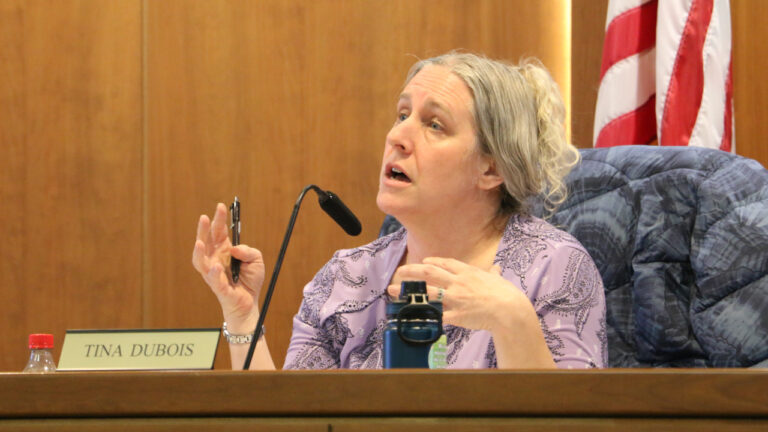

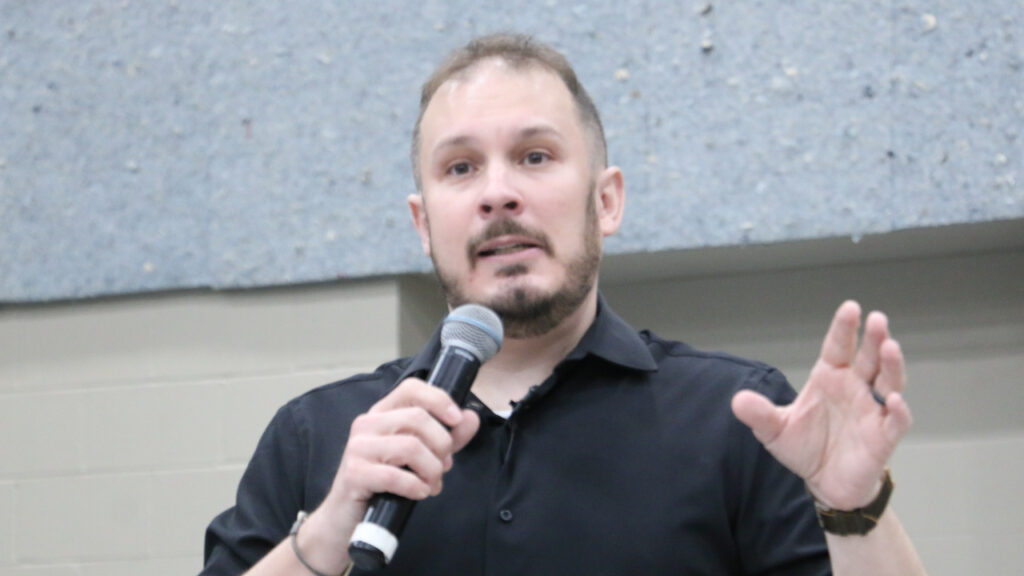
A town hall-style meeting in Palo Tuesday night, March 24, intended as an open discussion of a proposal to annex land into the city limits for a proposed Google data center, turned into an animated dialogue with several Palo residents concerned that more details about the project weren’t yet available.
And among the major questions raised at the meeting, attended by dozens of Palo residents at the Palo Community Center: Why Google decided to bring the proposal to Palo after previously negotiating with Linn County leaders to potentially build the site in an unincorporated area of the county.
Newly-elected Palo mayor Bryan Busch said the meeting was called as a preliminary step in community discussion of the Google proposal, which is in its preliminary stages with no firm plans yet in place.
In acknowledging the meeting’s unusual timing, Mr. Busch said Palo leaders chose to convene before having specific technical information about the Google proposal, rather than wait until decisions were further along. No formal annexation application has been filed for the project, and no development agreement has been reached with Google.
“We’re going to be really transparent and really open and honest from the very beginning, as early as possible,” Mr. Busch said.
Mayor says Palo wants to have control, potential benefits
Mr. Busch repeatedly stressed the jurisdictional issues driving the city’s interest.
The proposed data center site currently sits in unincorporated Linn County, outside Palo’s city limits. As a result, Palo currently has no regulatory authority over the project and would see no direct financial benefit – a situation Mr. Busch compared to the Duane Arnold Solar project that was built north of Palo in recent years, despite local opposition.
“We have this opportunity to engage and to have conversations and to see what that could look like, and that makes a lot of sense to at least explore,” Mr. Busch said. “I think shutting that down and saying no would be, frankly, just a disservice to the community.”
Mr. Busch stressed that the site of the proposed data center – generally described as east of Palo Marsh Road and south of the Duane Arnold Energy Center – hasn’t changed, but he said Google approached Palo directly about the possibility of the city annexing the land, which would give Palo both regulatory control and financial upside, through property taxes and potential economic development agreements.
Questions aired on how, why Google approached Palo
Several residents questioned why the meeting was being held when specifics of the proposal weren’t yet available.
Several also wondered aloud why Google decided to move their negotiations to Palo after earlier negotiating with Linn County for the site, noting the decision came after Linn County enacted a new set of zoning regulations governing the development of large-scale data centers in unincorporated portions of the county.
“There is absolutely no way that this big, successful company did that unless they thought, or knew, they would get a better deal with Palo than they did with Linn County,” Palo resident Ann Brown said. “What is the benefit to Google that they have identified with going with Palo? Because it has to be something.”
In response, Mr. Busch said Palo would be developing its own set of oversight ordinances governing the data center project, and noted that Linn County’s ordinance was in development for several months before it was approved.
He declined to characterize what had transpired between Google and Linn County, saying it was not Palo’s place to involve itself in another jurisdiction’s processes.
“Any suggestion or insinuation that any company would come to Palo to skirt regulation, or to just kind of bulldoze Palo – I’m just going to be very, very frank – I find it insulting and offensive to me personally,” he said. “We live in the same neighborhoods, so no member of the city council or the city staff of Palo, I think, has any interest in not protecting our community or our residents, because that’s what we are. We’re also residents.”
Concerns raised about water consumption, energy usage
The roughly 2.5 hour open forum drew pointed questions from residents on four other main topics the mayor identified as the community’s primary concerns: water consumption, energy usage, ancillary impacts such as traffic and noise, and economic benefits for the city of Palo.
Water drew the most sustained attention. Multiple residents cited figures of hundreds of thousands to millions of gallons per day in potential water usage and questioned the impact on the Cedar River and regional aquifers.
Mr. Busch distinguished between domestic water — which the city can supply — and cooling water, which would likely be drawn from and returned to the Cedar River, subject to Iowa DNR regulation. He acknowledged specific details on the cooling system Google would employ have not yet been determined.
Wally Taylor, legal chair of the Iowa chapter of the Sierra Club, said he was skeptical that the DNR would provide adequate regulation or oversight of water consumption for the project.
“The DNR does not regulate the water growth at all,” he said. “They grant permits like candy, and they don’t do any investigation as to what the impact on the aquifer is going to be when they grant a permit.”
On energy, Mr. Busch noted the project’s proximity to the Duane Arnold nuclear facility — whose restart is being made possible in part by data center projects in Cedar Rapids, as well as the proposed Palo project — as a distinguishing feature. He said the data center would draw from a dedicated energy source, rather than competing for power with existing residential and commercial users.
Residents also raised questions about long-term economic benefits, citing skepticism born from the Duane Arnold Energy Center’s construction decades ago. One resident said promised reductions in property taxes and utility bills for Palo residents never materialized.
Several others questioned whether the number of permanent jobs created would be significant, or whether workers would even live in Palo.
Ron Corbett, vice president of economic development for the Cedar Rapids Metro Economic Alliance, spoke at the meeting and offered regional context, noting Google has operated data centers in Council Bluffs for nearly 20 years and has been a development partner in Cedar Rapids for roughly a decade.
He also noted that Palo isn’t obligated to move forward on any project with Google if it isn’t in the city’s best interest.
“This deal isn’t to the finish line,” he said. “We’re not here to advocate whether it’s in Palo or outside of Palo. We would just like to see the deal come to the finish line. If you’re the organization that gets it to the finish line, or the county’s the organization that gets it to the finish line, we just want to see it there.”
City plans to develop comprehensive ordinance
Mr. Busch said the city will develop a comprehensive data center ordinance requiring three public hearings before adoption. He said a voluntary annexation application — meaning it would be filed by Google or the property owner, rather than initiated by the city — has not yet been submitted, and no firm timeline exists. Final decisions would rest with the five-member city council after public input, not a resident referendum, he said, noting that he wanted “communication early and often” on the project.
“Part of the reason we’re doing this is because the alternative would be, let’s wait down the road until we get all of that technical information and have all those answers, and then circle back and say, now we’re going to invite the public to have a meeting,” he said.
He again stressed that no decisions have yet been made, as the project is in its preliminary stages, and that he felt confident further negotiations with Palo would be mutually respectful.
“We’ll continue to act in good faith,” he said. “I think they are too. And this is coming from somebody that’s probably more naturally skeptical when I enter into any kind of negotiation. It’s absolutely (been) in good faith, and we’ll continue down that path.”
Mr. Busch invited residents to monitor the city website and Facebook page for meeting announcements, and to reach out directly with questions or concerns.