
The Linn County Planning and Zoning Commission began soliciting public input Monday, July 20, on whether data centers that support the restart or expansion of a nuclear power plant should be allowed in the county’s EU-2 zoning district, even as an 18-month moratorium on new data center rezoning applications remains in effect for the rest of unincorporated Linn County.
Charlie Nichols, Linn County’s planning and development director, told the commission the discussion stems from the moratorium resolution the Board of Supervisors adopted July 1, which barred new applications to the county’s EU-3 large-scale data center district for 18 months, but also directed staff to study whether data centers tied to nuclear power deserve separate consideration.
Under the county’s current code, data centers are permitted only in the EU-3 district. The county’s EU-2 district allows nuclear power generation facilities, associated nuclear waste storage, and natural gas-fired electric generating facilities, but not data centers. Mr. Nichols said he was not presenting draft ordinance language Monday, and emphasized the board has made no decision on the matter.
“So we’re not just sidestepping the supervisors here. This is just exploratory,” Mr. Nichols said, adding that the goal of Monday’s meeting was to begin taking public comment, rather than debate specific amendment language. He said he plans to bring proposed amendment language to the commission’s Aug. 17 meeting, though that timeline could vary depending on the volume of public comment received.
Mr. Nichols said the pairing of data centers and nuclear power reflects the high “capacity factor” of nuclear generation. He said nuclear plants operate at roughly 92% capacity on average, compared with lower rates for solar and wind – combined with the long-term power purchase contracts data center operators are offering nuclear plant owners, which he said are financing plant restarts and new construction nationally. He cited Google’s power purchase agreement (PPA) with NextEra Energy to help fund the proposed restart of the Duane Arnold Energy Center in Linn County as one example.
A proposed starting point, Mr. Nichols said, would keep the same requirements currently imposed on EU-3 data centers – including a major site plan, a water study and water use agreement, noise standards, road use agreements, emergency response plans, and economic development or community benefit agreements – while allowing the EU-2 district to determine where accessory data centers could be sited, given that the county currently has only one nuclear power plant.
Mr. Nichols said staff need public input on several unresolved questions, including how to legally define an “accessory” relationship between a data center and a nuclear facility, whether additional standards beyond those in the EU-3 ordinance are needed, and how the county would verify over time – including after a long-term power purchase agreement expires – that a data center remains tied to the nuclear facility.
Commission questions and comments
Several commission members pressed Mr. Nichols on how the EU-2 proposal squares with the county’s 18-month moratorium on new data centers.
“Doesn’t that just go around everything that the board of supervisors just said we want a moratorium on?” one commission member asked.
Mr. Nichols responded that the board’s resolution specifically directed staff to explore the nuclear question, and that the answer to whether an EU-2 data center pathway should be created “is not a definite yes.”
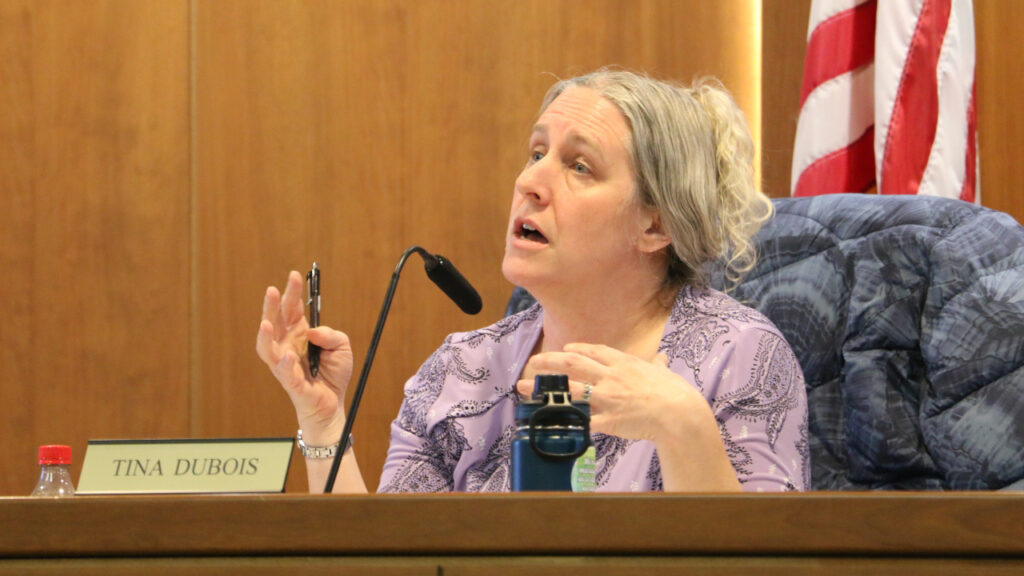
Commission chair Tina DuBois said she remained concerned about enforcement and water use, saying her “goodwill is not where it was” after Google’s shift from an unincorporated Linn County site to a Palo annexation strategy.
“If they don’t do what they’re supposed to be doing, does the county have the capacity to deal with the legal piece of enforcement” against a large company, she asked.
She also said she would like to see the county’s EU-2 standard require a closed-loop water system for any data center.
Another commission member asked whether the restart of Duane Arnold is effectively contingent on a data center project moving forward.
“Unless Google builds a data center … if the board of supervisors puts a very long moratorium on data centers, the nuclear plant isn’t going to restart,” he said.
Mr. Nichols responded that NextEra has not stated the restart depends on the Google project specifically, but “it is clear that the power purchase (agreement) with Google is what’s made the restart cost of capital” feasible.
Another commission member asked about small modular reactors. Mr. Nichols confirmed that most new nuclear construction now underway nationally involves smaller, 50-to-200-megawatt reactors built in multiples, rather than single larger units.
Another commission member asked whether nuclear power aligns with the county’s comprehensive plan goal of 100% renewable energy by 2050. Mr. Nichols said the county considers nuclear “renewable” in the sense that it is zero-carbon, though it produces waste that still lacks a federal long-term storage solution.
The commission member also asked why the county wasn’t directing large power users toward existing renewable energy purchase programs, such as one offered by Alliant Energy, rather than nuclear. Mr. Nichols said the county has not taken a position steering utilities toward specific generation types.
One commission member asked whether the county’s zoning authority would even apply if a municipality such as Cedar Rapids or Palo hosted a data center drawing nuclear power. Mr. Nichols confirmed city zoning codes would govern in that case, and noted Palo is expected to pursue annexation of property near the Duane Arnold plant, which could ultimately place that project outside county jurisdiction regardless of any EU-2 amendment.
Public comment
Mr. Nichols said public comments would help shape any draft ordinance language and could also be submitted by email to the county’s planning and development department.
Andy Krug of Cedar Rapids said transparency should be paramount in the process.
“We need to make sure that everything that you do and the public is engaged in is clearly defined and also understood,” he said, adding that he wants the county, not outside parties, making the ultimate decision on data center development.
John Zakrasik of Cedar Rapids questioned how quickly small modular reactors could be built and cautioned that Duane Arnold – and any new nuclear generation – would still need backup power during maintenance outages. He also raised the possibility of a future single application combining both a data center and a co-located nuclear plant, and urged the county to build exit-strategy protections into any power purchase agreement requirements so that ratepayers aren’t left responsible for stranded infrastructure if a data center operator later scales back. He noted ratepayers previously paid $170 million to buy out the power purchase agreement that led to Duane Arnold’s earlier shutdown.
Wally Taylor of Marion argued a data center is a customer of a nuclear plant, not an accessory use, and said the county should not tie data center siting to any single energy source. He also said a NextEra witness at a recent related Iowa Utilities Commission hearing testified the company would not be pursuing the Duane Arnold restart without its power purchase agreement with Google Energy, and that Google Energy — not Google’s data center division — controls where that power is ultimately sold.
Abe Kellison of Fairfax said allowing an EU-2 pathway while the EU-3 moratorium is still being studied “does kind of feel like a loophole,” since a data center tied to nuclear power would still require land, water, roads and transmission infrastructure.
“Let’s call this what it is. This isn’t energy for us. This is energy for data centers,” he said. “The county should finish the study it just committed to, listen to the residents, review the comprehensive plan, understand the regional impacts, and then decide whether the current ordinance is strong enough. Please don’t create a shortcut before that work is done. Once this door is opened, it can’t be closed.”
Cindy Anderson of Fairfax asked a series of questions about the Google-NextEra arrangement, including how binding the agreement is, what happens if Google ends its involvement, and what water and wastewater protections would apply if data centers draw water from the Cedar River.
Jay Hopkins, a Linn County property owner, said he did not believe NextEra’s investment in Duane Arnold would be abandoned even without an EU-2 data center carve-out, since Google Energy operates broadly in the energy business.
Dan Wozniak of Fairfax argued nuclear power is not renewable given finite uranium supplies, and warned against creating exceptions to existing county zoning ordinances.
“The more exceptions that we have, you really don’t have ordinances anymore,” he said. “You have thoughts, or direction, or guidelines. And we’re dealing with trillion-dollar companies that love the fact that there are exceptions and loopholes and gaps. So I would recommend that if you have a moratorium that says we’re not going to allow data centers, you stick to it.”
Cindy Boland of Fairfax said the county’s current 18-month data center moratorium is too short a period to fully study the issue, and that she opposes any nuclear-related allowance during the moratorium.
And Martha Scheer of Fairfax said a data center moratorium “should be a moratorium for all data centers” regardless of power source, questioning whether companies involved have shown themselves trustworthy stewards of the land.
Next steps
No commission vote was taken Monday night.
Mr. Nichols said staff will continue collecting public comment through the Aug. 17 Planning and Zoning Commission meeting, where draft EU-2 amendment language could be presented, though Mr. Nichols again stressed that timeline may be pushed back depending on the volume and nature of public input.