
Any company looking to build a large-scale data center in unincorporated areas of Linn County will now need to comply with the county’s new zoning ordinance amendment for such developments.
The Linn County Board of Supervisors voted unanimously Wednesday, Feb. 18 to approve the new ordinance, which creates new exclusive-use zoning rules for both small and large data centers in the county’s unincorporated areas.
There are currently no data centers in unincorporated Linn County, and no formal application has been submitted to build a data center, but county officials say they’ve received several inquiries from potential data center developers in recent months, and Google is considering a data center site near the Duane Arnold Energy Center near Palo.
As a result, Planning and Development director Charlie Nichols said it’s important for Linn County to proactively develop a data center zoning ordinance, so county officials can have a framework of criteria to evaluate any data center proposals that are submitted.
The new ordinance doesn’t affect two data center developments being built in southwest Cedar Rapids by Google and QTS, but supervisor Kirsten Running-Marquardt said she felt the county has “learned from the mistakes of others” in crafting its data center zoning rules.
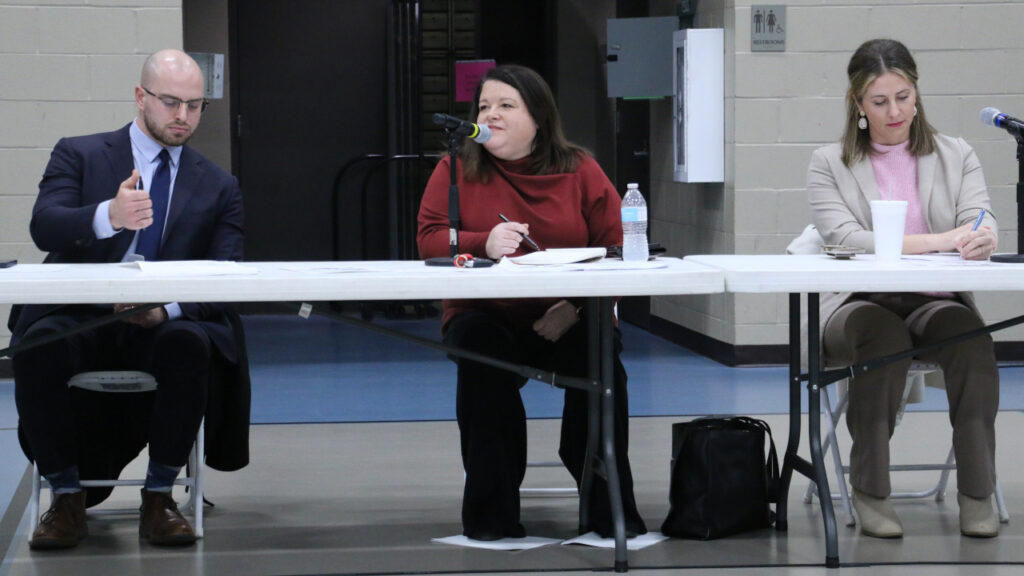
She also thanked county residents for their comments and input, noting that “many good points” were raised during public meetings, including in a public hearing at the Palo Community Center, and that the ordinance was modified as a result of that input.
“Other places consider this under regular business development,” Ms. Running-Marquardt said. “We chose to go the route that it is not regular business development, and we put a very aggressive ordinance in place … within our jurisdiction of unincorporated areas, we chose to have a data center ordinance that is probably one of the most comprehensive, not only in the state, (but) maybe in the Midwest.”
Supervisor Sami Scheetz agreed.
“I think this does an excellent job of balancing protections for residents when it comes to water, noise setbacks, light pollution and solid waste concerns, but also recognizing that we are a growing county, and growth is good for our residents,” Mr. Scheetz said. “It’s good for not only the union construction workers that are going to have life-changing work through these projects that could generate generational wealth. But this kind of growth, if it’s done responsibly, is just good for the county overall. And I think this sets a really good framework for any company that wants to come and develop a data center that says, if you want to do business in Linn County, here’s the rules that we’re establishing.”
Supervisor Brandy Z. Meisheid sought to clarify her concerns about potential decommissioning, raised during the ordinance’s second reading, including QTS’ assertion that their data center buildings may have a 20-year feasible lifespan.
“Maybe decommissioning wasn’t quite the right language,” she said. “I think that’s an important word, but one thing I’m really passionate about in addition to that is property maintenance, and I look forward to working with my colleagues in placing that in some different language within the county, in a broader sense. I think there’s a combination of what decommissioning and property maintenance looks like with 20-year platforms and 20-year buildings.”
Ms. Meisheid also addressed the concern raised by some county residents that the new ordinance was being “rushed” to approval.
“Our staff and our team have been working on this for what feels like an eternity,” she said. “There’s a lot of pieces that are in our ordinance … that really prolong where the finish line is at. To me, this ordinance is essentially the guardrails (for) what it would take for a data center to consider applying here, but it’s not the end-all – you meet this set of requirements and you can build. This is the minimum it takes to be here. It’s establishing a framework. There’s all these additional agreements that we have in place that require them to collaborate with Linn County, and at any point in time, if we can’t come to an agreement on those, we do not have to approve an application.”
Linn County Planning and Development director Charlie Nichols reviewed the changes to the ordinance from its original iteration – including requirements for a waste management plan, a lighting plan, coordination with the Iowa Department of Natural Resources on water use agreements to address well interference concerns from area residents, and a requirement for an applicant-led public meeting to occur before the first Planning and Zoning Commission meeting on any rezoning requests.
He also said he felt that the ordinance, while imposing significant requirements for potential data center developers, is “buildable.”
“Our staff has done a lot of research on existing data center ordinances in Iowa, in the Midwest, in the country, and I am very confident that no ordinance for data centers in Iowa is asking for more information or asking for more requirements to be met than our ordinance,” Mr. Nichols said. “We know that data center developers seek to keep their costs low, as evidenced by the proliferation of tax benefits for data center projects all throughout Iowa. We have had interest in data center developments in rural Linn county. It is entirely possible that a data center developer will choose to locate within jurisdictions that ask for less than our ordinance. We know that although this ordinance is buildable, it asks for more than other people are asking for in Iowa right now. I think the requirements our ordinance puts forward are fair and workable, and all Iowa residents would be better off if these basic requirements were adopted by more jurisdictions.”
The ordinance creates a new exclusive-use zoning district (EU-3) for data centers, similar to the county’s new zoning ordinance for nuclear energy generating facilities, approved by the county in September.
It specifies rules for considering data center zoning applications, covering a variety of zoning considerations, including building setbacks, noise limits, traffic and road impacts, emergency planning, and site plan review.
The ordinance would also incorporate other data center-related site developments, including battery energy storage systems, on-site solar arrays, standby or backup power generation facilities, substations, micro grids, water treatment and maintenance or support facilities.
According to the ordinance, a zoning application for a large-scale data center will be required to include a legal description of the site, a major site plan and a general description of the project, including a proposed construction timeline.
Additional information will then be required before a building permit is issued, including the planned location of underground and overhead electric lines, interconnection points, project entrances, written verification of capacity from the project’s proposed power provider, structural requirements, stormwater management plans, water pollution prevention plans, and erosion and sediment control.
The ordinance also requires development setbacks of 200 feet from neighboring property lines and 1,000 feet from public places of assembly or residentially-zoned property.