
Google has abandoned its plans to construct a data center in unincorporated Linn County, and will instead pursue the project on land to be annexed into the city of Palo, Linn County Planning and Development director Charlie Nichols told the Board of Supervisors Wednesday morning.
As a result of that decision, Mr. Nichols said a planned regional water balance study – which Google had agreed to fund with a $500,000 contribution as part of their data center plans – is being put “on pause,” because Google no longer plans to fund the study.
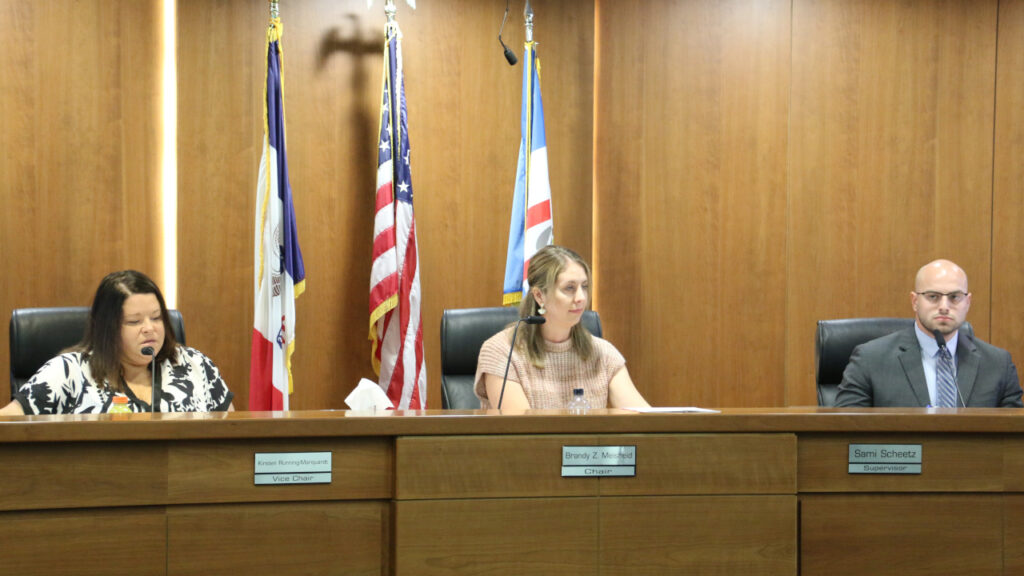
Supervisors said Wednesday that they felt it was clear that Google’s decision to relocate its project was made to bypass the county’s recently-enacted ordinance on development of new data centers in the county’s unincorporated areas – an ordinance which imposes a series of restrictions on developers.
All three supervisors reacted strongly to Google’s decision and to the water study being shelved.
“We took this process seriously from day one,” board chair Kirsten Running-Marquardt said. “We invested significant time and resources to create an ordinance with strong protections for our residents and our water resources, all while having Google, a trillion dollar company, pay their fair share, We gave Google a clear, workable path forward. We were not trying to block this project, but we believed in working together in a transparent process for both regional benefits and protections.”
Ms. Running-Marquardt also said she hoped the water protection study could be pursued with other funding sources, stressing its importance for county residents.
“We asked for a water plan that included … their curtailment plans for when (the Cedar River) is significantly low, and we do go through drought phases, because we care about where our water comes from, and then where it goes downstream, and the people, businesses and communities that are downstream from us,” she said. “On top of this, we also pushed Google to pay their fair share. This was too much for Google to work with us.”
Ms. Running-Marquardt also indicated that despite Google shifting its plans away from a rural Linn County site, she didn’t regret the county’s decision to develop and approve the data center ordinance — an ordinance that was developed in consultation with Google.
“I believe that people will understand at the end of the day what happened here, and that we did stand up for our people,” she said. “We put them first. We made them our priority and our resources, and I’m proud of the work that we did.”
Supervisor Sami Scheetz confirmed that no part of the county’s data center ordinance specifically precluded Google from submitting an application to build in rural Linn County.
“I am disappointed,” he said, noting that county leaders spent seven months developing an ordinance he termed “probably the most comprehensive in the state, and one of the most comprehensive data center ordinances in the country.”
“I can’t speak to their state of mind or their thoughts,” he said of Google, “but if I had to take a guess, I assume, as they’ve done across the country, they’re looking for less regulation when it comes to water specifically, to pay less money and to provide a larger return to their shareholders.”
He also noted that developments like a large-scale data center affect the entire surrounding area, including impacting the county’s water supply with a project that Google leaders have said could require several million gallons of water per day for cooling.
“This is going to have regional impacts, regardless of which jurisdiction is going to decide the fate of the project,” he said. “I just want the public to remember that this board of supervisors worked diligently to ensure that there are water protections for residents, as much as we could given state code in terms of reporting requirements. And it’s just unfortunate that a huge company like Google is trying to pit jurisdictions against each other for their own favor …my encouragement to Palo city officials is to hopefully stand strong and follow the path that we’ve laid out. Frankly, our ordinance was pro-growth and pro-community, and I hope that Palo takes that path going forward as well.”
Supervisor Brandy Z. Meisheid also said she felt the county’s data center ordinance protects the county “as much as we can, within our jurisdiction, and then, you know, (when) it walks away at the end is always disappointing.”
Ms. Meisheid also noted that as her district represents a large part of the county’s rural areas, she feels “a little more sentimental towards small towns trying to survive.”
“I understand that Palo has seen an opportunity, and I don’t necessarily want to fault them for doing that,” she said.
She said she hoped that the county and its communities could move forward with a more regional vision for large-scale economic developments such as data centers.
“I hope between Palo and the county and Cedar Rapids and any other community that might consider a data center in the future, that we start looking at what a regional approach looks like,” she said. “This isn’t going to impact one town. It’s going to impact all of us.”
She encouraged Palo city officials to consider “a similar approach” as Linn County regarding the regulation of data center developments, “so not only Palo residents, but that the broader Linn County community, can feel confident that our interests are being protected. I encourage Palo to do that, and I thank everybody for the work they put in to get us here and hope to see a regional approach in the future.”