
After nearly three hours of public comment and pointed debate among board members, the Linn County Board of Supervisors voted 2-1 Wednesday, July 1, to approve an 18-month moratorium on new applications to rezone unincorporated county property to the county’s new EU-3 large-scale data center zoning district.
The vote on the resolution, proposed by supervisor Brandy Z. Meisheid as a “pause,” came just months after the board unanimously adopted what several speakers Wednesday called one of the most comprehensive – and restrictive – data center ordinances in the state.
Ms. Meisheid and supervisor Kirsten Running-Marquardt voted for the moratorium, while supervisor Sami Scheetz voted against it.
As approved, the moratorium is set to run through Jan. 1, 2028, though it could be shortened or lengthened by a vote of the board.
The backdrop
Linn County is already home to a rapidly growing data center footprint.
Ms. Meisheid told the board the county has roughly 3,500 acres tied to data center development within its borders, including in incorporated cities, and cited proposals or projects including up to 12 data center buildings in Cedar Rapids tied to QTS and Google, six proposed centers near Palo, a proposed site on Highway 30, a proposed site near Walford, and reported interest near Mount Vernon that she said she could not yet confirm.
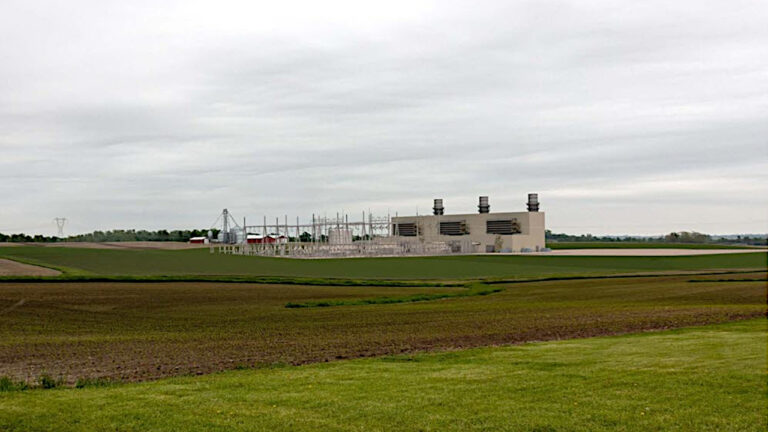
Wednesday’s spirited discussion took place against the backdrop of Alliant Energy’s proposed Morgan Valley Energy Center natural gas plant, which multiple speakers linked directly to data center power demand, and the pending restart of the Duane Arnold nuclear plant, which Ms. Meisheid said depends on funds from data center developers to move forward.
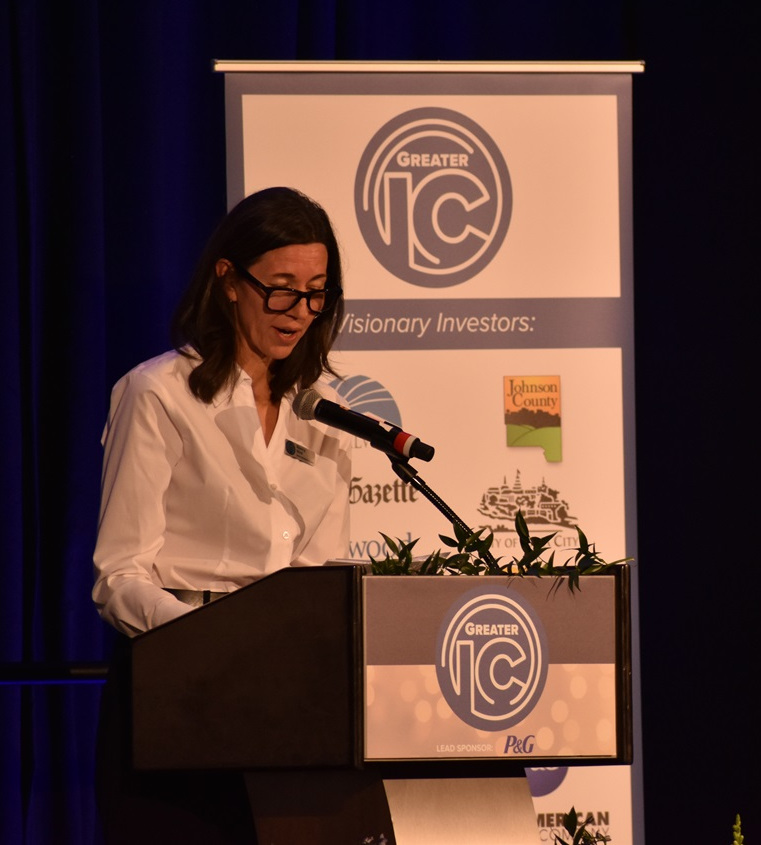
Meisheid: ‘Information has changed’

Ms. Meisheid stressed repeatedly that the moratorium is “not a direct statement for or against data centers” and said Linn County remains “open for business, but we are not open for business at any cost.”
She said her position shifted after the county’s ordinance was adopted in February.
“In the beginning, when Google had approached Linn County and proposed their site near Palo, I was supportive, and we did write a wonderful ordinance that I believe is really strong,” she said. “However, since then, we know that there are multiple locations in Cedar Rapids with … up to 12 data centers … six proposed data centers in Palo … a proposed site on Highway 30 … a proposed site near Walford.
“It is my opinion that we cannot move forward without knowing what our community can sustain,” she said.
Ms. Meisheid also defended an amendment, later stripped from the resolution, that would have exempted nuclear-linked data centers from the moratorium, saying restarting the Duane Arnold Energy Center near Palo “does not happen without data center support” because it is “so expensive to restart that the only people that are open to financing it are the data centers.”
She said Google is covering costs associated with the proposed Duane Arnold restart.
Ms. Meisheid also produced a binder full of news stories on recent research – including reports from the National Bureau of Economic Research and studies on data centers’ effects on air quality, health, wildlife and rising costs – as the “new information” justifying the pause.
Asked by Mr. Scheetz how Ms. Meisheid settled on an 18-month moratorium, Ms. Meisheid said an engineering firm, Stantec, estimated it would take roughly 17 months to gather adequate data for a thorough regional water report.
“The bottom line is that as local governments, we are forced with making decisions whose impacts will last for generations,” she added, “and it’s my opinion that I can no longer look my constituents in the eye and tell them in good faith that we have accurate data to make these informed decisions, because I truly believe we do not.”
Scheetz: ‘We’d be the only county… to suspend a data center ordinance we already built’
Mr. Scheetz, while calling residents’ concerns “completely legitimate,” said he could not support the moratorium as written.
He noted the board spent roughly eight months and worked with three outside consultants developing the county’s EU-3 ordinance governing large-scale data centers – just approved by the board in February. That ordinance already requires data center developers to complete an independent water balance study, a binding water-use agreement with the county, an economic development agreement. He also said it preserves the board’s authority to reject any rezoning application outright.
He noted that several counties in Iowa have approved or discussed data center moratoriums, but unlike Linn County, none had an ordinance in place governing data center proposals.
He argued the moratorium would have limited practical effect because the board’s zoning authority extends only to unincorporated areas.
“This moratorium will not stop data centers in Linn County,” he said. “It does not limit what any city in Linn County can approve.”
Instead, he said, it could “send development projects towards jurisdictions with fewer protections” – a scenario that has already unfolded in Linn County, where Google originally proposed a data center near Palo before shifting its focus to Palo itself, asking that their proposed rural site be annexed into the Palo city limits.
“We have never once had the chance to apply our ordinance, because no application has come before us,” Mr. Scheetz said. “So my central concern with this resolution is simple: We would be suspending an ordinance before we have ever tested it, declaring it insufficient before we have let it work a single time … The local government in Iowa with the strongest protections for residents on data centers, will be closed for business, which will push projects towards the places with the weakest regulations, which is the opposite of protecting our region and our people.”
Mr. Scheetz moved to postpone the vote and refer the matter to the Planning and Zoning Commission for a formal public hearing, arguing the moratorium resolution had been added to the board’s agenda with only 24 hours’ notice for what he called a consequential decision. That motion was seconded but did not pass.
He later moved to amend the moratorium’s length to nine months instead of 18. That motion failed for lack of a second.
Running-Marquardt: ‘It is not fair’
Ms. Running-Marquardt, the current board chair, delivered an extended, emotional case for the moratorium centered on her dealings with Alliant Energy, ITC Midwest and data center developers.
She said Alliant told her directly it plans to power the Cedar Rapids QTS and Google data centers with “a proposed 720 megawatt fossil fuel burning natural gas plant” in the Morgan Valley area of rural Linn County –a plant that, if approved, “will put over 100 tons of pollution into the air,” with infrastructure costs shared by individual ratepayers.
She also described repeated, unsuccessful requests to reroute ITC transmission lines away from ballfields and school property in the College Community School District, and said a Google-linked project could draw “10 to 12 million gallons of water a day” from the Cedar River, as opposed to data center designs that use closed-loop cooling systems.
Ms. Running-Marquardt recounted a hallway conversation with an unnamed investment partner of developer Jim Condon, who is developing one of the Cedar Rapids data center projects, after a public hearing on gas-plant setbacks.
“He told me he was with a group that wanted to put data centers in, and they were going to need massive amounts of power from gas plants,” Ms. Running-Marquardt said. “I asked him, what about the pollution from the gas plants and the impact to the neighborhoods nearby? He told me two things. One, the investors he is working with had so much money they could buy out entire neighborhoods, and two … it would be a shared sacrifice for everyone, like our servicemen, who had recently lost their lives in Iran.”
She called the remark “disgusting” and said it illustrated “how much they care about the people of Linn County and our quality of life.”
“I am supporting this 18-month moratorium,” she added, “because I’m putting the quality of life of the people of Linn County ahead of greed and profits for billion-dollar companies … Good public servants know when it’s time to take a break, evolve, and put in better policy. We can do that here and still be leaders in job growth and economic development.”
What residents and stakeholders said
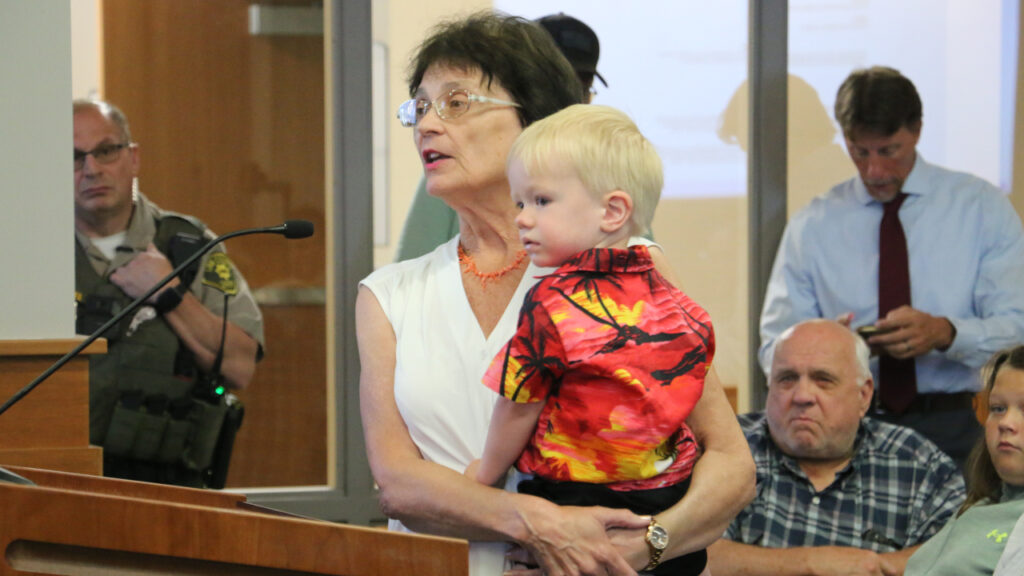
Dozens of supporters of the proposed moratorium –and a few opponents – filled the county’s formal board room and two overflow rooms. Several wore shirts for Save Morgan Valley, a group opposing an Alliant Energy proposal for a 720-megawatt gas-fired power plant in western Linn County.
“Choose the people of Linn County, choose transparency, choose responsible planning, choose to protect our communities before corporate interests dictate our future,” said Jenny Kellison of Fairfax.
“This is not a ban, it’s a pause, so we get answers before the next [proposal] lands,” said Jon Lee, who lives near the proposed Morgan Valley power plant site.
He also cautioned that not approving a moratorium could pave the way for more data center projects.
“What if it’s not one data center?” he asked. “What if it’s 10 or 20 or 50, all pulling from the same wells, the same rivers, and the same grid? No water study answers that. Rules say how to build one. Only a pause tells us how many we can survive before we’re stuck with the answer.”
Cindy Boland, who described herself as a longtime labor organizer, pointed to a funding gap between developers and regulators.
While data center developers “have probably spent close to $100 million above market value for the farmland to build the data centers,” she said, the county’s health department “doesn’t have the budget to pay $28,000 to monitor the air.”
Opponents of the moratorium, including union representatives and developers, warned of economic costs that could come with pausing new data center development.
Jim Condon, who said he is “one of the data center developers” in Linn County, defended closed-loop cooling technology, saying “the water thing is just a falsehood, at least in context of closed loop data centers,” and argued the county’s existing ordinance already requires data center rezoning applicants to answer questions about water and power.

Felicia Hilton, political director for the North Central States Regional Council of Carpenters, said building trades workers “are not just swinging a hammer” and urged supervisors not to “kill jobs” that come with data center construction.
Cheri Monahan, director of customer and business Solutions for ITC Midwest, said the county’s existing data center ordinance already “provides a thoughtful framework for growth” and warned “a moratorium risks putting opportunities on hold or losing them entirely.” And Mike Sadler, business manager for UA Local 125, questioned the timing of the moratorium, asking supervisors whether “you were serious when you passed the ordinance” in February.
Several other speakers, including Fairfax Mayor Jo Ann Beer and Benton County Supervisor Bruce Volz, asked Linn County to coordinate more closely with neighboring jurisdictions going forward – a request Ms. Meisheid said she intends to act on through what she described as a planned regional effort involving other counties, cities, the Iowa Department of Natural Resources and state legislators.
How the resolution was amended
Before the final vote, the board approved an amendment – recommended by Planning and Development Director Charlie Nichols – striking a clause that would have let data centers co-located with nuclear or utility-scale solar facilities continue applying to rezone during the moratorium.
Mr. Nichols told the board that carve-out would have undermined the resolution’s legal standing as a moratorium, since a true moratorium must apply uniformly to the entire EU-3 zoning district. The amended resolution instead directs the board to consider a separate ordinance amendment process if it wants to create a specific pathway for nuclear- or solar-linked data centers in the future.
The amendment passed unanimously before the board took up the moratorium itself.
What happens next
The moratorium immediately halts new EU-3 rezoning applications in unincorporated Linn County for up to 18 months, though it includes provisions to end early if the board determines sufficient data has been gathered, or to be extended if more time is needed.
Ms. Meisheid outlined four goals for the moratorium period: Gathering regional water data, updating the county’s comprehensive plan (which was last revised in 2013), pursuing state legislation that would prevent data center power costs from being passed on to ordinary ratepayers, and revising the county’s ordinance based on “lessons learned” — including a possible requirement that all data centers use closed-loop water systems.
No formal committee structure or timeline for that work was adopted Wednesday.
Comprehensive plan input sought
Linn County is currently seeking public input on its Comprehensive Plan update and future land use map with a public survey and comment period open on Linn County’s website through July 17, 2026. County leaders use the comprehensive plan to guide long-term decisions about growth and development in unincorporated areas of Linn County. The decisions affect land use, natural resource protection, renewable energy, hazard planning, and community development.
Linn County last updated its comprehensive plan in 2013.