
Palo city officials have repeatedly stressed that a proposed city ordinance is intended to govern data center development in general, not specifically a proposed Google data center project.
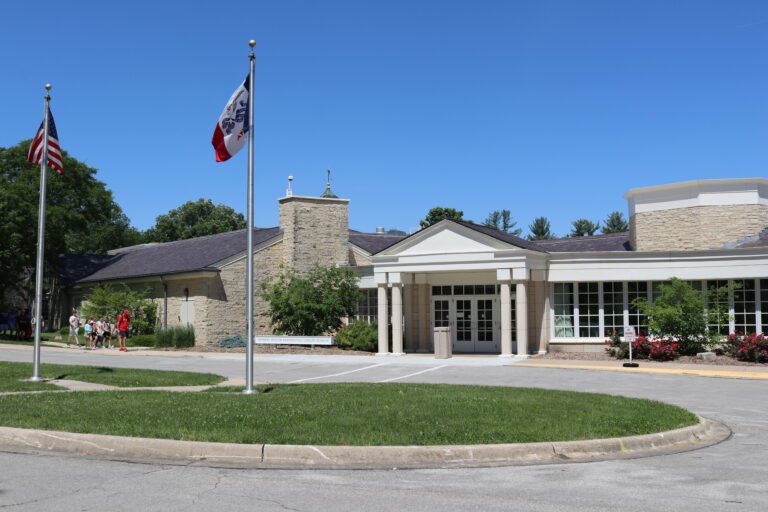
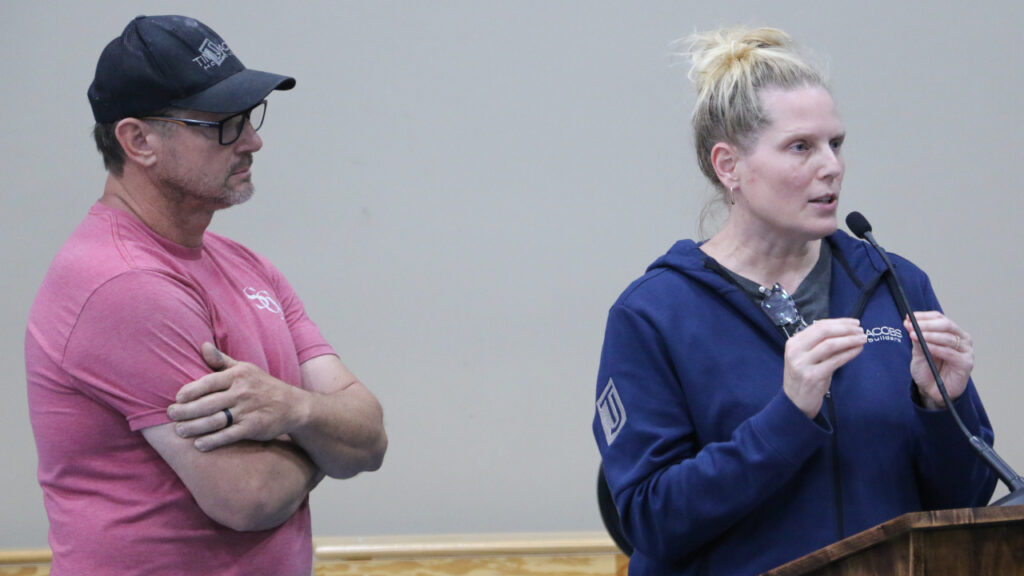
Even so, dozens of speakers overwhelmingly voiced their opposition on several fronts during a public hearing and first consideration of the proposed ordinance Monday night, June 1 at the Palo Community Center.
The meeting, with about 150 people in attendance, ended after nearly three hours with the council voting unanimously to approve the first reading of the ordinance, which would create a new exclusive zoning district for large-scale data center projects within Palo city limits.
More than 40 attendees spoke, nearly all voicing their displeasure with the proposed ordinance – and the potential development of a Google data center near Palo.
Google had been negotiating with Linn County to site a new data center on unincorporated land near the Duane Arnold Energy Center, but after the county’s data center ordinance was approved, the tech company switched gears and began preliminary discussions with Palo officials about annexing the proposed data center site into the city – and under its proposed data center regulations.
Palo officials said Google hasn’t yet submitted a formal data center application to the city, and noted that the ordinance is intended to cover general regulations, while specific restrictions would be addressed during the negotiation of a development agreement.
Water issues, including water supply and potential contamination, were addressed by many speakers during the public hearing, dominating the litany of concerns. Wally Taylor, a Cedar Rapids attorney legal chair of the Sierra Club’s Iowa chapter, said he was disappointed that unlike Linn County’s recently-approved data center ordinance, the Palo proposal would not require data center developers to conduct a water study that would determine how much water the data center would use for cooling, and whether area aquifers can meet that demand without creating water shortages for existing residents.
Palo’s ordinance would defer water quality and usage oversight of a data center to the Iowa Department of Natural Resources, a solution Mr. Taylor termed inadequate based on the DNR’s approval standards for water use permits.
“They (the DNR) make absolutely no effort to determine whether the water withdrawal is appropriate, whether there’s enough water there, how much is going to be used, and what the impact is,” Mr. Taylor said. “They simply go by some arbitrary categories that they have devised, which aren’t in the Iowa Code, they’re not in regulation.”
He said a recently-approved Allamakee County ordinance regulates data centers as a conditional use in industrial areas and requires closed-loop, non-evaporative cooling systems, effectively eliminating water consumption concerns. He suggested Palo consider a similar approach.
“It’s better to do this right than to do it quickly,” he said.
Deb Shields of Covington, a few miles south of Palo, said she shares a neighborhood well with 22 other households, and expressed concerns about dropping Cedar River water levels.
“Linn County, I believe, did their due diligence in setting out certain requirements for the data center, including a water use study, and Google’s bypassing those conditions by working instead with the city of Palo to annex land is a red flag,” she said. “Data centers are currently not legally required by state law in Iowa to formally report or disclose their water or energy consumption … I can’t imagine that there will be sufficient water during periods of drought to supply the data center, and will the data center be required to cease operation during these dry periods, or will it take priority over local residents?”
Jennifer Leaven, who owns land near Palo, said she recently negotiated the DNR’s water use permit process, and described it as “very vague, probably vague on purpose.”
“You need to be more specific with your ordinance,” Ms. Leaven said. “When I filled out my water use permit, I specifically read what happens if my well goes dry, because I want to make sure I dig it deep enough that I have water for many years to come. You have to file all sorts of forms to prove that your neighbor was the reason that your well went dry. So how do we prove that all of this (data center) water usage is the reason our wells go dry if we don’t do any water surveys ahead of time?”
Fairfax mayor Jo Ann Beer and council member Cindy Anderson also expressed frustrations with heavy traffic through their community during the ongoing construction of QTS and Google data centers in southwest Cedar Rapids.
“Why do the billion dollar companies come to small towns? Because we say yes,” Ms. Andersen said. “I’m asking you to say no. I’m asking you to think more … We have got to care for the people that we represent, for the people who live in these communities. Water is not an unlimited resource. Land is not an unlimited resource. And ultimately at the end of the day, people matter.”
Ms. Beer echoed those concerns and said the Cedar Rapids data center construction projects, with “thousands of construction workers” driving through daily, have brought “zero tax benefit” to Fairfax. She warned of similar potential consequences for Palo.
“Your ordinance needs to be very, very strong in the area of traffic (and) road use,” she said. “I don’t think I go a single hour anymore without receiving a resident complaint about traffic. It is a huge, huge deal.”
Several other speakers said they felt the Palo ordinance itself, which addresses issues such as buffering, noise, emergency response and economic development, is still too general in ways that leave important determinations to post-approval negotiation in development agreements, rather than establishing enforceable baseline requirements.
Speakers argued this approach effectively removes meaningful public oversight once the ordinance passes.
A number of speakers also questioned how a data center would benefit Palo, challenging written comments from the mayors of West Des Moines and Altoona, who asserted that data center projects brought several economic benefits to their communities.
“Google has invented so many incredible things,” said Kirsten Jacobs of Cedar Rapids. “If this is something that moves forward, be what the rest of the country reaches for. Don’t be afraid to do that. Do it without our water. Hey, you can come, but you can’t use our water, and these are our light limitations. Don’t be afraid to set your boundaries … find the balance, request the data, and define these boundaries better.”
Another speaker, Doug Seavey of Palo, said he’s developed several data center projects, including the first private data center in Iowa. He offered to serve on a committee that would advise Palo officials on data center issues, but said he’d received no response to his offer. He said his data centers were cooled without water, and asserted that other data centers, including Google’s, shouldn’t require water for cooling.
Two more readings are required for the ordinance to become law. The second reading is set for the council meeting Monday, June 15 at 6:30 p.m. and the third reading will be held during a special council meeting Monday, June 22, also at 6:30 p.m.