
The creation of another exclusive-use zoning district in Linn County – this one covering the possible development of data centers in the county’s unincorporated areas – is on its way to the Linn County Board of Supervisors for consideration.
The county’s Planning and Zoning Commission voted unanimously to recommend approval of an ordinance that would create a text amendment for a new exclusive use zoning district – EU-3 – for large-scale data centers, defined as either having an electrical design capacity of more than 20 megawatts or using more than 50 gallons of water per minute for cooling.
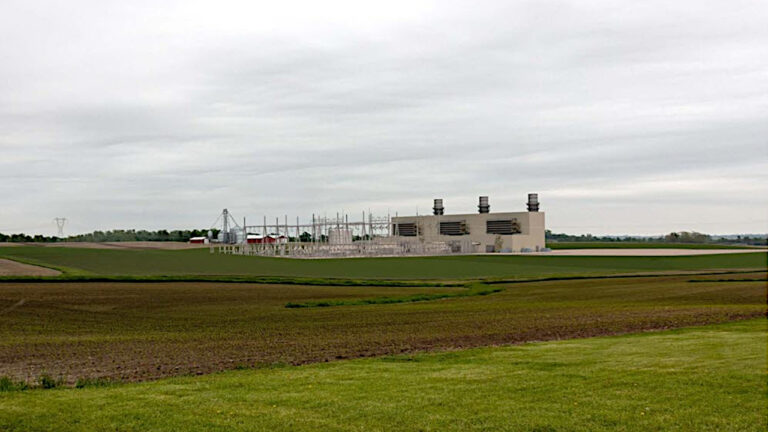
Linn County Planning and Development director Charlie Nichols said the ordinance was developed because of growing interest in data center development throughout Iowa, and specifically in Linn County. Two data centers, owned by Google and QTS, are already under construction in southwest Cedar Rapids, and Google is considering another data center near the Duane Arnold Energy Center near Palo.
“There are other data center developers, though, that have reached out to the county planning and development staff, so the time is right to have some regulations, to have some code on the books that determines where data centers can be built and how they are built,” Mr. Nichols said, noting that since data centers are a “newer use,” they’re not specifically addressed in the county’s current Unified Development Code.
The intent of the ordinance, Mr. Nichols said, “is to establish a clear, comprehensive framework for large-scale data centers.”
“These are generational infrastructure uses,” he noted, “and we want to make sure they are consistent with our comprehensive plan, and they’re located in areas of the county that are appropriate for uses of this scale.”
Similar to the county’s new zoning ordinance for nuclear energy generating facilities, approved by the county in September, the data center ordinance specifies rules for considering data center zoning applications. The rules cover a variety of zoning considerations, including building setbacks, noise limits, traffic and road impacts, emergency planning, and site plan review.
The ordinance is also designed to specifically address infrastructure impacts of data centers, most specifically in terms of water usage – a factor that’s become increasingly important with data center developments nationwide, since water-cooled data centers require large quantities of water to operate.
“Water usage is a big concern nationally for data centers, and is no different here in Iowa,” Mr. Nichols said. “Our ordinance does address water usage, but it’s important to note that the county does not have the final authority over how much water a business can use.”
That authority is reserved for either the Iowa Department of Natural Resources or the municipal water supply, depending on the data center’s water source.
The ordinance would also incorporate other data center-related site developments, including battery energy storage systems, on-site solar arrays on site, standby or backup power generation facilities, substations, micro grids, water treatment and maintenance or support facilities.
According to the proposed ordinance, a zoning application for a large-scale data center will be required to include a legal description of the site, a major site plan and a general description of the project, including a proposed construction timeline.
Additional information will then be required before a building permit is issued, Mr. Nichols said, including the planned location of underground and overhead electric lines, interconnection points, project entrances, written verification of capacity from the project’s proposed power provider, structural requirements, stormwater management plans, water pollution prevention plans, and erosion and sediment control.
The ordinance will also require development setbacks of 200 feet from neighboring property lines and 1,000 feet from public places of assembly or residentially-zoned property.
Mr. Nichols noted that the ordinance also included a section on “confidentiality and open records compliance.”
“This is something that we don’t typically do, but confidentiality and open records has been a sticking point for a lot of communities and data center projects around the country, particularly when it comes to reporting water usage,” he said. “Water usage is considered a trade secret by data center developers. The reasoning there is they feel that competitors can back into the design of how the facilities are laid out based on the amount of water they use. We have different interpretations about that at the staff level, and we will be asking them for water usage data.”
If a developer feels that information should remain confidential, Mr. Nichols said, they will need to explain “why that information qualifies for an exemption for Iowa open records law. So we’re saying up front that if you want certain information to be kept private and not part of the public process, you need to justify that.”
To address water usage concerns, the ordinance will require a pre-rezoning water study, proving that there is sufficient water available for the project and its impact on existing water users. It will also mandate a water use agreement with Linn County before any construction work can begin.
An economic development agreement will also be required, explaining how the developer and county will work together, any possible economic incentives, and how a developer will “give back to the community.” The developer will also be required to create a Community Betterment Fund, similar to those created for the Cedar Rapids data centers, to support public infrastructure, services, environmental protection, workforce developments or other community priorities.
Other sections address noise generation, light emission, impacts on public infrastructure and road use agreements.
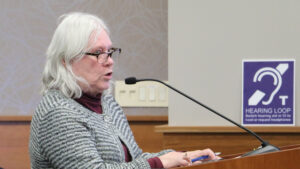
During the public comment period, Pam Mackey Taylor of Marion, director of the Iowa chapter of the Sierra Club, said she felt the ordinance needed further consideration.
“I appreciate the county’s efforts to get a handle on data centers,” she said. “They can have a huge impact on our quality of life in the county. The planning staff spent a significant amount of time creating the ordinance, and the public has had little time to review the ordinance. I would suggest that the ordinance is not ready for prime time. It needs to be sent back for more work and greater review.”
Specifically, she said, “There are very few requirements in addressing real ongoing problems of data centers, including water usage, electricity usage and air pollution from the diesel (backup) generators.”
John Zakrasek of Cedar Rapids, executive director of the Linn Clean Energy District, also expressed concerns about water usage, particularly with the pending restart of the Duane Arnold Energy Center, another large-scale water user, and existing water demands from major industries in the Cedar Rapids area.
“These data centers are going to add to that water consumption,” he said. “If you look at the forecasts for Iowa going forward, you can see temperatures are going to rise. And of course, we’ve been having typically more water in the spring, but then we hit these periods where things just dry out … I can just see there being a point where we hit one of these flash droughts, and now the nuclear plant doesn’t have sufficient water, or it’s overheating the water it’s letting out into the streams, and so it has to shut down. At the same time, the data centers (then) may not have enough water, so they’re going to turn up their compressors and pumps, which is going to require more energy.”
The ordinance now heads to the Linn County Board of Supervisors for three separate readings before becoming official.
The first is slated for Wednesday, Feb. 4 at 6 p.m. at the Palo Community Center. Second and third readings will be at the board’s meetings on Monday, Feb. 9 and Wednesday Feb. 11, both at 10 a.m. at the Jean Oxley Public Service Center.