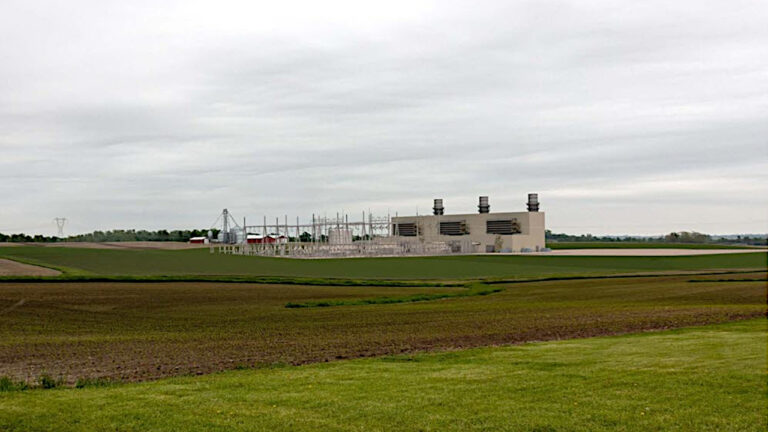

There are no data center projects currently proposed in Johnson County, but county leaders gathered Monday, July 20, seeking to get ahead of the curve cooperatively on key data center issues by forming a countywide “working group.”
The meeting, hosted by the Johnson County Board of Supervisors, was attended by representatives of a number of government agencies, including the Board of Supervisors, North Liberty City Council, Iowa City Community School District, Iowa City Council, Coralville City Council and Tiffin City Council.
It was headlined by Nancy Bird, president and CEO of Greater Iowa City Inc., who proposed a countywide “data center principles work group,” with representatives from agencies across Johnson County.
Ms. Bird said the working group would not create binding regulations, but would focus on guiding principles covering transparency, water and energy stewardship, infrastructure impacts, fiscal considerations, land use compatibility, and regional benefit-sharing of any possible data center developments.
Ms. Bird said that over the past several weeks, members of the business community and the Greater Iowa City executive council “have encouraged us to become involved in community conversations surrounding data centers and related policy considerations.”
“We are not here today advocating for or against any specific data center, project, site, developer, or community outcome,” Ms. Bird said. “Rather, we are here because this issue is increasingly important to our business community, and because decisions made in one jurisdiction can have dilution for the entire county.”
Ms. Bird said that data center development has generated significant discussion around economic development, land use, infrastructure, energy, water resources, fiscal impacts and community character.
“A regional approach is really important,” Ms. Bird said. “This is a complex issue, and a regional approach matters because data centers do not operate within the boundaries of a single jurisdiction. And when it comes to impacts, water systems, electric infrastructure, transportation networks, workforce availability, emergency services, and economic activity are all interconnected across Johnson County. Each goes beyond individual jurisdictional boundaries. Potential benefits may accrue to one jurisdiction, while some impacts or externals be experienced more broadly throughout the region.”
Lack of a coordinated approach in Johnson County, she said, carries significant risks of its own.
“If communities approach this issue independently, there is a risk that cities in the county could find themselves competing against one another or being placed in difficult positions relative to neighboring jurisdictions, and we’re seeing some of that play out in other parts of our region,” Ms. Bird said. “A coordinated framework in Johnson County can help ensure that local decision making remains local while it also works.”
“We also recognize that data center development has generated significant discussion around economic development, land use, infrastructure, energy, water resources, fiscal impacts of community character,” she added. “A regional regional approach is really important. This is a complex issue, and a regional approach matters because data centers do not operate within the boundaries of a single jurisdiction … Potential benefits may accrue to one jurisdiction, while some impacts or externals be experienced more broadly throughout the region. If communities approach this issue independently, there is a risk that cities in the county could find themselves competing against one another or being placed in difficult positions relative to neighboring jurisdictions, and we’re seeing some of that play out in other parts of our region. A coordinated framework in Johnson County can help ensure that local decision making remains local, while it also works on our shared regional interests.”
Ms. Bird offered to serve as a neutral convener or facilitator for the group, and asked each jurisdiction to name a representative to serve on the group. A deadline of Aug. 1 for assembling the group’s members was pushed back, as supervisor board chair Jon Green noted that many smaller agencies only meet monthly and would not meet again before Aug. 1.
The meeting comes amid a rapidly intensifying national debate over data center development. Attendees at the meeting were told that the number of data centers in the United States has jumped from 2,700 in 2022 to nearly 4,200 by 2025. A statewide poll has also indicated that 7 in 10 Iowans oppose data center development.
Johnson County imposed a moratorium on data center applications in November 2025, but that moratorium is set to expire in November. In addition, Johnson County’s Planning and Development is slated to begin development of a countywide data center zoning ordinance July 22.
Concerns about available water resources dominated the discussion at Monday’s meeting. Multiple officials referenced a USGS study of the Silurian Aquifer, showing the aquifer — which underlies Linn, Johnson, Iowa, Muscatine, Washington, and Cedar counties — is a finite, slow-recharging resource that’s already being strained, even before any data center developments.
That topic, along with detailed information on electric capacity and legal authority, were identified as needing subject-matter and legal expertise – including what municipalities can and cannot legally regulate.
Group members also identified the need to identify any potential concerns with conflicts of interest. One city council member said utility partners, like MidAmerican Energy, shouldn’t participate as neutral stakeholders in the group’s discussions, because they stand to profit from data center growth.
Mr. Green said he’d push for a rule that any elected official joining the work group sign an attestation that they are not under a non-disclosure agreement with developers or utilities. He said he’s heard “horror stories” elsewhere of officials secretly signing NDAs before the public learns of a project.
Another attendee said she was concerned about the work group’s missing, saying the conversation risked assuming data centers are a matter of when, not if, and asked that “not allowing this at all” remain explicitly on the table as a legitimate outcome.
Ms. Bird noted that they’re no preconceived notions of the outcome of the group’s discussions.
“We believe this is an opportunity for Johnson County communities to demonstrate collaborative leadership on a complex issue that will likely remain part of Iowa’s economic development landscape for years to come,” she said. “Regardless of where individual communities ultimately land on data center development, we believe there is value in having a conversation together collectively.”