
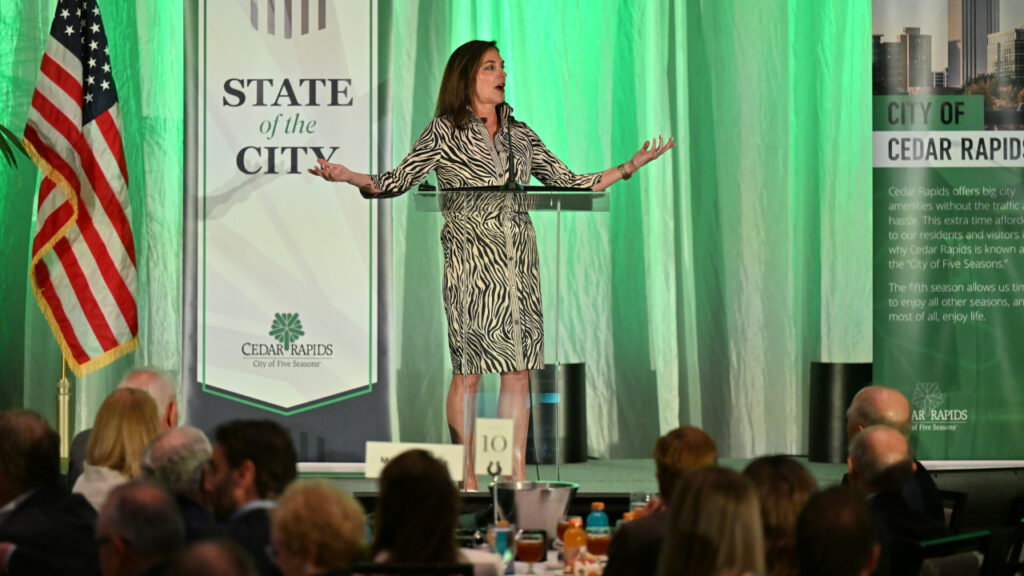
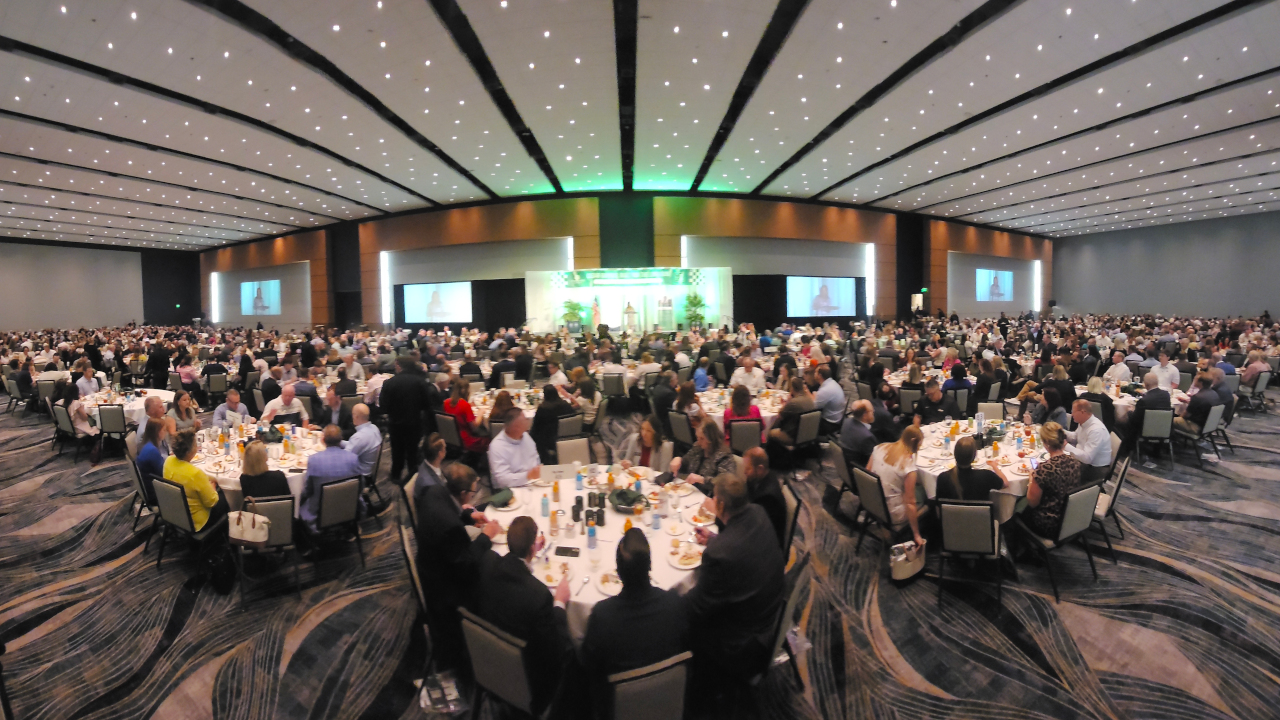
The theme of race-running – anchored by Cedar Rapids hosting its first-ever marathon June 7 – was persistent and prevalent throughout Cedar Rapids mayor Tiffany O’Donnell’s State of the City speech Wednesday, May 27 at the DoubleTree by Hilton Cedar Rapids Convention Complex.
From the replica race bibs, sports drinks and season-specific lip balms handed out to the estimated 800 attendees, to the speech itself – titled “The Long Run” and divided into subsections such as “Finding Our Rhythm,” “The Hills,” “Hitting the Wall” and “The Next Mile” – Ms. O’Donnell leaned heavily into the running theme, emphasizing the city’s growth in economic development (including the oft-discussed data centers on the city’s southwest side), housing, community attractions and more.
Noting that the Cedar Rapids marathon has been certified as a qualifying race for the Boston Marathon, Ms. O’Donnell – delivering her fifth State of the City address – said the efforts to organize such a large-scale event don’t happen accidentally, nor does the city’s progress in recent years.
“Cedar Rapids wasn’t suddenly the city we are today,” Ms. O’Donnell said. “We’ve been training for this moment for a very long time – 175 years, to be exact. We’ve been putting in the miles, making strategic investments, building partnerships, strengthening infrastructure, and planning for a bright future. And it’s taken generations of community members just like you, committed to moving this forward, even when the path wasn’t easy, to build that stable, growing, and prosperous community that we enjoy today.”
Economic development
Ms. O’Donnell’s speech delved extensively into economic development. She noted that total capital investment in incentive-supported development projects in Cedar Rapids rose from $110 million in 2015 to nearly $897 million in 2025, totaling an estimated $3.8 billion over that 10-year period.
“That is next level activity,” she said. “So when we talk about many employers investing across Cedar Rapids, we’re not just talking about one project, we’re not just talking about one company. We’re talking about a decade of momentum that’s been building over time.”
She highlighted some of the companies behind those investments – including Sub-Zero (which hosted a ribbon-cutting ceremony for its new Cedar Rapids facility May 22), Modern, Lil’ Drug Store Products, Altorfer, Worley Warehousing and IFF – noting that those companies are “continuing to reinforce their role in our city, strengthening our manufacturing, logistics, food production, and industrial base, while all the while creating jobs and opportunities for our residents.”
Highlighting the Cedar Rapids mayor’s role as the “mayor of economic development” as outlined in the city’s charter, Ms. O’Donnell noted the city’s growth in annual building permits. In the early 2000s, she said, annual permit valuation ranged from $130 million to $200 million per year, and rose to $200 million to $300 million in the 2010s – “steady growth, and the sign of a healthy city.”
However, that total valuation has skyrocketed in the past two years, to $2.6 billion in fiscal year 2025 and $4.6 billion in fiscal year 2026.
“That is not business as usual,” she said. “That is the new scale of investment in Cedar Rapids.”
Data center growth
Ms. O’Donnell acknowledged that much of that growth has come from the billions being invested into the Google and QTS data center projects in southwest Cedar Rapids, “and they are the outliers right now – but they are not random.”
“Projects of that scale don’t happen in cities that are standing still,” Ms. O’Donnell said. “They happen in the cities that plan ahead, the cities that have the capacity, the cities that have the infrastructure. They happen in cities that have planned for growth way long before the opportunity arrived.”
She said the data centers are placing Cedar Rapids on “the forefront of a new frontier,” and noted that “we’ve been here before. We’ve always been on the forefront of innovation here in good ol’ Cedar Rapids.”
While data center developments represent a different type of innovation – and have their share of opponents, in the community and elsewhere – Ms. O’Donnell stressed that they represent the forefront of the artificial intelligence revolution, and have brought thousands of construction jobs to the community.
“These projects are not simply about artificial intelligence,” she said. “They’re the phone in your pocket, they’re about the systems that our businesses use, hospitals, schools, and our military rely on every day. They’re about national security. They’re all about America’s ability to compete and lead in this rapidly changing world. And we are a part of that. Cedar Rapids is doing what Cedar Rapids has always done.”
She noted that companies like Collins Aerospace and BAE Systems, which have helped lead technological innovation, and ag companies that have “helped feed the world” represent a community that has “never shrunk from responsibility. We lean into it … this community is never shirked from our responsibility. We lean into it, and we do it by protecting what matters most: our people, our resources, and our future.”
She also called out data center critics.
“For those who question the presence of data centers in Cedar Rapids, I will ask you this. What if previous generations had rejected every major industrial investment out of fear and misinformation?” she said. “Cedar Rapids wouldn’t be the city we inherited. The responsibility of leadership is to separate legitimate concerns from exaggerated narratives, and then make decisions grounded in facts. So, yes, we have a responsibility to step up, not recklessly and not blindly, but the way good Iowans always do: Responsibly, thoughtfully, with clear eyes, and with due diligence.”
Infrastructure needs
She noted that while the city’s water systems have the capacity to serve current residential and industrial projects, significant investment will be required to continue the city’s momentum – and part of that investment, she said, is being funded by the data center developers and industries themselves.
“That is exactly why Cedar Rapids plans ahead, phasing investments in treating capacity, source water, wells, storage types, redundancy, and long-term system reliability,” she said. “These are needs that we anticipated, even without the arrival of our data centers … These projects are part of a much larger economic pipeline that ultimately strengthens our tax base, supports local employment, and creates opportunities for our workers. It helps fund the services and the infrastructure that our residents depend on.”
Civility in public discourse
Ms. O’Donnell then went “off-script” to address an ongoing topic of concern: A growing lack of civility in public discourse, including at Cedar Rapids council meetings. She said that the city had been approached about adding metal detectors at City Hall – “and we balked at it, until now.”
“In the last year, I (and) my council colleagues have received threats to our personal safety,” she said. “I’ve received them to my family’s safety and my dog’s safety. I had a woman with a baseball bat come after me at City Hall. Look at social media comments if you want a glimpse of the vitriol that’s out there.”
She noted that city council members are paid a “modest” salary for their positions, “and we are happy to do it. No one is complaining about that. But the fact that we have to be subjected to personal attacks, personal threats, is absolutely unacceptable, and you should be outraged, because the actions of a few people are affecting your access to government.”
“I have the skin that rivals that of an alligator,” she added. “I can take criticism, I can take disagreement. In fact, I welcome it. But when you come after my dog – yeah, let’s get past the wall. We all have a role to play.”
Community development and housing
She also addressed the need for community development and attractions that keep local residents connected to their city; hailed the ongoing development of the Eastern Iowa Airport as “one of the clearest signs that Cedar Rapids is competing at a higher level”; and stressed the need for additional housing as “one of the defining issues” facing Cedar Rapids.
A recent housing analysis, she said, projects demand for nearly 6,000 new housing units in Cedar Rapids by 2030, including more than 1,400 single-family homes and nearly 2,400 new rental units.
“We need more housing at every price point,” she said. “We need starter homes, we need workforce housing, we need market-rate apartments, senior housing. The demand is real, and the pressure on supply is real again, not just here in Cedar Rapids, but across our region.”
After discussing the city’s progress in addressing homelessness and in lowering the crime rate, she concluded her speech with a call to not let the city’s momentum fade, as can often happen to a runner near the end of a marathon.
“Cedar Rapids is increasingly becoming recognized as a city that knows how to compete by understanding our strengths and building from them,” she said. “We are a city that makes things happen. We solve problems. We value neighborhoods, and we certainly like to welcome all people. So in 10 days, when the runners line up for Cedar Rapids’ first marathon, they will run through a city that understands what it means to commit to the long run. They will run through a city that understands what recovery, resilience, growth, and momentum looks and feels like.”