
In a way, Jack Perry’s launch of Zeam has been a natural progression of the streaming video revolution he’s helped to lead.
Having founded or led several broadcast technology firms over 30-plus years, Mr. Perry has established a leading foothold in the ever-evolving advertising-based video on demand (AVOD) streaming platforms.
Now comes Zeam, his most prominent endeavor yet – and one that he says is fundamentally changing the landscape for local broadcasters and streaming content providers nationwide.
Zeam’s business model
In a recent interview with the CBJ, Mr. Perry outlined the journey that led to the launching of Zeam in February 2024.
“Zeam was really the rebranding and the growth of the VUit brand that we previously had,” Mr. Perry said from the company’s Marion headquarters. “We had been watching that little app do really well, and I thought, if we’re going to get big and go all in on this thing, why don’t we go hire a big agency to rebrand VUit into something that’s a much more consumer-friendly, that could stand up against the Netflix-es of the world, at least brand-wise, and they came up with Zeam.”
VUit, launched in September 2020, was a free, ad-supported streaming service focused on live, local content from television stations across the country.
Zeam represents an expansion of that model to individual streaming video providers seeking a larger audience for their content.
“It’s really the evolution of what I call ‘life in real time’ streaming,” Mr. Perry said. “So we take all the hundreds of hyperlocal or local TV channels that we have – that’s very similar to VUit – and we add in our studios that we have now, which range from a studio in Times Square to our Zeam 360 van, which is a live streaming van that streams everything that it sees. Then we have a Yooper studio in the Upper Peninsula of Michigan. We even have flown out (to) an ice fishing shanty. And we really do that because we want to inspire others to do life in real time, ‘extreme’ streaming. That’s the main evolution (from VUit).”
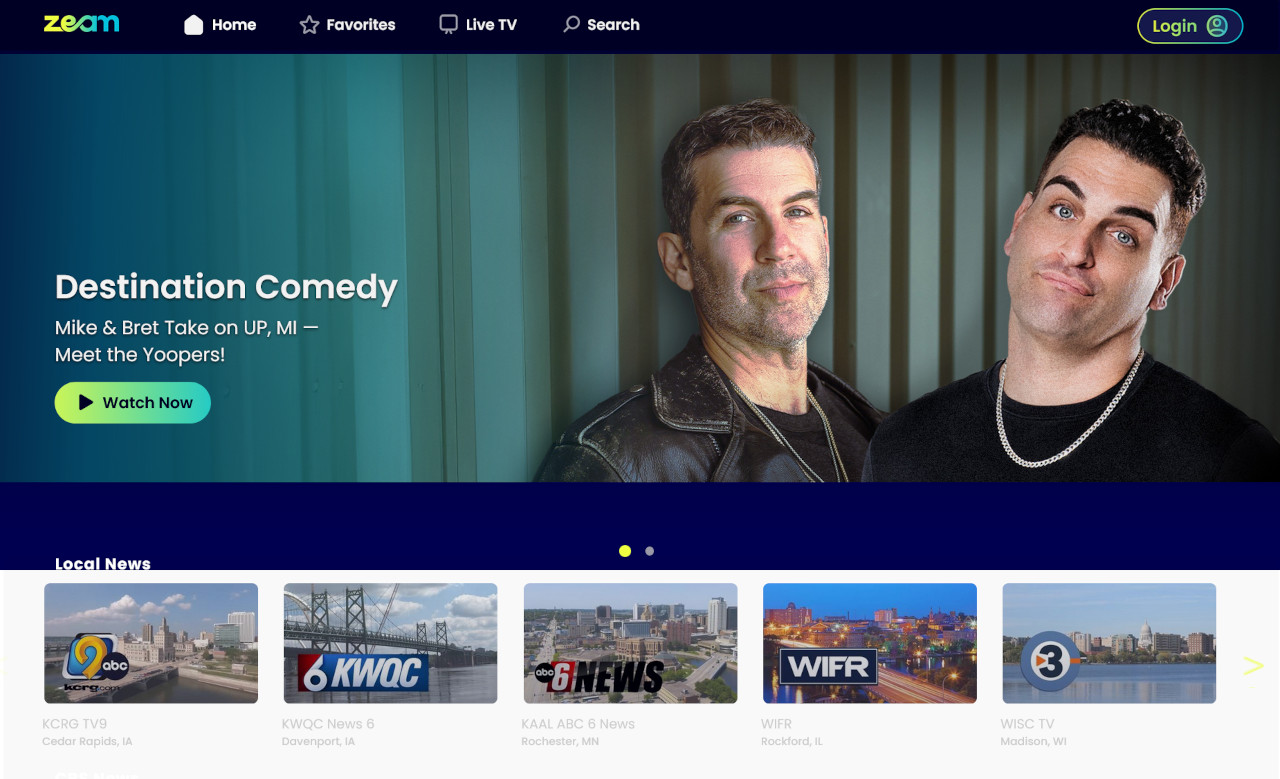
Certainly, Zeam still offers streaming services for content from over 300 local television stations across the country. Those stations are part of various media companies like Gray Television, CBS, Hearst, News Press & Gazette, and Morgan-Murphy.
In Iowa, that includes stations like KCRG-TV9 (and 9.2, for local sports broadcasts and other live events), KWQC in Davenport and KTIV in Sioux City.
“We now do about 27 million hours a year of local broadcast content,” Mr. Perry said.
Those local news stations’ content are still featured prominently on Zeam’s home page.
Platform for local streamers
But what really sets Zeam apart, Mr. Perry said, is the hundreds of smaller video content providers across the country who are using Zeam as an aggregating platform to stream their segments and live shows.
And as awareness of the Zeam platform continues to grow, those providers are reaching out for a chance to join the streaming party.
“For the most part, the local community providers and the TV stations have been coming to us,” he said.
One highly visible local example is the West End Diner in Marion, founded by Mr. Perry’s wife Annette in October 2019 as part of the larger West End Marion development. The diner has a small streaming studio that hosts several local video podcasts, “created to showcase the voices, ideas and businesses that make up Eastern Iowa.”
Among those local podcasts:
- “Gun Talk,” with hosts from Cedar Valley Outfitters;
- “The Mainstreet Maven,” hosted by Rachel McCurdy and focusing on local entrepreneurs;
- “My Story, My Reality,” in which host Tara Allen engages listeners in “thought-provoking discussions on personal growth, perspective, and resilience”;
- “The Holy Grail podcast,” with hosts David Lewis Moore of Vintage Heaven and Art Liebich of Toy Lair discussing vintage toys and collectibles;
- “Garden Wisdom,” hosted by a variety of Linn County master gardeners;
- “Traveling Person,” with host Lisa Person providing travel tips and tricks; and
- Ms. Perry’s own self-explanatory “Conversations with the Most Interesting People in Town.”
“They’ve all essentially approached us to say, ‘we want to get onto Zeam, and can we use the studio to do it?’” Mr. Perry said.
There are hundreds of other streaming content providers nationwide available as well, providing content on topics as diverse as comedy, sports, true crime, food and travel. The Zeam studio in Times Square, for example, hosts “Stand-Up New York,” with two live shows weekly; “Theatrely,” featuring updates and commentary on Broadway shows; and “The Morning Movement,” a weekly fitness show hosted by influencer Sarah Gaines.
“Our goal is to take that young lady (Ms. Gaines) and give her everything she needs so she can be kind of the Oprah Winfrey of fitness programming,” Mr. Perry said.
The streaming studio has also hosted several special events. One of the most recent occurred in June, just after the death of founding Beach Boys member Brian Wilson. Actor John Stamos has a long-term relationship with the band, having played with them on several occasions.
“The morning after Brian passed, John brought the Beach Boys to our studio in Times Square, and they played for about two hours,” Mr. Perry said. “They also had the comedian Matt Friend, who does about 250 impersonations. They were all singing and playing, paying tribute to Brian. Christian Love was there, whose father is (Beach Boys lead singer) Mike Love. The rest of the gang was there in the studio too, and we live streamed the whole thing.”
So what’s the deal with John Stamos, anyway?
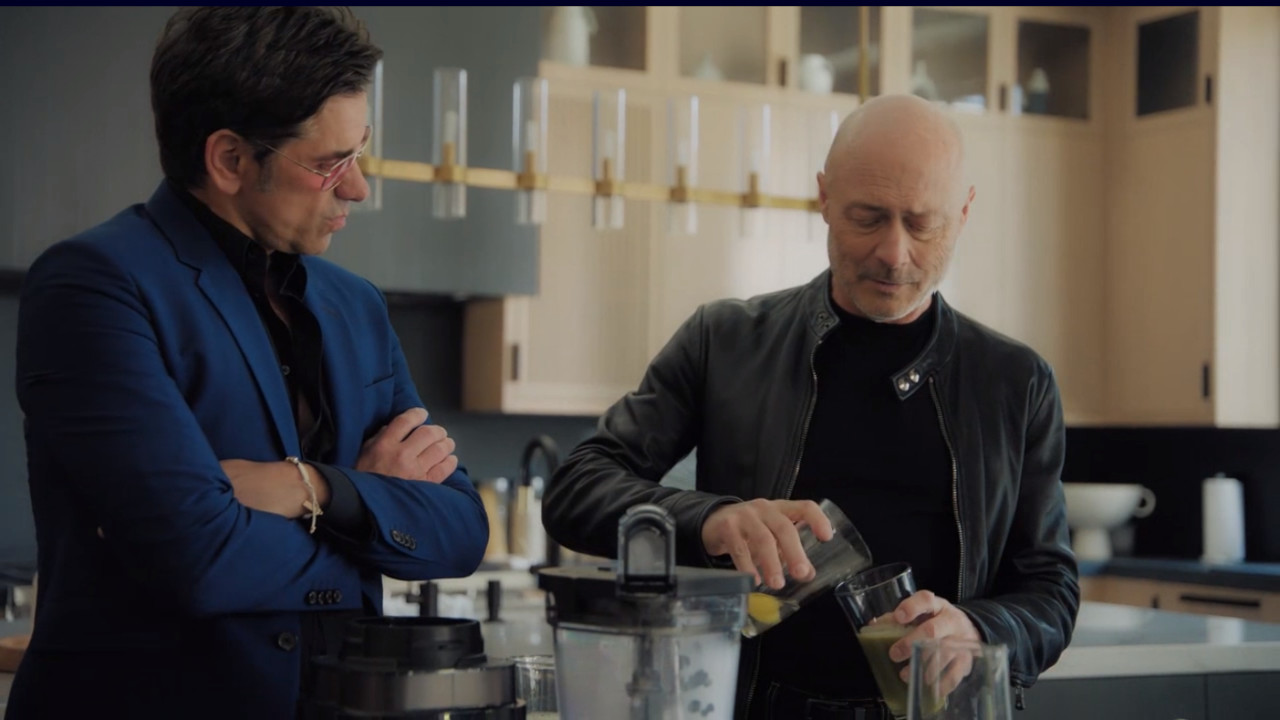
On its surface, Zeam’s relationship with Mr. Stamos, who emerged as a teen idol from his portrayal of uncle Jesse on “Full House” and has been regularly featured in Zeam commercials as the company’s chief spokesperson, might seem a little unusual.
But there’s a curious story behind the partnership.
“John is extraordinary,” Mr. Perry said. “He always calls himself a former teen idol. I don’t see it that way. Once you’re a teen idol, you’re always a teen idol.”
The connection between the two was made when Known Marketing, the agency that developed the campaign for the company’s rebranding to Zeam, was looking to produce a launch ad that would air during the 2024 Super Bowl. That agency connected Zeam with Mr. Stamos – and the rest, as they say, is history.
“We were looking for somebody who resonated with all generations,” Mr. Perry said. “Women love him, men love him, kids love Uncle Jesse. We were looking for someone who really could speak to every age group, because at the end of the day, Zeam is about having something for everyone, on a local level. As we went through the process with our ad agency, we looked at probably 200 different celebrities, and my wife actually went to the list and said, ‘Are you crazy? It’s John Stamos. He’s the one that resonates with everyone.’ And of course, she was right.”
Zeam’s Super Bowl ads, which featured Mr. Stamos and have now aired during the past two years’ Super Bowl games, provided a high-profile introduction to the service for a nationwide audience.
After the first Super Bowl ad, Mr. Stamos partnered with Zeam as the company’s chief innovation officer. The service has since been featured on highly-visible billboard campaigns and continues to run ad spots during Zeam streaming broadcasts, featuring intros from Mr. Stamos customized to the markets where the ads are running.
“The way he and I strategize about it, Full House is one of the longest-running syndicated shows out there,” Mr. Perry said. “It’s been on the air somewhere, 24/7, since the ‘80s. But what really enabled that show to take off, back in the day, was that there was one station in every market where you knew you had to tune in to that particular channel to see it, and that was a local broadcast channel. So (John and I) instantly connected on the power of syndication.
“What made Oprah Winfrey?” Mr. Perry continued. “She’s great without television, but what really was her catalyst was the fact that there was one TV station in every market that brought their viewers to her. And as John and I worked on things, we said, ‘let’s just apply that same principle to streaming.’ So that’s a big part of what we’re doing. It’s a great relationship. We love working with him, and just thrilled that he has really embraced everything at Zeam.”
It may seem surprising that an Eastern Iowa company has connected so strongly with a television icon, but Mr. Stamos has embraced that connection, particularly when he came to Cedar Rapids in June 2024 to perform with the Beach Boys during a concert at the McGrath Amphitheater.
“When he came to town, everybody was kind of speculating – where is he? What’s he doing?” Mr. Perry said. “A radio station came out to the West End and made the connection. The reality is, he came to Cedar Rapids with the Beach Boys to say hello to my wife. So that’s why he was in town for the concert last summer, and we are eternally grateful to have spent the afternoon with him at the West End Diner.”
Streaming platform for national providers
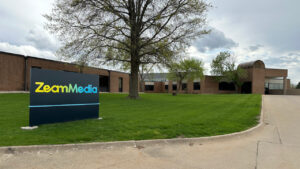
Zeam is the gateway for local streaming platforms, but the OTT technology behind it, provided through Zeam Media, is utilized by some of the nation’s largest broadcasters.
CBS All Access, Hulu, fuboTV, Sony, Amazon, the NFL, Paramount, and the CW are among the company’s largest customers.
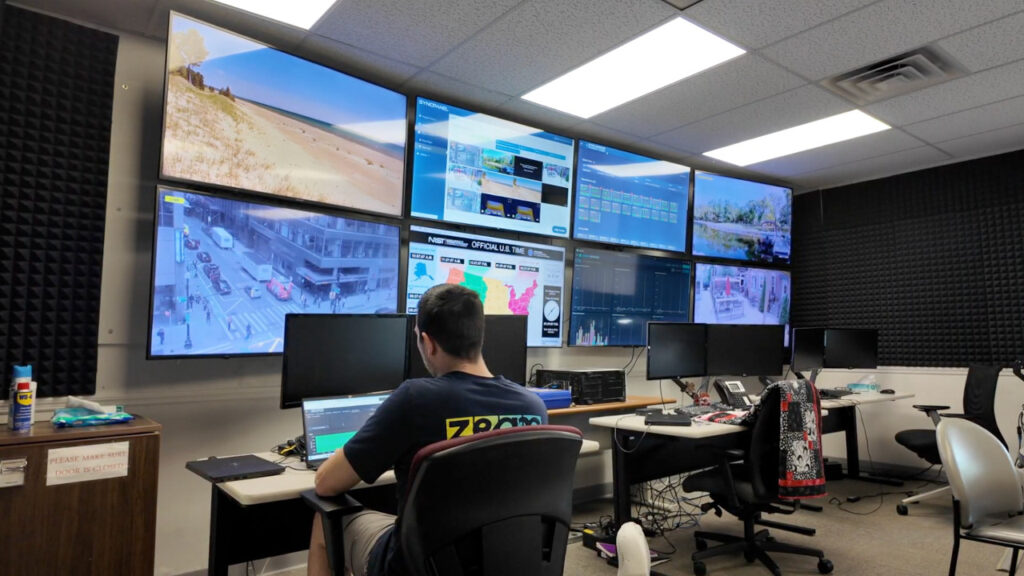
Zeam Media’s end-to-end platform, SimpleSync, is used by broadcasters for live-stream transcoding, cloud-based rights resolution, cloud-based DVR, device filtering, geo-location services, content management, stream monitoring, video clipping and dynamic ad insertion.
Zeam’s niche
As Mr. Perry sees it, Zeam is an ideal viewing companion for TV viewers who may be “binge watching” content from other national providers.
“You’ll find some live original programming on Zeam,” he said. “But I don’t think we’ll ever hire Taylor Sheridan to go create a long-form series for us, like Yellowstone. Those battles are being fought by the studios, so there’s no reason to try to compete in that space. Where I can compete is to give my technology to the local stations and encourage them to go and create hyperlocal content, and then bring in a comedian or two, or even a comedy club, and say, here’s the studio, here’s the technology. You just create content. I think in that area, we can effectively be a market leader in that one-off, hyperlocal programming. The one thing that people need when they come out of binge mode is a place to land. The vision for Zeam is, we have content where you’re at, where you’re from and where you’re going.”
The Zeam platform is also designed to prioritize, or “bubble up,” content from stations who are carrying coverage of specific current events.
Registration is not required on the site, but doing so will provide the viewer with content customized to their geographic location and interests.
“You don’t have to sign up, but it’s better if you do,” Mr. Perry said. “(The algorithm) infers different things. Maybe the person likes high school sports or whatever. We have to know where someone’s from, so we know what channels to feature in their version of Zeam. Signing up gives you the ability to control the channels and the content that you see.”
Fully ad-supported service
The Zeam service is completely free, for both users and broadcasters.
And it will stay that way for the foreseeable future, because the service’s model is based on a strong business case, Mr. Perry believes.
“We own our own ad technology, which powers hundreds of other apps and websites, so we have the ability to put the Zeam traffic in there, and it’s completely ad-supported,” Mr. Perry said. “There are advertisers out there willing to pay for you to see content. Someone just needs to do the matchmaking, and that’s where Zeam comes in. We take the content owner and the viewer, we get in the middle and bring in an advertiser, and the model works.”
“If you just run the numbers, in the average hour of programming, a person is going to see 15 minutes or so of commercials,” he added. “We like to do less, but when we’re live, we have to put ads in based on when we’re given the ad breaks. The math just works. No one should ever have to pay to watch anything if there’s advertisers out there. What we’re going to prove is, can I make an audience of one profitable?”
As an example, Mr. Perry cited a provider livestreaming from an ice fishing shanty.
“Maybe we know where they’re from,” Mr. Perry said. “Maybe we know they like Ford trucks. A Ford dealer would value that little bit of data, to know whenever a viewer is watching, they can make sure their ad is seen. Whenever you say that, you’re going to get a higher ad rate. It’s more targeted, and your viewing experience is better because you’re a Ford truck fan. There are advertisers who value that, and I see it as my job to try to connect all those dots.”
Mr. Perry’s journey
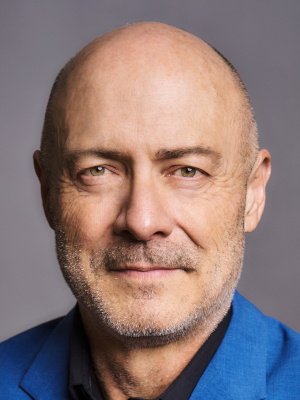
Mr. Perry’s technology journey has been wide-ranging. He started his first software package, Running Counts – “the first-ever fitness tracking package,” in his words, based on his personal fitness passion – back in 1989.
After licensing that technology to another company, he worked with several other Midwestern software firms – Prisma Software in Cedar Falls, Power Core in Chicago, CE Software in Des Moines – before becoming president of US Digital Video.
“That was one of the first MPEG video compression companies out there,” he said in a May 2021 CBJ article, ”which is really important to what we do today, because that was the beginnings of streaming and interactive television.”
Mr. Perry was subsequently brought on board by The Gazette Companies (now operating as Folience) to either “turn around or shut down” Decisionmark, a television data and technology company.
“I had actually decided we were going to scrap the whole thing,” he said. “And in the process of shutting the company down, I stumbled into an opportunity in the broadcast world that led to the creation of Geneva Technology, which managed the relationship between the two (main) satellite companies and all the local broadcasters in the United States. That was my first foray into creating internet/broadcast technology.
“Decisionmark went from being on its last gasp to a very profitable company that lasted for 13 or 14 years,” he added. “And when I sold that company, I started Syncbak to take over-the-air (television) broadcasting and put it on the internet.”
Syncbak, founded in 2009, then evolved to incorporate VUit, an ad-supported, direct-to-consumer platform providing over the top (OTT) streaming services to hundreds of local TV stations nationwide. By downloading an app from Google Play, the Apple app store, Roku, Amazon Fire or AppleTV, or on desktop platforms, consumers could set up their personal preferences for access to local video streams from broadcasters nationwide. Syncbak was then rebranded to Zeam Media last year.
Mr. Perry said he expects Zeam to be his latest success story. And, he says, it’s already succeeding.
“We’ve delivered (more than) 4 billion ads since our first Super Bowl,” he said. “I did a Super Bowl ad two years ago, and I did it again this (past) year. That should be a pretty good indication that we’re doing OK.”