
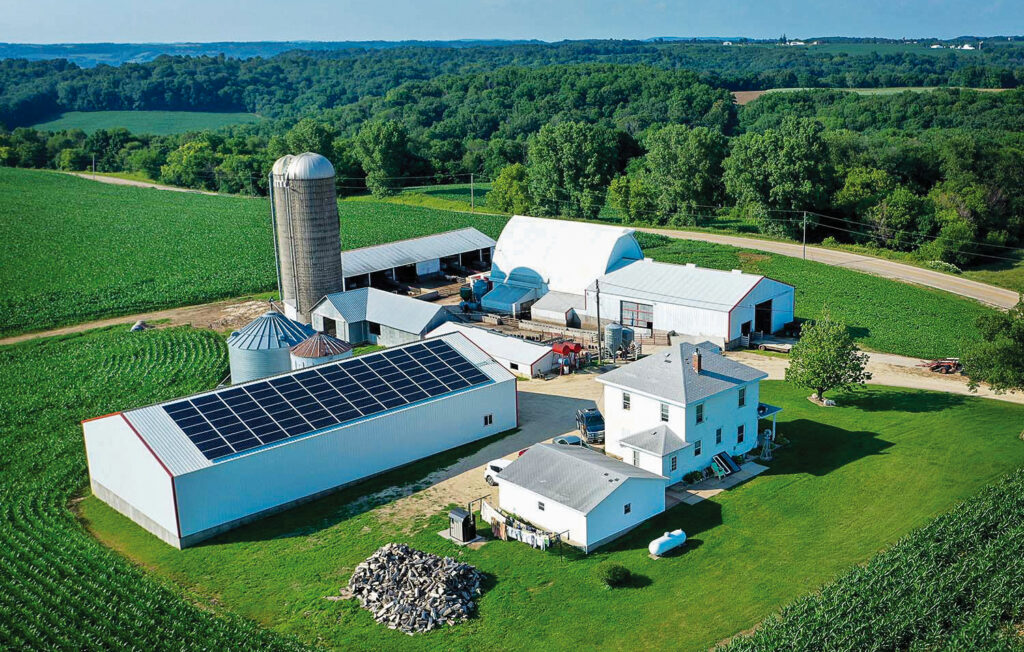
In the past decade, renewable energy production has surged across the United States, a trend that is clearly evident in Iowa.
According to an April 2024 report from Climate Central, an independent nonprofit group of scientists and communicators focused on climate change, the U.S. generated 238,121 gigawatt-hours (GWh) of electricity from solar sources in 2023 — more than eight times the amount generated a decade earlier, in 2014.
Wind power has more than doubled this decade as well, according to the report, with 425,325 GWh coming from wind installations across the country in 2023.
Together, these two renewable energy sources generated enough electricity in 2023 to power the equivalent of more than 61 million average American homes.
“These data — combined with federal capacity forecasts — show how renewable energy growth is driving America’s progress toward net-zero carbon emissions targets in the U.S.,” the report added.
Iowa has also moved forward dramatically in renewable energy production. As of 2022, wind energy is the largest source of electricity generation in Iowa, with over 12,200 megawatts installed, ranking second in the nation.
The Iowa Environmental Council’s 2024 Electric Generation Condition of the State report, which referenced its previous “Iowa’s Road to 100% Renewable” report, “summarized various pathways for Iowa to meet a 100% renewable energy goal based on a dozen regional and national studies.”
“We found that this goal is achievable and desirable,” the 2024 report said. “In fact, wind energy surpassed coal as Iowa’s primary source of electricity in 2019 for the first time ever, and provided 63% of Iowa’s electricity in 2022.”
Solar energy capacity, meanwhile, has seen explosive growth. As of early 2025, Iowa had 1,162 megawatts of installed solar capacity with a solar market value of $1.7 billion — enough energy to power more than 151,000 Iowa homes, according to the Solar Energy Industry Association. More than 554 megawatts were installed in 2024 alone, at an investment of $706 million.
All told, Iowa ranks first in the nation for its share of electricity generated from renewable sources, according to a 2024 report from America Clean Power.
Much of the growth has come in utility-scale solar projects. The Duane Arnold Solar project, located near the former Duane Arnold Energy Center in Linn County, has been developed in two phases thus far: a 50-megawatt (MW) Duane Arnold Solar I and a 150 MW Duane Arnold Solar II. Both projects were developed by NextEra Energy Resources and are now owned and operated by Alliant Energy. A third phase, Duane Arnold Solar III, is still under development, and details of that project haven’t yet been released.
A separate, 127-megawatt Coggon Solar project is being planned by Clenera Energy. The project was approved by the Linn County Board of Supervisors in 2022, but the permitting process for the project is still unfolding.
And in 2022, MidAmerican Energy announced plans for a $3.9 billion renewable energy project in Iowa, including wind and solar generation, and the exploration of new technologies.
In a filing with the Iowa Utilities Board, MidAmerican’s proposed project, called Wind PRIME, would add 2,042 megawatts of wind generation and 50 megawatts of solar generation to the state’s electrical grid.
But there are major policy changes on the horizon that are expected to dramatically impact the expansion of renewable energy — particularly on the residential level.
Impact of sunsetting tax credits
Specific policy changes are still being evaluated, but Solar.com reports that with Trump’s One Big Beautiful Bill as law, the 25D solar tax credit expiration for homeowners is set for midnight on December 31, 2025.
Residential solar systems installed by the deadline would still qualify for the 30% federal tax credit, and there is no retroactive component in the law that strips the tax credit from homeowners who have already claimed it lawfully.
But in 2026 and after, there will be no residential tax credit for homeowners to claim for their investment. However, according to Solar.com, homeowners can still benefit from the 48E solar tax credit for Third-Party Ownership (TPO) arrangements installed before the end of 2027. In TPO arrangements, such as leases and Power Purchase Agreements (PPAs), the leasing company claims the tax credit and the homeowner benefits from lower payments for their system.
Changes are also coming for the commercial solar investment tax credit (Section 48E) While not eliminated, the commercial solar ITC now has stricter deadlines. Projects that begin construction by July 4, 2026, qualify for the full 30% credit and benefit from a four-year safe harbor. Projects starting after that must be placed in service by December 31, 2027, to be eligible.
Both the residential and commercial tax credits were originally slated to be available for several years into the future, according to the stipulations of the 2022 Inflation Reduction Act, under when they were authorized.
An analysis of the One Big Beautiful Bill’s impact on renewable energy from Yale Environment 360 said the U.S. stands to “reverse course on clean energy.”
“The Republican spending bill … will reset the course for the U.S. energy sector, analyses show,” the report indicates. “The law rapidly phases out tax credits for wind, solar, and electric cars, while making it cheaper to drill and mine for fossil fuels on federal lands.”
The loss of federal support is expected to curb the buildout of wind and solar by more than 70 gigawatts by 2030, driving up household energy costs by $165 per year, according to a new analysis from Princeton University. The loss of the EV tax credit could lead to roughly 8 million fewer plug-in cars sold this decade, according to an earlier Princeton analysis.
Impacts on solar companies, installations
Representatives of Iowa solar companies and organizations say the impact of the loss of tax credits is already being felt —and is expected to broaden in the coming months.

Todd Miller, president of Ankeny-based 1 Source Solar and current president of the Iowa Solar Energy Trade Association, said he’s concerned about the future of solar installers across the state, particularly smaller companies.
“I don’t know where this legislation is coming from, but it’s extremely concerning to me,” Mr. Miller said. “We have 42 employees. If our number of jobs is cut in half, which is kind of what we’re predicting, I’m worried about my employees. Residential installations will essentially come to a halt, at least until the markets have adjusted.”
As a result, Mr. Miller said he expects a dramatic impact on many companies’ operations and employment levels.
“My company will do about 115 homes this year,” he said. “I (wouldn’t) be shocked if we didn’t do 10 next year. We want all solar companies to survive and benefit, because there’s still plenty of consumers that have the need and the want. There’s over 1,000 solar jobs in Iowa right now. And quite honestly, if this stays in place, I would bet that number (of jobs) cuts in half by January of 2026.”
Greg Barnett, a board member for the Iowa Renewable Energy Association (I-Renew), headquartered at the Prairiewoods Franciscan Spirituality Center in Hiawatha, has experience with Moxie Solar — a North Liberty-based solar energy firm that closed in 2023 — and, as a retired engineer, has taken an active interest in the ongoing development of renewable energy.
He also has a solar energy installation at his home, and worked with I-Renew on their updated Jordan Solar Center project, completed in 2022. The project comprises a 14.4-kW solar array, producing 26,280 kilowatt hours of electricity each year.
Without the tax incentives, Mr. Barnett believes the residential solar industry could essentially “dry up.”

“Without that 30% tax credit, if you start running the numbers, it’s hard to make it work,” Mr. Barnett said. “It’s already a tough business. The margins are so low that it’s [hard] to make a go of it.”
Chris Hoffman is a senior solar energy consultant for Eagle Point Solar, which has an office in Cedar Rapids and serves residential and commercial customers throughout Iowa, Illinois and Wisconsin.
As Mr. Hoffman sees it, time is of the essence for customers looking to install solar energy projects. New installations can often be completed on-site in just a few days, but the entire process includes a substantial amount of time required to gain approvals for those installations.
“A typical turnaround period, from the moment that someone has signed paperwork until they’re making their own electricity, is on average, about three months, and it might take [up to] four months,” Mr. Hoffman said. “And two of those three months, we are usually waiting for the utility company to do two things for us. First, we’re waiting for them to give us permission to construct, and there’s an application process. Every utility across the country has an application to interconnect that needs to be submitted, and they have to approve it before we can begin to construct.
“Then once we are finished with our construction — if it’s a homeowner, usually, those projects can be completed in a day or two at the most — it then goes back to the utility company, and then the homeowners need to wait until there’s permission to operate, or PTO, granted by the utility companies, and that can take another month,” he continued. “So if I say a project takes three months, we can technically wait at least two of those three months for the utility company to do those two things for us.”
Both Mr. Miller and Mr. Hoffman said the scheduling requirements for new solar installations are tightening quickly.
“For us to have [residential] systems online by the end of the year, you really have to have them contracted in August sometime,” Mr. Miller said. “This is just not giving us a lot of time to allow the markets to adjust, number one, but also as a business owner, to come up with a new business plan as to what it’s going to look like moving forward.”
However, “I will say that on the commercial side and the utility side, I suspect we’re going to see an increase there over the next couple years,” he added.

Even so, the pressures on commercial, municipal and agricultural projects will be growing as those deadlines grow nearer, Mr. Hoffman said.
“If you’re talking about a commercial project, there are some elements of that that really aren’t defined yet, and that’s a little bit tougher to explain,” he said, “because while the end of 2026 is the commercial federal tax credit expiration date, there’s a certain element of a project that could be started, and we believe that that time frame is going to be 12 months (after) the bill was passed. So that will be in that July 2026 timeframe. As long as a project has some element of substantial progress that’s been initiated, it has four years to get to full completion.”
Most of Eagle Point Solar’s commercial projects are going to be wrapped up in 2026, Mr. Hoffman said.
“Very few of them are going to linger beyond then,” he said. “But that rule of a project being completed within four years is going to have an impact on utility-scale projects. We’re not a utility-scale contractor, but if you’re talking about a larger utility-scale project, when that four-year clock starts running, that is going to be difficult for some to be done by that point in time. So you’ll really see that push for (construction of) those projects over the next four years.”
As an example, Mr. Hoffman cited MidAmerican’s plans, announced in February, for an 150-megawatt solar farm project covering 900 acres near Iowa City, called the Johnson County Solar Triangle. That project would potentially power up to 30,000 homes.
“That’s a project that’s been discussed for a couple of years, and they’re almost to the point where MidAmerican and the Iowa Utilities Commission can agree on what the project will look like,” Mr. Hoffman said. “But they certainly can’t turn one shovel of dirt or make any purchases on the equipment until they get to that point. So that’s a perfect example locally of a project that’s really going to be under the microscope to get pushed through if they want to take advantage of that tax credit.”
Sense of urgency for customers, installers
While there’s not an overwhelming amount of panic in the solar industry, representatives say they’re encouraging customers to make decisions about renewable energy projects as soon as possible.
“I think it’s more of a calm urgency,” Mr. Hoffman said. “A lot of the conversations that we have are with (people) that we’ve spoken to in the last few years. There’s always been a sense of urgency, whether it’s rising utility costs or net metering policies with the utility companies, to avoid some type of future pain. There’s always something changing, and oftentimes it’s for the worse for the consumer. The conversations that we’re having so far have been calmly urgent. We’re comfortable knowing that we’ve got enough weeks left in this year and months left, where not only can we get these projects going on paper, but we have a significant ability to get them fully constructed before the end of the year.
“That’s easy for us to say at the end of July, because these are the conversations that I have every day,” he added. “But a month from now, that conversation, and our capacity as an industry across the country to build residential projects, is just going to get more and more compact. So there will be a different sense of urgency a month from now, and certainly two months from now.”
And in some cases, a renewable energy project could still make financial sense even after incentives are no longer available, Mr. Hoffman said.
“This technology has really gained a lot of traction,” he said. “It’s become a lot more efficient over the last 25 years, and costs have come down remarkably so in that time period. So there’s not a lot of additional cost reduction that can be found, like it had been in the last five, 10 or 20 years, so the project’s costs are not likely to get noticeably less expensive.
“If there’s an upside to it, the cost for electricity across the United States, especially here locally in Iowa, is forecasted to get remarkably more expensive over the next 10 years,” he added. “(With) data centers and AI, our utility companies need to provide that electricity, which means they’re going to need to build in purchasing more power from somewhere, and that cost is going to get passed on to consumers and ratepayers. So both of those things are going to be true. The solar investment is going to be more expensive because there’s not a tax credit left after this year. But on the other side of it, the cost for their electricity that they would otherwise purchase from their utility is going to go up. So the payback time period on this investment, ironically, might look the same six months or a year from now, just because the costs for electricity are expected to go up rather noticeably in that time frame.”
Even so, Mr. Hoffman added a cautionary note for consumers and business owners.
“This is a really tough thing for a consumer to be in the middle of right now,” he said. “In the past, anybody telling you that you’ve got to sign stuff before the week’s out to get a discount, they were simply trying to push a sale. But there are legitimately some time constraints that we’re all under right now. So my advice, for anyone considering solar, is to have a couple of conversations with companies. Look for the consistency, and then make your decision based on a couple of conversations. You’ll develop this comfort level on how you want to go about it. But you’ve got to take control of that conversation. If you’re a consumer, whether residential or business, that sense of urgency is still there, because most likely people and businesses don’t have money just laying around not being used.”
Another key to the future of the renewable industry, Mr. Barnett said, is to lower the ancillary costs of installations.
“So much of the cost of solar in the United States is soft costs, dealing with the power companies,” he said. “A 10-kilowatt system costs (more than) $2 a watt in the United States, maybe closer to $3, depending on the situation. But in Australia it’s 50 cents. So it’s all red tape. It takes a month from the time you sign the contract to get the utility company to say, okay, we’ll let you put solar on the grid. And so in less than a week, the solar is up on the roof, and then you wait at least another month for all the inspections. There’s got to be a way to (lower those costs). And that’s not even an Iowa issue, it’s a national issue. I don’t know where or how that could be solved, but those soft costs are way too (high).”
Mr. Barnett said he had been working with a small, Community Supported Agriculture (CSA) farm near Solon that had expressed interest in installing a solar energy and battery backup system to power their produce freezers.
“They went through the whole process of getting REAP grants and other incentives for small farmers, and now they just didn’t pull the trigger fast enough,” he said. “Everything changed last November, so now they’re on indefinite hold of getting any kind of help to do that. They can’t make that kind of investment on their own. They’re sitting in limbo right now, and they may be sitting there for a long time.”
Still, Mr. Barnett expressed hope that policies on renewable energy incentives could be reconsidered in the future.
“We can remain hopeful that more sanity prevails and we realize that we have an energy crisis,” he said. “President Trump is right about that. We do have an energy crisis, but then he basically bans the cheap, easy way to solve it. I don’t understand the thought process.”
This is an installment of the Corridor Business Journal’s Energy in Iowa article series which will extensively examine Iowa’s energy sector and its impact on the region’s economic development. Our next installment will feature perspectives from utility companies and renewable energy advocacy groups.