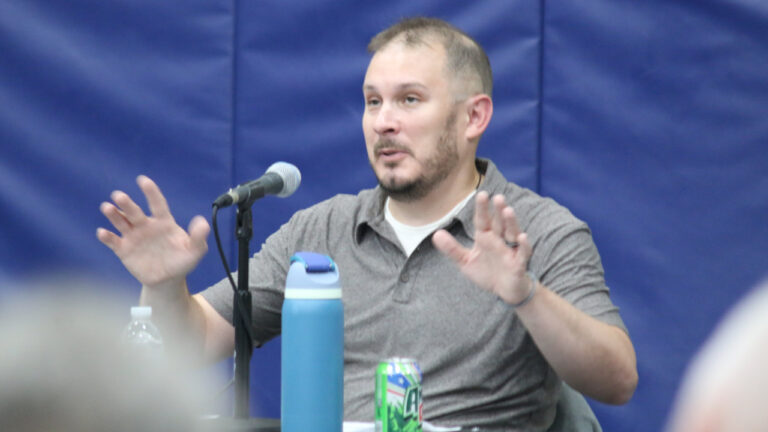

Britton Langdon is the founder and CEO of the startup BuildFactory, an off-site construction ecosystem that is connecting teams, streamlining procurement, and cutting risk.
Britton shares the story behind building a cutting-edge software ecosystem for construction prefabrication, drawing on his experiences founding and scaling MSuite before a successful exit to Stanley Black & Decker. He offers insights into the challenges and opportunities of launching a tech company in the Midwest, the impact of artificial intelligence and data centers on the local and national economy, and his vision for making Cedar Rapids a hub for technology-driven businesses. Along the way, Britton discusses the evolution of AI in business, the importance of building strong regional talent networks, and what it takes to create lasting change in a traditional industry.
Sponsored by MidWestOne Bank, this is the latest edition of the CBJ’s Real Success with Nate Kaeding and notable Iowa business and cultural leaders.
Real Success with Nate Kaeding was named Best Business Podcast at the 2024 Iowa Podcast Awards.
Nate Kaeding: Britton, can you share a high-level overview of BuildFactory and the core need it’s addressing in the construction industry?
Britton Langdon: We’re building a software ecosystem that allows construction companies to purchase prefabrication — essentially, offsite construction — instead of building everything on site. The idea is to take advantage of the benefits of offsite construction, like safety and a controlled environment, and democratize those benefits across the entire industry.
My experience at my previous company, MSuite, which managed the shop floors of fabrication organizations, revealed a striking imbalance: some shops around the country were bursting at the seams, running two shifts and burning out their teams, while another shop just down the street might have no work at all. They often had the same processes and skills, and sometimes even traded people back and forth, but the work wasn’t evenly distributed.
That arbitrage opportunity stuck with me. In order to address it, there needs to be a software platform that can orchestrate and connect these opportunities. Think of it as combining the Amazon distribution center model for prefabrication with the orchestration layer of Uber. We connect shops with work to those with capacity, creating connective tissue across the industry. With developments in AI, this orchestration isn’t just about capacity. It’s a full project management suite that incentivizes these types of transactions.
Kaeding: Your background in Cedar Rapids played a key role in this journey. Tell us about the origins of your experience in the industry.
Langdon: I was with Modern Piping here in Cedar Rapids when we bought a large facility in 2014, about 70,000 square feet of prefabrication space. My role was to build momentum within both the fabrication and 3D modeling and design groups, because you can’t do fabrication well without accurate drawings. We got really good at selling fabrication to major companies like DuPont, Shell, and Cargill, and even managed projects around the world.
But we were managing all of this with emails and spreadsheets. The things we were prefabricating — piping systems for chemicals, food, school districts — are complex, and it’s just more efficient to build them offsite, especially in Iowa winters. We needed a way to measure, manage, and communicate status to the field, so we built our own software. We soon realized the whole industry had the same problem, so we spun it out as its own company, MSuite, in 2015. After growing it for seven years, raising a Series A, and surviving the usual startup nightmares, we sold it to Stanley Black & Decker DeWalt in 2022.
Kaeding: When did the idea for BuildFactory start to take shape?
Langdon: The seeds were definitely there during my time at MSuite, seeing the imbalance in shop workloads. After selling the company and even after leaving, I was at an architectural design software company called Snaptrude. At a conference in London in 2023, I noticed architects were starting to talk about prefab in the same way trade contractors do, which was a major shift. It made me realize the wave was coming.
I reached out to Randy Altschuler, CEO of Xometry, a marketplace for CNC manufacturers and 3D printers. I sent him a message because what I wanted to build for construction was similar to what Xometry did for manufacturing. He responded, and we ended up talking for an hour and a half. By the end, he told me, “You’ve got to do it. I don’t think anyone else has this in mind, and it sounds like you have the background and connections to pull it off.” That was the push I needed.
Kaeding: What was it like starting BuildFactory pre-revenue, especially in the Midwest and not Silicon Valley?
Langdon: When I was raising money for MSuite in 2020, being in Cedar Rapids was a huge problem. Investors in Silicon Valley would say, “We don’t invest outside New York, the Bay Area, or Austin.” Even Austin was early back then. But now, there are more VCs focused on the Midwest, and the Bay Area has woken up to the fact that not all great ideas come out of Stanford.
A funny story: When I was early raising money for BuildFactory, I switched my LinkedIn profile to show the company’s name to get verified for the Microsoft Startup Program. Within three days, I was featured at the top of a VC newsletter, and suddenly had 200 emails from all over the world — including the big names like a16z and Sequoia. Most of them want to jump in at the seed or Series A stage, but those connections are valuable.
It’s far easier now to build a company in a place like Cedar Rapids than it was even a few years ago. You can hire talent from all over the world. Grinnell College, for example, produces some of the best software engineers, but they all go to the Bay Area. There’s a lot of opportunities here.
Kaeding: Where is BuildFactory now in terms of funding and growth?
Langdon: I raised a significant pre-seed round, knowing that category creation and behavioral change takes time. That gave us about 40 months of runway, and we have about 32 months left. We’ll probably raise a seed round in a year or so, but I want to see good traction first so we can bump up our valuation. Ultimately, the goal is to operate and scale the business without having to raise a massive Series A and dilute ourselves.
Kaeding: What have been the biggest surprises in the early days of BuildFactory?
Langdon: Some of the surprises are new, some are expected. The data center crunch is seriously impacting people’s behavior. For example, companies that were once fierce competitors are now working together out of necessity due to hyperscale project schedules. Union and non-union companies are collaborating, and there’s a sense of “what can we do to pick up speed?” That’s never been the case in construction before.
From a startup perspective, hiring is very interesting right now, especially for software engineers. With AI, you don’t need as many people, but the quality of your hires is even more important. AI can write code very fast, good or bad, so you need talented people to make sure you’re not generating junk code.
Kaeding: How big is your team now, and what are your plans for growth?
Langdon: We have three people in Cedar Rapids and six total, and that will jump to nine total and four in Cedar Rapids in the next few months. We’re excited to be growing locally.
Kaeding: Let’s talk about AI. How is it woven into BuildFactory, and what should local businesses be paying attention to with AI?
Langdon: I think of AI as another tool. You won’t even see “AI” mentioned on our website. It’s becoming like having a website or a mobile app: table stakes. The value comes from how you use AI and what problems you solve with it.
Software is no longer a moat; if non-technical people can build apps with no-code platforms, your software has to solve a complex problem or companies will just build it themselves. For us, we use Anthropic, Gemini, and OpenAI in different ways because each is good at different things. For example, Gemini is great for deep research, Anthropic for creating agents and executing tasks, and ChatGPT is like Google for everyone. Even within those platforms, there are different versions suited for different tasks.
What we’re building is the ability to read your emails, Slack messages, or Teams chats, and surface the most important things you should be focused on. In construction, 90% of project management happens in communication. If we can be on the front end of those tools and create context around situations, we can alert users to things they might have missed — like an important email attachment from two weeks ago. It’s not as simple as sending everything to OpenAI and getting an answer; you need to process subject lines, bodies, and create memories. So we built an AI to evaluate which AI is best for each job. Now we have AIs watching AIs.
Kaeding: What advice do you have for business owners or professionals just starting to experiment with AI?
Langdon: Number one: try it. Always get the paid subscription. OpenAI uses your data to train their models on free accounts, but paid subscriptions are isolated. I showed my mom how to use ChatGPT to identify a lamp and find where to buy it. It’s amazing for things like creating recipes or researching gifts. For business, it can help organize projects, refine ideas, and manage documents.
One important tip: personalize your AI settings. Tell it not to agree with everything you say. If you don’t, it will just be a sycophant, telling you every idea is great. Prompt it to challenge your assumptions and find counterarguments. There are prompts out there for novice users to help with this. Otherwise, you’ll think all your ideas are brilliant, and that’s dangerous, especially if you’re using AI as a counselor or for mental health advice.
All the models are like an eager 12-year-old with a Stanford MBA: smart, but not mature. They’ll tell you whatever you want to hear, so you have to be intentional.
Kaeding: Data centers and AI are reshaping the region. What’s happening in Linn County, and what are the implications?
Langdon: We have two data centers going up around the airport right now: one is Google and the other is likely Meta. These are massive, 30-40 feet tall, multiple football fields in size, filled with server racks. Each facility uses 30 megawatts of energy or more, and they’re moving toward 50 or even 100 megawatt facilities.
At each site, there are 1,500 to 2,000 workers at any given time, coming from all over the country. In some places, they’re living in trailers or temporary camps. Cedar Rapids is better equipped for this, but in other parts of the country, these projects create boomtowns and then ghost towns when the work is done.
The goal is to build these facilities in 18 months with half a million square feet in that time frame. The scale and speed are unprecedented, and money is no object for these companies. I was told there are 200 data centers in progress nationwide, with a goal of 700 by the end of next year.
Kaeding: With so much investment, is there a risk of an AI or data center bubble?
Langdon: Some of the big players are building with cash, not leverage, so if AI or quantum computing doesn’t pan out, they won’t be wiped out. They’re also betting on quantum computing as the next wave. The bubble risk is more for companies building technology around specific AI models. If you build around ChatGPT 5.2 and the next one comes along, you could be obsolete. But Google, Meta, Nvidia, and the big chip manufacturers have runway for decades.
Kaeding: Are local governments doing enough to manage the impact of these facilities?
Langdon: We could always be better. It’s an incredibly challenging time for elected officials. Even for someone in the industry, it’s hard to keep up. The pace of change is unlike anything we’ve ever seen. We’re going from the Wright brothers to a spaceship in a matter of years. We’re still in the dial-up era of AI, but we’ll be at fiber speeds by the end of next year.
AI is a hungry tool, and leaders need to be intentional about how we manage power, water, and real estate. We’re putting giant buildings in places we may not want them 20 years from now. But it’s also exciting, and Iowa is uniquely positioned with cheap, available energy and the foresight to have industrial parks ready.
Kaeding: What’s your long-term vision for BuildFactory? Can you build a company of scale here in Cedar Rapids?
Langdon: We want to be the Amazon for construction. Procurement in construction today is slow and antiquated with emails, RFPs, and invoices. It feels like the 1960s. We want to make it as convenient as buying toilet paper on Amazon, taking friction out of the process and getting from concept to building faster and less expensively. We want to be both the orchestration layer in software and the infrastructure, like Amazon.
It’s important to me to build this company here. Cedar Rapids has amazing tech talent, but we don’t get enough credit. Collins Aerospace is a great company, but it doesn’t feel as local as it used to. We need to build businesses here that rival Amazon. It’s possible, but it takes luck, hard work, and a concerted effort from people who might not even think they should care.
Kaeding: On a personal level, how do you think about the risks and rewards of building another startup after a successful exit?
Langdon: I was fortunate to take some chips off the table when I sold MSuite, so I don’t have to worry about the next dollar coming in. But after three years not playing the game, I realized I wasn’t done. When I left Modern and started MSuite, I had a vision for changing the industry, making it easier for people who are passionate about construction but frustrated by unnecessary friction and waste.
Other industries have figured out how to remove friction like Amazon, Uber, and Airbnb. It’s not easy, but it’s possible. I realized I was in a unique position to go after this opportunity, and I’d feel like I was doing a disservice to the industry if I didn’t try.