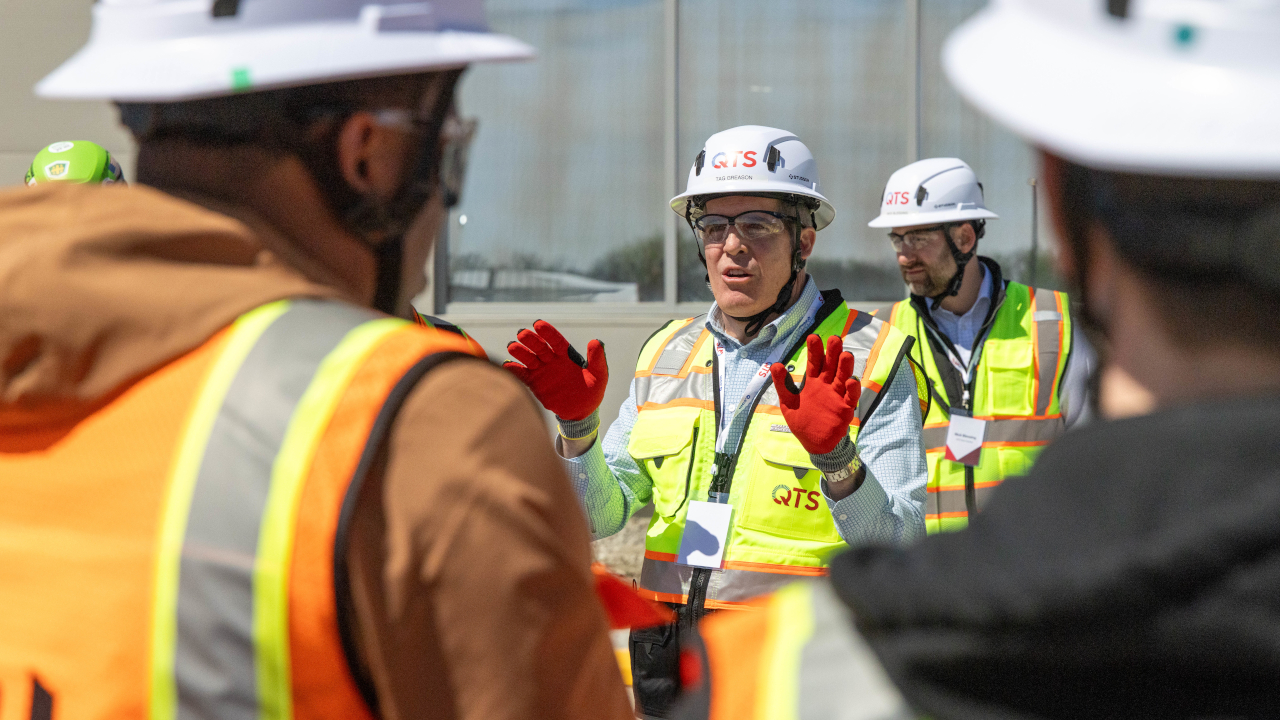

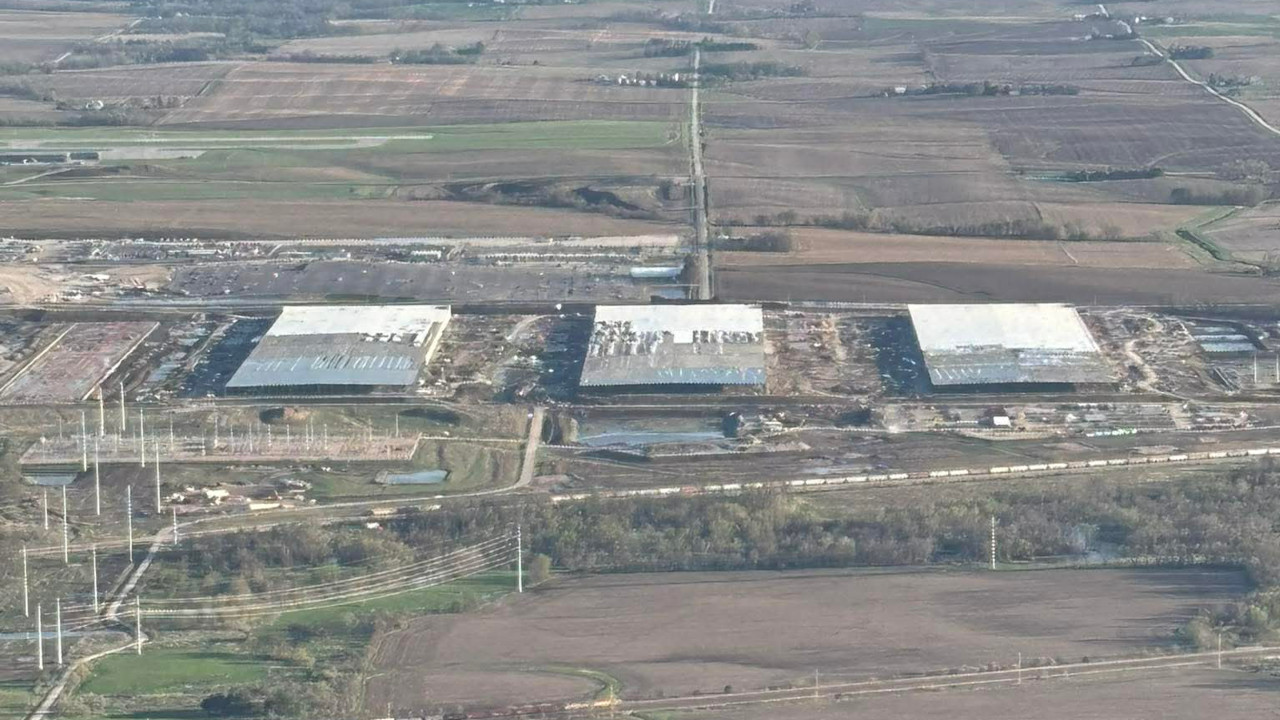
The massive QTS data center campus now under construction on the south edge of Cedar Rapids – the largest data center project in the QTS portfolio – will put the city on the “cutting edge” of industrial and technological development and is expected to represent up to $50 billion of overall economic growth to the region, local and national leaders emphasized after touring the construction site Friday, April 24.
The Cedar Rapids campus tour was planned around a visit by U.S. Energy Secretary Chris Wright, who toured the 612-acre site along with QTS co-CEO Tag Greason, Blackstone Infrastructure Strategies CEO and QTS board member Greg Blank, Cedar Rapids Mayor Tiffany O’Donnell, U.S. Reps Ashley Hinson and Mariannette Miller-Meeks, and Allliant Energy CEO Lisa Barton.
Wright: Project represents reindustrialization of U.S.
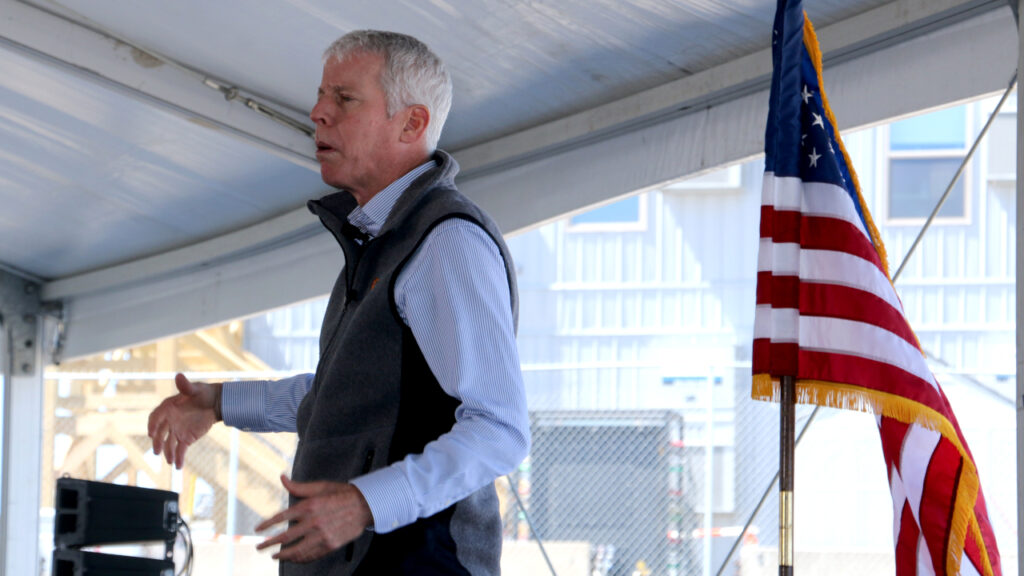
In his remarks to QTS site workers and dignitaries after the tour, Mr Wright said the QTS project represents the emergence of a new artificial intelligence industry that;’s “going to be led and dominated by the United States.”
He said the Trump administration’s policy of “reindustrializing America,” exemplified in projects like the QTS data center campus, represent a reversal of economic policy that began around the turn of the century, when China was admitted as a full member of the World Trade Organization.
“They were going to be a free trading nation and rise up with us together in the world,” Mr. Wright said. “It may not have seemed like a bad idea at the time, but it’s had tough consequences. They did everything they could to bring manufacturing jobs to China, and the United States lost our way … we decided we’ll design (things), we’ll finance them, they’ll get built over there, and we’ll bring them on a ship back. We’re just click button clickers.
“This was never a good idea,” he added. “I’ve been passionately against this idea for decades. It was a mistake on so many fronts, to let industry, the building of big, grand things, go overseas and just import them.”
Mr. Wright said as part of the Trump administration’s initiative to “reindustrialize” the United States, “we want to massively expand our energy system, because it lowers costs. It makes everyone’s lifestyles better if you have lower-cost energy, (and) it enables us to build big, bold things in the United States.”
He noted that the QTS project, with a minimum anticipated investment of $1.75 billion, represents the largest industrial project in Iowa’s history and “one of the largest projects ever built in the world,” catalyzing up to $50 billion in overall regional capital development.
“The spillover benefits of this will be gigantic,” he said. “This will be a home of technology, a home of other manufacturing that will come.”
Under the Trump agenda, he said, “we’re going to lean in. We’re not going to go slow. We’re not going to nudge us towards manufacturing again. We’re going to do whatever it takes. His charge to me and everyone is whatever you must do to attract massive amounts of capital and massive amounts of reindustrialization in the United States, do that. If it’s a problem, if there’s barriers, barrel through those barriers and make it happen.”
He praised companies like QTS, Alliant Energy and Blackstone – which acquired QTS Data Centers as a portfolio company for $10 billion in 2021 – who “believe passionately” in domestic industrial and technological development.
“We let other industries go overseas,” he said. “We’re not going to let artificial intelligence go overseas. Artificial Intelligence is this catalyst. It’s drawing massive investment here. But we’re going to see modern manufacturing here. We’re going to see all sorts of new industries we didn’t even dream of before emerge out of the ability to build big things in America, and you’ll have this incredible leverage of our creativity and our minds from artificial intelligence.”
Iowa, he said, will be the home of many of those new industries.
“We will have industries in Cedar Rapids five years from now that none of us can even think about right now,” he said. “It’s something that we couldn’t do today, but with what’s built here, with the training, with the workforce, with the compute, with the artificial intelligence, we’re going to say, ‘oh my god, we can do this.’ We’re going to be touring cancer or another disease. We’re going to be inventing new materials, new industries, again, that we can’t think of. They’re going to be built right here, because success snowballs.”
QTS co-founder: ‘We can pay our own way’
Mr. Greason, QTS’ co-CEO, said when company leaders first started meeting with representatives of the Cedar Rapids Metro Economic Alliance and the city of Cedar Rapids, they set a goal: to “build big, meaningful infrastructure without burdening the taxpayers, (electric) ratepayers and our communities.”
“We started with this audacious goal to say, we can do it,” he said. “We don’t need to build infrastructure and put the burden on the individual ratepayers. We can pay our own way. We can invest in generation. We can do the things that need to happen, in partnership with Alliant and others, to make sure that these projects actually are net positive to our communities, not net negative.”
He also noted that the workforce for the data center project – which currently is near its peak, with an estimated 8,500 workers on site daily – is building with 28,000 tons of domestically-sourced steel, along with other U.S.-made materials.
“There’s a lot of negative news out there about power rates and noise and water,” he said. “We pay our own share, and I don’t hear any noise. We should be proud of what we’re doing. We should be proud of how we’re doing it, because it’s not about what we build. It’s about how we build it, and if we build in the right way, we treat our communities in the right way, we should be a shining star for this economy.”
Each of the seven data centers on the QTS campus, once operational, will begin operations with an amount of cooling water approximately equivalent to an Olympic-sized swimming pool – and since the centers will employ a closed-loop cooling system, ongoing water consumption will be minimal.
Most data centers, he noted, use evaporative cooling, which has sparked concerns nationally and locally about excessive water consumption. “No good,” he said.
Since the QTS project broke ground last May, more than 8.5 million man hours have been expended, he said, and construction is expected to be completed within 16 months.
With its seven data center buildings, the Cedar Rapids data campus, Mr. Greason said, is currently the largest in QTS’ U.S. portfolio.
Mayor says project has already spurred other development inquiries
Ms. O’Donnell, who compared the QTS data center project to other innovations in the city’s history – from the Wright brothers to Arthur Collins – noted that the site was once a horse farm, and that the current QTS project has unfolded after “years of thoughtful relationships.”
“As Tag likes to say – and I agree – it’s not just a data center, it’s QTS,” she said. “And we in Cedar Rapids are used to doing things that haven’t been done before.”
She said that the QTS project, with its closed-loop cooling system, aligns closely with the city’s Climate Action Plan, which focuses on sustainability and minimal impact of development projects.
“We are extremely mindful of our land, our natural resources here,” she said. “So in terms of projects for our region, we’ve done a lot of due diligence on this project.”
She also said the city has “had interest from companies that need to be in close proximity to a data center,” she said. “Just from a very micro look at it, we’ve got companies interested in Cedar Rapids because the data centers are here.”
Barton stresses five-year electric rate freeze
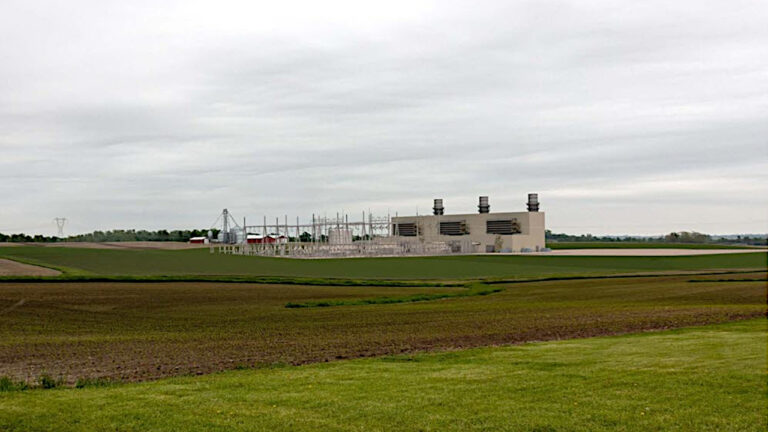
While the QTS data center will use about 1.05 gigawatts of electricity – enough to power about 800,000 homes – Ms. Barton said Alliant is committed to an “all of the above” energy generation strategy that will bring new power to the market.
“This milestone represents more than just investment,” she said. “It signals confidence in the community’s workforce, our infrastructure, our ability to deliver results, and it underscores Iowa’s position as a place where businesses can grow, communities can thrive, and innovation can flourish. Advanced manufacturing, data centers, electrification and digital infrastructure are expanding rapidly and strengthening U.S. competitiveness, and it’s important for all of us to work together to continue to make that happen.”
She also stressed that when Alliant reached its most recent rate case settlement with the Iowa Utilities Commission in September 2024, the company agreed to a five-year rate freeze for its Iowa service customers – and remains committed to that agreement, even with the added demand the QTS data center will bring.
“We appreciate customers like QTS who drive new large energy demand, and in turn pay for the infrastructure required to serve them,” she said. “We welcome the administration’s focus on ensuring electric customers do not pay for the growth of data centers associated with the rate payer protection pledge. This principle protects affordability for families, farmers, small businesses, and ensures that growth is economically sound and transparent, and it reinforces public trust that energy infrastructure development is both disciplined and fair. When growth is managed the right way, everyone benefits, and it accelerates the opportunities for growth. As industries electrify and innovation accelerates, utilities have a responsibility to lead with long-term thinking and to work hand in hand with our policy makers to make that happen.”