
Linn County’s new ordinance governing the approval and development of large-scale data centers is taking more new turns, as concerns about construction waste management and decommissioning are now being raised.
Monday’s work session meeting for the Board of Supervisors was originally slated to serve as a second consideration of the county’s new data center ordinance, including consideration of several new issues raised at the public hearing and first ordinance consideration Feb. 11 at the Palo Community Center.
Those concerns included lighting requirements, decommissioning plan requirements, water well interference concerns from private landowners and the potential effects of noise from data center operations on nearby livestock.
However, Linn County Planning and Development director Charlie Nichols brought a new concern to the board’s attention – waste management from the two existing data center construction projects in Cedar Rapids.
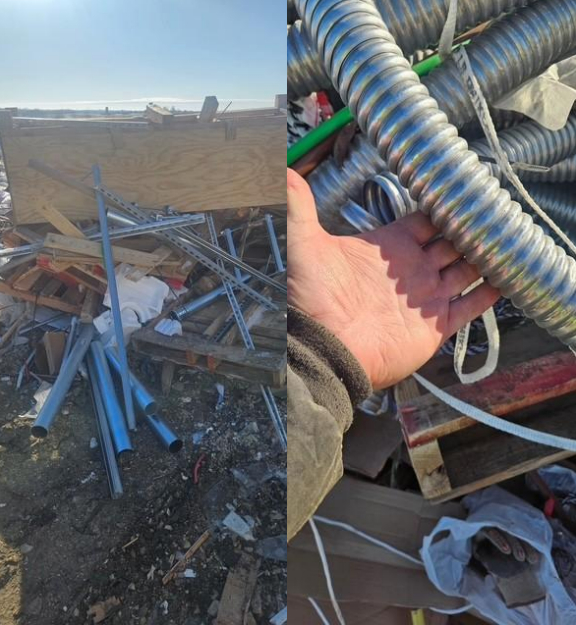
Mr. Nichols said the county had received a letter from Linn County Solid Waste Agency director Karmin McShane Feb. 11 regarding “current waste management practices” from the two data center projects. The projects are in the early phase of construction, but the solid waste agency is already seeing that waste is not being segregated. As a result, she wrote, “tonnage is trending higher,” a factor already being considered by Linn County and Cedar Rapids officials as part of a new governance agreement to help extend the landfill’s useful life.
Ms. McShane’s letter included photos of the waste generated from the construction project, showing that it contains significant amounts of clean wood, cardboard and metal.
“This is all material that can be segregated and diverted,” Mr. Nichols said. “Not segregating and diverting waste contributes to our landfill filling up faster than normally would be expected.”
According to Ms. McShane’s letter, “mixed loads containing (cardboard) are incurring double tipping fees because of the contamination.”
As a result, the solid waste agency is recommending, and Mr. Nichols agreed, that the county should require a waste management plan for data center projects as part of the new ordinance, prior to the issuance of any building permits.
“These are projects that are of a scale that we typically don’t see, and they do generate massive amounts of construction waste,” Mr. Nichols said.
The waste management plan would include estimated values and types of material to be generated during construction; identification of materials proposed for recycling, salvage and reuse; designated recycling disposal facilities, procedures for on-site, material separation and storage; and documentation requirements for final disposal or diversion.
The board unanimously agreed to include the waste management requirement in the ordinance, which is currently set for its third and final reading Wednesday, Feb. 18.
“I’m just grateful that the solid waste agency sent this letter when they did,” supervisor Brandy Z. Meisheid said. “I think it’s very important that we include this.”
Decommissioning requirements spark debate
Another topic, potential decommissioning requirements for data centers, generated differing views among board members.
Ms. Meisheid said she favored specific decommissioning policies for data centers in the county’s rural areas, noting that zoning policies for solar and wind energy projects include specific requirements for decommissioning.
“These are massive facilities, larger than the typical industrial facility that we see,” she said. “Is there evidence of abandoned data center sites requiring public cleanup? Well, no, they’re not old enough yet, so I feel like this is too new to actually answer that question.”
She said that QTS, the company developing one of the two Cedar Rapids data center projects, has indicated “an intention of 20 year (life)span buildings.”
“What happens in 20 years, when technology will change?” she asked. “I’m not saying decommissioning could involve a sale for some kind of warehouse, but I do think it’s most responsible for our constituents to have some form of plan.”
She added to her concerns later in the meeting.
“My biggest worry down the road, in the event they can’t get sold, in the event that there’s nothing to keep any applicant here to take care of those buildings, what happens to them if they need (to be) torn down?” she said. “Does that come back to our taxpayers? I just feel like it’s not responsible to move forward without some form of decommissioning plan in our ordinance.”
Supervisor Kirsten Running-Marquardt disagreed, saying she would prefer an overall plan for decommissioning industrial buildings in the county “that would satisfy any of the concerns about abandoned or non-used buildings.”
“I thought that it would be a better approach for us, to take a comprehensive look county-wide for when we have abandoned buildings or industrial complexes (and) look at what decommissioning could be, that that would be sort of a wider decommissioning ordinance for their whole county,” she said.
Supervisor Sami Scheetz concurred. “I don’t really see any need for (data centers) to be treated differently,” he said.
The board voted 2-1 against adding a decommissioning amendment to the data center ordinance.
Mr. Nichols noted that county officials have talked about a county-wide policy for abandoned buildings with decommissioning requirements. “It’s not something we have now,” he said, “but wouldn’t be a bad idea to look into, especially since we do have more development occurring in the rural areas.”
Water usage
In regards to adding restrictions to the data center ordinance regarding water usage, Mr. Nichols said the county’s authority on water usage in rural areas is relatively limited.
“f the data center is within city limits and the city has their own water utility, the city has much more leverage over that water usage reporting and curtailment,” he said. “If the data center usage occurs in rural Linn County and it gets a water use permit for either a deep well or drawing from surface water like a river, that goes to the Iowa Department of Natural Resources.”
The county can, however, require data center developers to demonstrate sufficient water supply for their operations and to provide ongoing documentation of that usage, and the proposed ordinance does include those requirements.
The Iowa DNR has recommended, however, that the Linn County ordinance include specific language that any water use agreement with the county should require the applicant to “demonstrate coordination” with the DNR on water use permits, interference with private wells, mitigation procedures, monitoring obligations and compliance procedures.
“So this would be set upfront, before a project is constructed,” Mr. Nichols said.
Noise impacts on livestock
County officials also researched concerns about the possible impact of noise from data centers on nearby livestock. Mr. Nichols said that based on his research, the projected noise levels from data center operations – 55 to 65 decibels – wouldn’t have a significant impact on livestock.
“There were negative reactions found in research in animals with sudden or impulsive, explosive noises, not consistent mechanical sound,” Mr. Nichols said. “Basically, what the research shows is that animals habituate, over time, to consistent noise levels.”
Pre-construction public meeting
The board voted unanimously to add one final amendment to the ordinance, requiring any potential data center operator to host a meeting for public input, prior to any governmental considerations.
Such a meeting, Mr. Nichols said, “would be a chance for the public to ask questions of any developer directly, before it moves into the county public process. It could be overkill, but we have seen it help out with the solar projects.”
Lighting standards
Concerns about lighting on data center sites can largely be addressed in the application process without pre-specified standards, Mr. Nicholas said, but a lighting plan will be required for any data center applications.
“It’s not prescriptive,” he said. “It’s meant to be flexible, depending on the project site.”
Overall ordinance impact
Despite her concerns, Ms. Meisheid said she remained supportive of the ordinance overall.
“I still think we’re stronger as a county to have an ordinance, and there’s a lot of great pieces in here that do protect the taxpayers,” she said. “I ultimately will be supportive, even though there are still pieces which I think can make it stronger. But ultimately, we are better served by having this ordinance.”
Mr. Scheetz said he felt the ordinance is “one of the most comprehensive” in the county’s history.
“(It) protects residents, but also recognizes that we are a pro-growth board and a pro-growth community,” he said. “We just need to do it responsibly, and the way to do it is the draft ordinance that we have here.”
Ms. Running-Marquardt said she was pleased that input from county residents was incorporated into the ordinance, which is set for its third and final consideration at the board of supervisors meeting at 10 a.m. Wednesday, Feb. 18.
“We tried to be as fully transparent as possible,” she said. “We chose a route to have an ordinance that is specific to data centers, because they are a special industry that (would use) a lot of our resources. So we have, to the best of our ability and to the best of our authority, used the power that we have as a county to put in many of these protections and still be a pro-growth county. I am proud of the work that we did here.”