
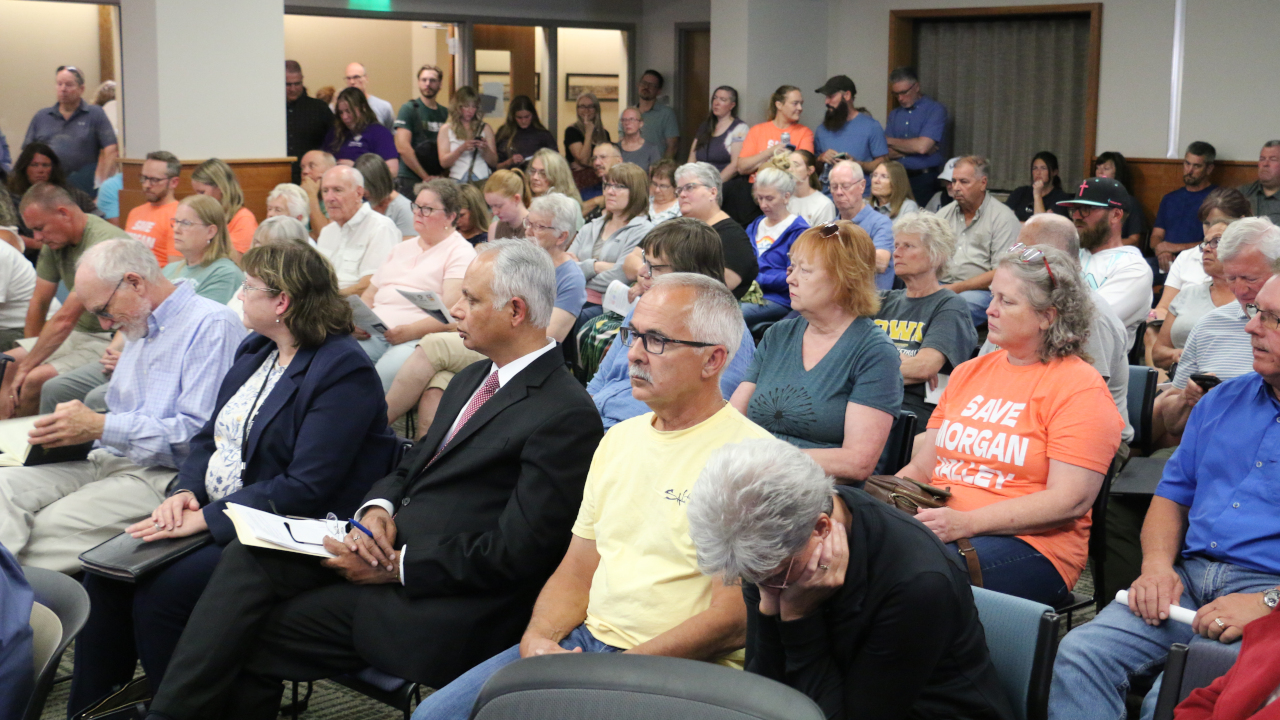
A public meeting convened by the Linn County Board of Supervisors Wednesday night, June 24 as an information session on air quality permitting processes evolved into the latest forum for residents to voice concerns about Alliant Energy’s proposed Morgan Valley Energy Center project.
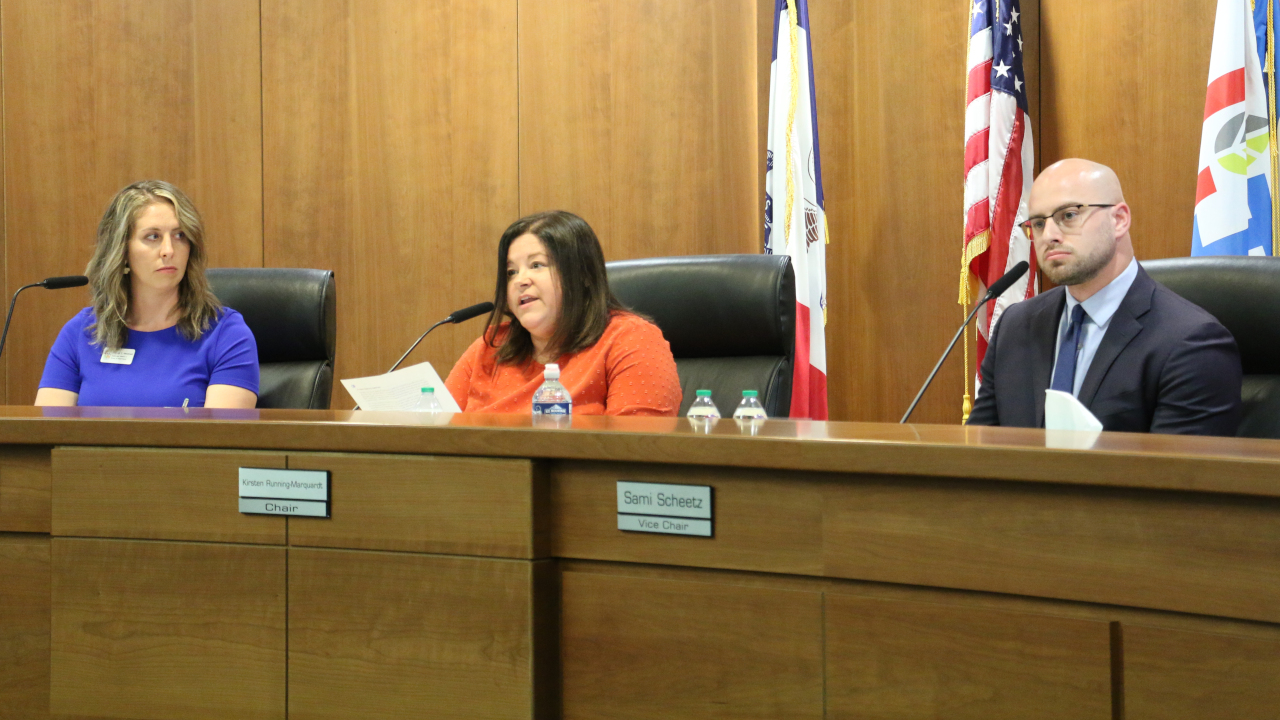
Board of supervisors chair Kirsten Running-Marquardt opened the meeting – which drew more than 100 attendees, filling the formal board room and spilling into three overflow rooms – by indicating it was not a formal public hearing and that no decisions would be made.
Despite that context, the majority of public speakers at Wednesday’s meeting focused on the proposed Alliant Energy gas-fired power plant and their opposition to it – highlighting intense community concern about the project’s potential health and environmental impacts.
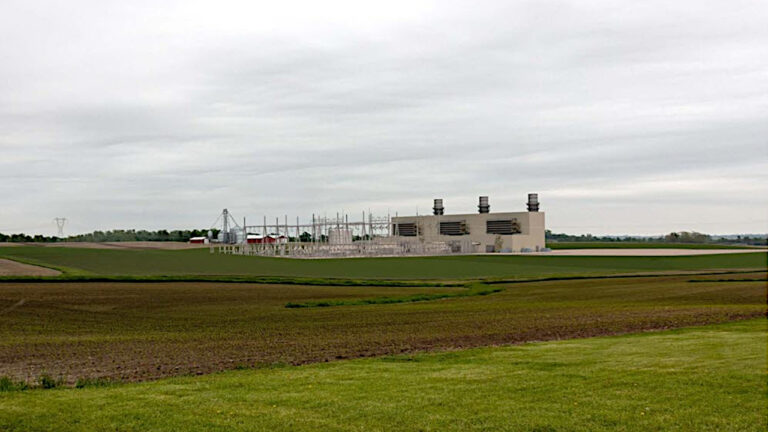
Alliant is proposing to build the Morgan Valley Energy Center on a 160-acre site in rural western Linn County, near the intersection of Highway 30 and Linn-Benton Road. The facility would consist of three simple-cycle natural gas turbines generating a combined 720 megawatts of electricity.
Ms. Running-Marquardt outlined three distinct regulatory processes the project must navigate.
The first is the air quality permitting process, which is approximately 80% complete at the application stage and is being reviewed jointly by Linn County Public Health and the Iowa DNR under the federal Prevention of Significant Deterioration (PSD) program.
The second is an application process for a generating certificate from the Iowa Utilities Commission, and the third is a rezoning application that would come before the Linn County Board of Supervisors — an application Alliant has not yet filed.
The PSD and Title V permitting process
Linn County Public Health Director Dr. Pramod Dwivedi and Air Quality Branch Supervisor Wanda Reiter Kintz walked through the permitting framework in detail.
Because of the proposed Morgan Valley project’s scale, it requires a Title V air quality permit as mandated by the Clean Air Act, a comprehensive set of guidelines that consolidates all of a major industrial facility’s air pollution requirements into one place.
Mr. Dwivedi and Ms. Reiter Kintz noted that Prevention of Significant Deterioration, or PSD, is a federal pre-construction permitting program under the Clean Air Act that applies to new or modified major sources of air pollution in areas already meeting national air quality standards. It requires engineering analysis, EPA-approved air dispersion modeling to evaluate worst-case scenarios, and a review of Best Available Control Technology to minimize emissions.
A public comment period is required before a permit decision is made.
Ms. Reiter Kintz described Linn County Public Health’s role in that process.
“Linn County Public Health serves as a local air pollution control authority, conducting technical reviews, issuing permits within our jurisdiction, and overseeing compliance and enforcement activities,” she said.
She noted that the Iowa DNR is the final permitting authority on PSD projects, while Linn County operates under “concurrent authority” — functioning, in her words, “like a subcontractor” for the DNR.
The Iowa EPA also plays an oversight role in the process, Ms. Reiter Kintz said.
Ms. Reiter Kintz said Linn County is one of only two counties in Iowa with its own local air quality program and the only one with a PSD permitting program. She noted the county currently oversees 16 Title V facilities.
The permitting process includes a public comment period of at least 30 days on a draft permit.
Air dispersion modeling
Multiple speakers at Wednesday’s meeting said they were concerned about the air dispersion modeling methodology used to evaluate Title V proposals.
Ms. Reiter Kintz said the application currently before Linn County Public Health and the DNR is at the 80% draft stage, meaning the formal technical review process has not yet begun. She noted that the 80% figure refers to the completeness of the application submittal, not the progress of the county’s technical review.
Speakers raised concerns about Alliant’s choice of background air quality monitors for modeling purposes. Ms. Reiter Kintz explained that the monitoring choices are driven by regulatory requirements about comparability.
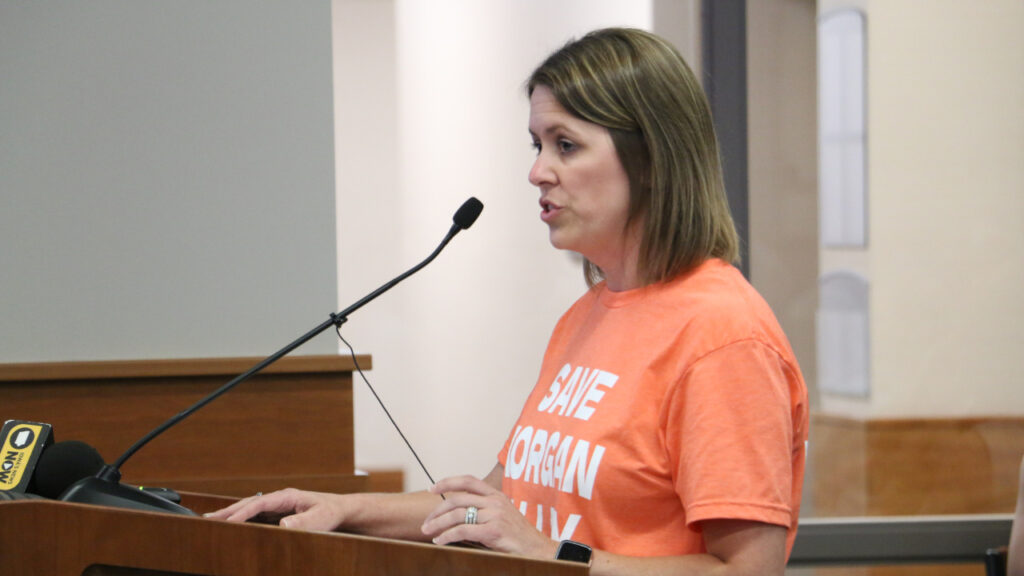
Resident Jon Lee, who lives about a half mile from the proposed plant, was among many speakers from Save Morgan Valley, a grassroots group opposed to Alliant’s plan.
Mr. Lee said he has conducted his own air monitoring near the proposed site. He said that the Morgan Valley floor runs approximately seven degrees colder than ground just 50 feet higher in elevation, suggesting that cold-air pooling and temperature inversions could trap pollutants at ground level.
He said fine particulate readings at his home already measure 7.4 micrograms per cubic meter, leaving a margin of only about 1.6 micrograms per cubic meter before reaching a federal annual average standard of 9 micrograms.
Save Morgan Valley member Jenny Ellison said that according to information from the Iowa DNR, Alliant’s draft modeling indicates pollution concentrations in the valley could run 10% to 20% percent higher than on flat ground.
Ms. Reiter Kintz confirmed that terrain and temperature inversions would be incorporated into the modeling under worst-case scenario assumptions, but said the modeling phase has not yet begun because a full application hasn’t yet been submitted.
Public health considerations

University of Iowa professor Peter Thorne, a former chair of the EPA Science Advisory Board, spoke at Wednesday’s meeting about the health impacts associated with the criteria pollutants a gas turbine plant would emit — primarily nitrogen oxides, carbon monoxide, ozone, and fine particulate matter.
He noted that the current federal standard for particulate matter – PM 2.5, for airborne particles measuring less than 2.5 micrometers – was recently tightened from 12 to 9 micrograms per cubic meter, in part because of evidence he and colleagues helped compile, showing elevated childhood asthma rates even at levels below 12.
“When you have exposure levels that are even in this range that we’re seeing in the national air quality standards, there still is an added risk to the public of childhood asthma — about 30% to 40% heightened risk,” Mr. Thorne said.
He noted that air pollution carries cardiovascular as well as respiratory risks, and that startup and shutdown cycles for gas turbines tend to produce pollution spikes.
Mr. Thorne also raised questions about Alliant’s use of a simple-cycle rather than combined-cycle turbine design for the Morgan Valley project.
He said combined-cycle plants recover waste heat to generate additional electricity, improving efficiency by 30% to 40% and producing correspondingly less pollution per unit of output.
“My view is that right away, simple-cycle as opposed to combined-cycle, you’re losing 30% efficiency,” he said. “So why would you do that?”
He acknowledged he had not reviewed Alliant’s formal application and was working from publicly available information.
Mr. Thorne also noted nocturnal noise as a health concern linked to stress, sleep disruption, and metabolic effects, noting it falls outside the Clean Air Act framework but warrants consideration in siting and permitting decisions.
Site-specific air monitoring
One of the most persistent questions from residents was whether Linn County Public Health would require Alliant to conduct pre-construction air monitoring at the actual site – specifically in the Morgan Valley area – rather than relying on distant reference monitors.
Ms. Reiter Kintz said the question of requiring site-specific monitoring could potentially be part of the formal permitting evaluation, but would require coordination with the DNR and likely the EPA as well.
Targeting a specific facility with a monitoring requirement could present legal issues, Ms. Reiter Kintz said. She noted that Linn County’s existing regulatory monitoring network does not include a site near the proposed plant location, and that adding a regulatory-grade PM 2.5 monitor would cost approximately $28,000 per unit – not counting staffing.
Ms. Running-Marquardt asked Alliant representative Ben Rogers – a former Linn County supervisor who attended Wednesday’s meeting – whether Alliant would voluntarily agree to site-specific air monitoring.
Mr. Rogers declined to answer at the meeting, saying he was taking notes on questions and would follow up with relevant stakeholders.
Compliance and enforcement
Ms. Reiter Kintz explained the ongoing compliance framework that would apply if an air quality permit was issued to an operating facility.
She said Title V facilities are required under federal regulations to undergo a full compliance evaluation every two years. Alliant would be required to conduct periodic stack emissions tests – at a frequency to be determined in the permitting process – and that Linn County staff directly observe approximately half of all required stack tests across the county’s facilities.
She also drew a distinction between emissions – what comes out of a smokestack, measured in tons per year – and ambient concentrations, the actual pollutant levels in the surrounding air as measured in micrograms per cubic meter. Compliance demonstrations focus on emissions, she said, while ambient monitoring is a separate system.
If a facility falls out of compliance, she said the county works with it to return to compliance before escalating to enforcement actions. Financial penalties for violations are possible, she added, but are not the first step.
Public comments
Most of the lengthy meeting consisted of comments from members of the public.
Michelle Lee, an oncology nurse who lives less than a mile from the proposed site, spoke about the limits of federal standards as health guarantees.
“A standard is a line drawn for an entire population,” she said. “It’s not a promise that a person living half a mile away won’t be harmed.”
Jon Lee framed the site-monitoring question in specific terms.
“What have you actually done to protect the people inside your box?:” he said. “Measure the air where we live before and after. That’s all we’ve ever asked.”
Children from the Morgan Valley also addressed the board.
“My community does not deserve to grow up like that,” one child said. “I’m 8 years old. I do not deserve to grow up like that.”
Abe Ellison, a Fairfax resident who said he has researched the regulatory record, raised the question of selective catalytic reduction technology, asking why readily available technology that can reduce nitrogen oxide emissions by approximately 90% is not being included in the proposal, and whether cost is the determining factor.
Dan Wozniak, a Fairfax city council member, questioned the logic of adding a new pollution source in a county that the American Lung Association grades as failing on ozone.
Ms. Reiter Kintz clarified that ozone and fine particulate days that have contributed to that grade are largely attributable to transported pollution, including wildfire smoke, rather than local industrial sources.
Mr. Wozniak also asked about formal mechanisms to ensure that affected municipalities, like Fairfax and Atkins, would have an opportunity to be heard alongside Alliant during the regulatory review process. That question was not fully resolved during the meeting.
Alliant’s participation
Mr. Rogers, senior community and public affairs specialist for Alliant Energy, spoke briefly but deferred most substantive questions for future response.
He said Alliant has not yet submitted a complete air permit application to Linn County Public Health for formal review, and said that on that basis, he declined to answer project-specific questions.
“This is not due to a lack of willingness to engage,” Mr. Rogers said. “We look forward to sharing modeling results once the application is complete.”
He noted that Alliant has previously answered technical questions about the project from community members in written filings in the Iowa Utilities Commission docket, and encouraged residents to review those materials online.
Mr. Rogers also confirmed that Alliant will hold public information sessions on the project on Thursday, July 30, at the IBEW Local 405 Hall at 1211 Wiley Boulevard SW in Cedar Rapids, with sessions from noon to 1:30 p.m. and 5 to 6:30 p.m.
Ms. Running-Marquardt directly posed several questions to Mr. Rogers, including whether Alliant would add a selective catalytic reduction system to reduce nitrogen oxide emissions, whether residential customers would be guaranteed not to bear the infrastructure costs associated with serving nearby data center projects, whether Alliant would pursue renewable power instead, and what is encompassed in what she described as “a six-phase development plan” referenced in prior conversations with Alliant.
Mr. Rogers declined to answer any of those questions at the meeting, saying he was there to take notes and would provide responses “at a more appropriate time.”
The Morgan Valley project is generally understood to be tied to surging electricity demand from large-scale QTS and Google data center developments in the Cedar Rapids area. Ms. Running-Marquardt said Alliant representatives had told her directly the plant is intended to power those data centers.
What’s next
Ms. Running-Marquardt said that questions posed at the meeting – including those Alliant declined to answer Wednesday – would be compiled and shared publicly on the Linn County website.
She said the board was committed to posting questions, answers, and unanswered questions in a single accessible location.
The formal technical review of the air quality permit application will begin once Alliant submits a complete application to Linn County Public Health and the Iowa DNR. That review will include air dispersion modeling, Best Available Control Technology (BACT) determinations, and a public comment period of at least 30 days on any draft permit.
Alliant’s IUC application process, and the eventual rezoning application to the Linn County Board of Supervisors, will offer additional opportunities for public participation.