
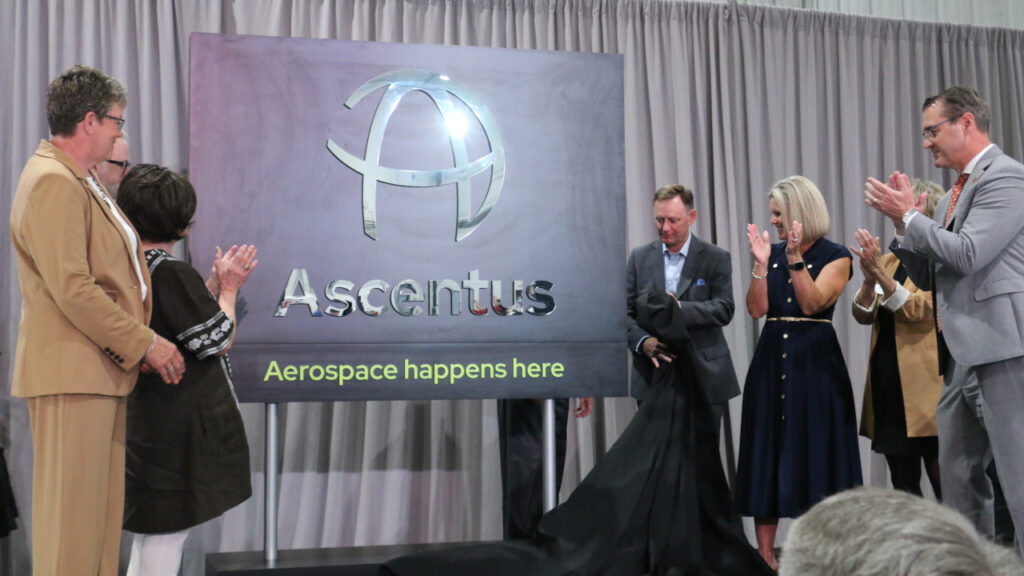
UPDATED: A pervasive spirit of alignment and optimism took flight at the Eastern Iowa Airport Wednesday, June 24, as airport officials, business and government leaders launched a new “Ascentus” branding and marketing initiative that will guide the ongoing development of an aerospace cluster at the airport.
The new initiative was announced as part of the “State of the Airport” event, traditionally held every two years to celebrate passenger traffic and air service milestones. But airport director Marty Lenss focused Wednesday’s event around a larger ambition: transforming the region’s aerospace heritage into a coordinated economic development strategy.
“Today is about new possibilities in our shared origin story of aerospace,” Mr. Lenss told about 300 attendees. “It is about something broader. It’s about how together we can build upon our aerospace origin story.”
The event drew representatives from city government, the Iowa Economic Development Authority (IEDA), the Cedar Rapids Airport Commission, Iowa State University, the University of Iowa, industry partners including Collins Aerospace and BAE Systems, and a range of smaller aerospace manufacturers and educational programs.
Foundation in Oliver Wyman study
The event’s announcement grew out of a study the Airport Commission pursued in partnership with the IEDA. The two organizations hired Oliver Wyman, a global aerospace and defense industry consultancy, to assess whether Eastern Iowa could credibly compete for aerospace investment at a national and global level.
Mr. Lenss summarized the study’s findings at Wednesday’s event.
“What we discovered confirmed what many of us have long suspected: Eastern Iowa and the state of Iowa already possess the foundational assets of a competitive ecosystem,” he said, citing workforce depth, world-class educational institutions, cutting-edge university research capabilities, and 1,500 acres of development-ready land adjacent to the airfield as the region’s core assets.
The market opportunity framing was central to the pitch.
“Our target sector industries in aerospace are expected to grow by over $130 billion over the next decade,” Mr. Lenss said. “The question is not whether the growth will occur, the question is where it will occur, and whether Iowa is prepared to compete for it.”
Ascentus branding
The main announcement was the unveiling of “Ascentus,” a new brand and platform designed to market the Eastern Iowa aerospace cluster to national and global prospects.
The name was chosen deliberately. Mr. Lenss explained that “ascent” signals elevation and capability, while the “us” embedded in the name “signifies in a subtle sort of way the partnership together.”
The tagline “Aerospace Happens Here” is intended to anchor a unified regional message, Mr. Lenss said.
A promotional video played during the unveiling positioned Ascentus as “not only a place but a powerhouse,” emphasizing the airport’s 1,500 development-ready acres in the CID SuperPark, university aerospace programs at both the University of Iowa and ISU, research capabilities with companies such as Collins Aerospace and BAE Systems, and what it described as a “pro-business partnership entirely committed to supporting accelerated decision-making.”
A dedicated Ascentus website is expected to launch in July, Mr. Lenss said, repackaging the existing CID SuperPark site under the new brand and incorporating brand strategy work developed in partnership with the state of Iowa.
Mr. Lenss used a temperature metaphor to describe the alignment goal.
“At 211 degrees, water is just hot. At 212 degrees, it boils and produces steam. Steam drives a locomotive,” he said. “I am confident, with one extra degree of effort around alignment, Iowa will move from good to great.”
City of Cedar Rapids
City Council member Ann Poe represented the municipal dimension of the partnership. Her remarks emphasized the city’s commitment to the campaign.
“The Cedar Rapids City Council is proud to stand alongside the Airport Commission and the State of Iowa in this work,” Ms. Poe said. “We are committed to deepening this partnership, supporting the strategic vision for the campus, and doing everything we can to attract new aerospace investment and innovation in our community.”
Iowa Economic Development Authority
IEDA Director Debi Durham traced the partnership’s origins to a failed aerospace recruitment effort, framing that loss as foundational rather than discouraging.
That effort was intended to attract JetZero, a company developing a revolutionary blended wing aircraft, to build a new production facility in Cedar Rapids. While the push fell short, Ms. Durham noted, it provided valuable context to the current campaign.
“We brought forward a shared vision for what Eastern Iowa could be,” Ms. Durham said. “And while we didn’t land the project, something important came out of it. It gave us a foundation and showed us what’s possible when we align our efforts, and it helps shape the momentum of what we’re celebrating here today … across the country and around the world, aerospace and defense companies are rethinking where they grow, looking for places with strong supply chains, available sites, and most importantly, talent — and that’s where Iowa stands out.”
Ms. Durham positioned Iowa’s manufacturing base – anchored by Collins Aerospace and BAE – as the natural foundation for aerospace cluster growth, and pointed to Kirkwood, Coe College, the University of Iowa, and ISU as providing the educational pipeline to underpin that ecosystem.
“We’re not starting from scratch,” she said. “We’re building from strength, and we’re doing it together.”
Cedar Rapids Airport Commission
Commission Chair Robin Therme highlighted the physical asset at the center of the strategy: the airport’s 1,500 acres of development-ready land, including parcels with direct airfield access.
“This type of asset is uncommon anywhere in our country, and it gives our region and the state a significant opportunity for long-term economic growth,” Ms. Therme said.
She noted that the land base was assembled through the foresight of previous commissioners, and that it includes property north of Wright Brothers Boulevard sufficient for a potential third runway, as well as sites appropriate for aerospace and defense business development – including maintenance, repair, and overhaul operations aligned with workforce training already underway at Kirkwood and Indian Hills Community Colleges.
Iowa State University
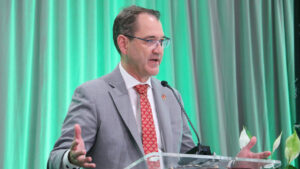
ISU President David Cook, who began his tenure on March 1, offered an enthusiastic endorsement of the project, as well as a concrete institutional commitment.
Mr. Cook highlighted ISU’s aerospace engineering program – one of the largest in the country, with more than 1,000 undergraduates – and its track record of producing industry leadership at companies including Boeing, Lockheed Martin, and Raytheon (the parent company of Collins Aerospace).
He also stressed his longtime personal commitment to retaining the state’s young people by nurturing career opportunities.
“How do we keep our graduates, our four-year graduates in the state of Iowa?” Mr. Cook said. “We have the talent, we have the work ethic – and now together we’re creating those opportunities.”
He outlined four specific areas of ISU’s contribution: preparing the next generation of aerospace engineers; advancing research connected directly to industry-defined needs; expanding opportunities through ISU’s role as the lead institution of the NASA Iowa Space Grant Consortium; and leveraging Iowa State Extension’s county-by-county presence to support K-12 pathway development.
“Please know we’re ready to do our part,” Mr. Cook said. “We are all in at Iowa State.”
University of Iowa
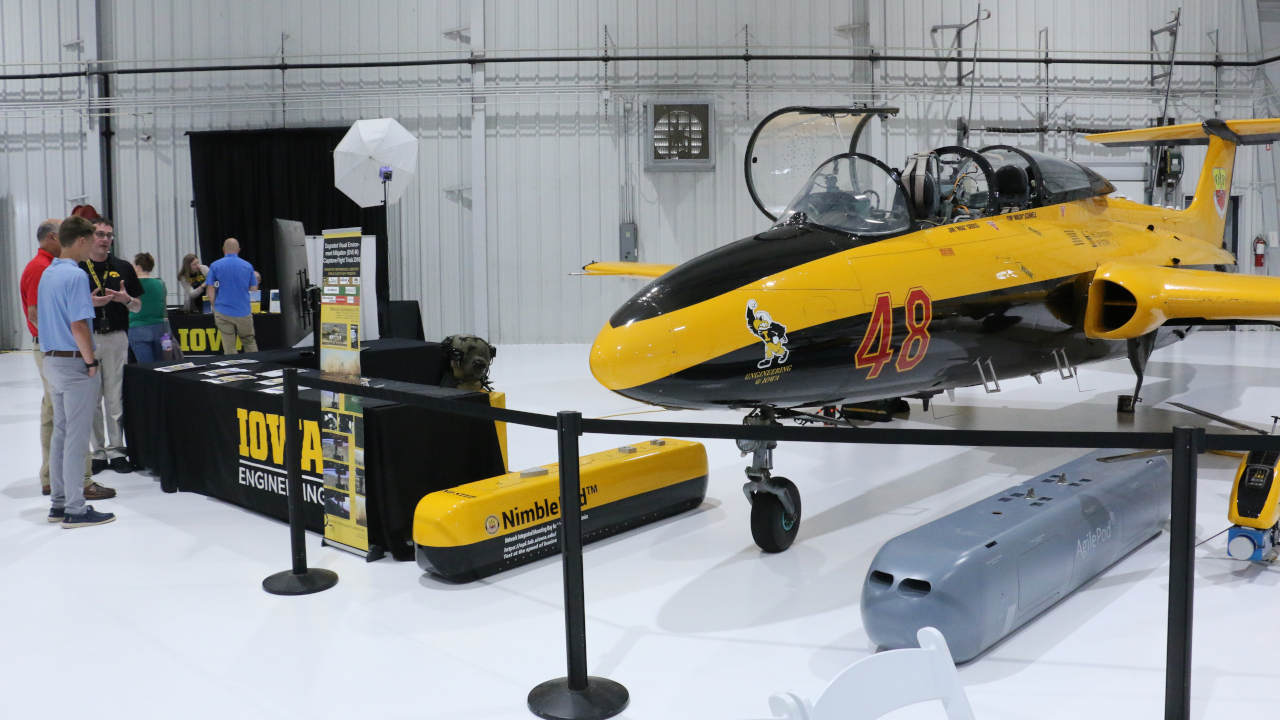
Associate Provost Barry Thomas offered a parallel commitment from the University of Iowa, referencing the institution’s long aerospace research history – particularly the legacy of physicist James Van Allen, whose discovery of Earth’s radiation belts established Iowa as a center for space science.
Mr. Thomas highlighted two active research programs at the University of Iowa.
The Operator Performance Laboratory (OPL), based at the Iowa City Airport, has partnered for more than two decades with government agencies, industry, and the military to advance safety, performance, and autonomous flight technologies.
And The Iowa Space Flight Laboratory in Van Allen Hall provides an integrated environment for designing, building, testing, and integrating space flight instruments, supporting projects from satellite missions to commercial aerospace.
“What excites me most about this opportunity here today is that it’s not happening in isolation,” Mr. Thomas said. “This opportunity we have today depends on partnerships – partnerships between universities, airports, industry, economic development agencies, and government leaders, who all have a vision for growing Iowa’s aerospace ecosystem.”
Mr. Thomas also offered a personal note, telling the audience that his oldest son is beginning aerospace engineering studies at Iowa State – a point he used to underscore what the initiative means at the individual level.
“We are creating more opportunities for young people like him to be able to continue to pursue their passions here at home in the state of Iowa,” he said.
Existing workforce and education infrastructure
Mr. Lenss detailed the college programs already operational at the Eastern Iowa Airport. Kirkwood Community College’s Aviation Maintenance Technology program is entering its fourth year, with a consistent waiting list. Coe College completed its first full year of aviation management and flight school operations, with enrollment strong enough that the flight school is relocating into a larger airport hangar to accommodate additional aircraft.
And Executive Aero recently held a ribbon cutting for Iowa’s first and only Cirrus-certified flight training center at the airport’s Signature Aviation facility.
Mr. Lenss also pointed to smaller Iowa-based companies as proof of concept for the broader ecosystem. As one example, he called out Stuke Iowa, a ten-employee manufacturer in Houghton, Iowa, that produces extruded, injection-molded, and 3D-printed aircraft interior parts for Boeing, Airbus, and Bombardier.
“Aerospace truly happens here,” he said.
Central theme of alignment
If the event had a single organizing principle, it was alignment — a word Mr. Lenss, Ms. Durham, Ms. Therme, Mr. Cook and Mr. Thomas all mentioned independently.
The “Ascentus brand,” they said, is explicitly designed to serve as the vessel for that alignment: A shared platform around which educational institutions, industry partners, economic development organizations, and government entities can coordinate messaging, recruitment, and investment attraction.
“We are introducing a new platform for collaboration, growth, and investment,” Lenss said, “and a brand designed to showcase our strengths, elevate our region, and position Eastern Iowa and the state as a destination for aerospace innovation, investment, and opportunity.”
Mr. Lens also highlighted the sales tax exemption for aircraft parts and labor — passed by the Iowa Legislature in 2022 — as a major enabling condition, allowing Iowa to compete with the roughly 70% of U.S. states that already had such exemptions in place.
“We are taking the next step in transforming Iowa’s aerospace legacy into Iowa’s aerospace future,” he said.