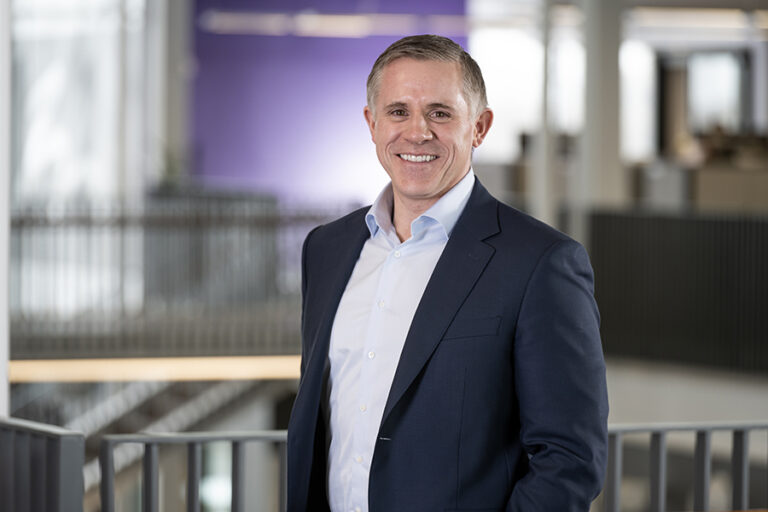

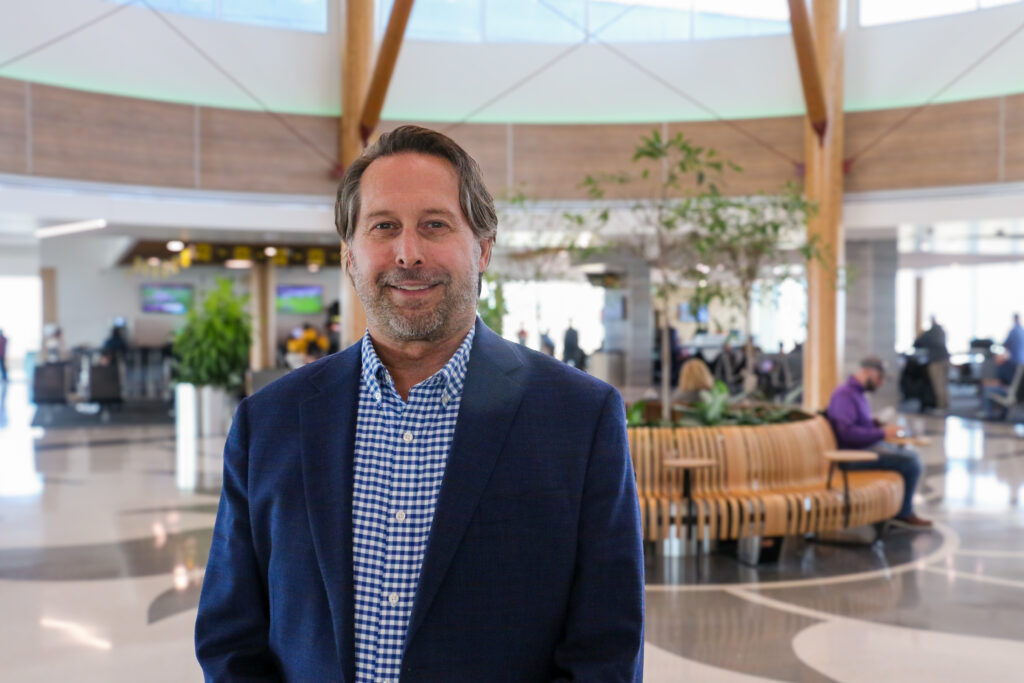
For Marty Lenss, the Corridor Business Journal’s Most Influential Leader for 2025, the passion for flight came at a relatively early age — in the eighth grade, to be exact.
“My interest in aviation would have occurred with my first real commercial flight,” Mr. Lenss said in an exclusive interview with the CBJ. “Many years ago, most kids didn’t go on airplane rides, at least not in my neighborhood.”
That first trip brought Mr. Lenss from his native Twin Cities to Newfoundland on a Northwest Airlines flight.
“I had gone to the airport maybe a hundred times, to pick up grandma or drop off my dad for a flight for work, back when you could meet family at the gate,” he said. “The terminal environment was fascinating to me. And it still is, in a geeky sort of way. Walking through a hub airport, looking at all the different gates and where people are going, I found it fascinating.
“There’s just a certain level of energy in a terminal, a lot of hustle and bustle, and a lot of emotion in a terminal,” he added. “People are going on a big business trip, maybe a big sales deal or an expansion of a company, or family members getting together that maybe haven’t seen each other for a while. But then there’s also funerals. That sort of mix in a terminal, for whatever reason, I have always found energizing.”
That energy inspired Mr. Lenss to pursue a degree in aviation from the University of North Dakota in Grand Forks, where he graduated in 1993 with a bachelor’s degree and a double major in airport administration and business management.
“I started out flying initially,” he said. “I have a private instrument (rating). If you know the joke — how do you know if someone’s a pilot? Just wait a while and they’ll tell you. So that’s what I thought I wanted to do back then. But pilot jobs weren’t quite like it is today, where there’s a shortage and it’s a fantastic career. Back when I was learning to fly, it just wasn’t that way. The pay wasn’t what it is today. Regional pilots were not paid well. All that has changed today.”
As a result, Mr. Lenss decided to pursue an aviation career path that would have a less “uncertain future” and switched his focus to aviation administration.
After graduation, Mr. Lenss then served an internship at the Minneapolis-St. Paul airport in the noise environmental department before taking his first “real job” with the Tulsa Airport Authority in Tulsa, Oklahoma — a role that combined airport management and law enforcement.
“I went through the peace officer academy for the state of Oklahoma, then did ‘ops and cops,’ as they called it back then,” he said.
Mr. Lenss was then hired in December 1995 as assistant airport director at the Cheyenne Regional Airport, where he fondly remembers working for mentor Jerry Olson.
“I just learned a ton from Jerry about small airport management and the entrepreneurial spirit, how to get the job done with not a lot of resources,” he said. “And Jerry was phenomenal in the grant arena.”
After Mr. Lenss and his wife Shona had their first child, Mr. Lenss said he and his family “had this desire to get back to the Midwest, so that our kids could know their cousins and their grandparents more than just a week a year.”
Mr. Lenss was then hired in December 2001 as director of operations and public safety at the Dane County Regional Airport in Madison, Wisconsin, where he worked for seven years before taking his first job as airport director in April 2008 at the Outagamie County Regional Airport in Appleton, Wisconsin. Then in May 2013, he moved to another role as executive director of the Rochester International Airport in Rochester, Minnesota.
That experience was unique, he said, because the Rochester airport is operated by the Rochester Airport Company, a wholly-owned subsidiary of the Mayo Clinic.
“That was unique in that it was a contract,” Mr. Lenss said. “The Mayo Brothers started the airport way back when, so I worked for the Mayo Clinic. They called it Mother Mayo in Rochester for a reason.”
After spending nearly two years there, helping to “right the ship financially,” as he described it, Mr. Lenss received a call from a search firm regarding an opportunity in Eastern Iowa.
“I said honestly, I wasn’t looking, but maybe I am interested,” he said. “So I talked to my wife and thought, let’s just take a long weekend to Eastern Iowa. We’d never been here before. And we loved it. You often hear, just get the people here and it’ll sell itself. We’re a living testament to that. We went back and thought, if the kids are up for another move, we’ll throw the name in the hat. If they’re not (up for it), we’re not applying. At the time, (daughter) Megan was in high school, but she was up for it, and our son, Connor, was up for it, so we said all right, we’ll put our name in the hat and see where it goes.”
And in November 2014, Mr. Lenss was officially named as director of the Eastern Iowa Airport, which is owned by the City of Cedar Rapids and governed by the five-member Cedar Rapids Airport Commission.
In addition to his role as airport director, Mr. Lenss serves on the Large Investor Council for the Cedar Rapids Metro Economic Alliance and the Economic Development Innovation Council for Greater Iowa City, Inc. He is also Past-President of the Iowa Public Airports Association (IPAA), National Chair of the Air Service Committee for the American Association of Airport Executives (AAAE), and Board of Directors for the Great Lakes Chapter-AAAE.
This interview, presented here in a lightly-edited question-and-answer format, touched on a host of issues, from development of the airport and surrounding properties to the airport’s four-phase, $121 million terminal modernization project, operations during the COVID-19 pandemic, and how he’s navigated controversy and challenges.
CBJ: When you first started, what were the initial impressions of the airport itself? And what did you see as priorities for the operation as a whole?
Mr. Lenss: I guess the first couple things that stood out to me right away were a great team, financially very sound, a commission form of governance for the airport, (which) is phenomenal. Just great business leader support at the commission level. It’s been a who’s who in the community that has served on the commission over time. So that was exciting from a mentoring standpoint, challenging you to do more and better and push that envelope a little bit. That’s just a great setup, great community support across the region. I say the airport really has no ZIP code. We serve Eastern Iowa. That’s the name of the airport for a reason. We’re a Cedar Rapids airport, Iowa city’s airport, and points beyond. We have a lot of folks coming from border regions of Wisconsin, Illinois, really a broad swath. Thinking back now 11 years, what stood out to me is a lot of opportunity that’s not been tapped. And when I say opportunity, lots of land. The (CID) SuperPark (the airport-owned industrial park) had just been established for the property north of Wright Brothers. The airport has about 3,000 acres. A lot of opportunity on the physical land perspective for development.
CBJ: Go ahead and expand on that.
Mr. Lenss: Financially, (it offers) an ability to do some things creatively and also aggressively. I would say the culture was very conservative, which is good. You want to be good stewards of the public facility. But we spent some time trying to put our money to work for the community and for the airport and to grow the business. We’ve been very purposeful about that. We had some leadership changes. We had some changes on the management team. We got through that, and really have a fantastic team. We talk about small and mighty. I like to believe we do some things in a non-traditional sense. I think you had to have an entrepreneurial mindset at a smaller facility. I really credit Jerry Olson and that mentoring over the years to really foster that, because it’s hard for our size market to be completely reliant on air services. It’s a very dynamic environment. It can change quickly, for good or bad.
CBJ: You’ve had a lot of peripheral development. Some of the warehouse development. You have the SuperPark, and some of the other facilities that have been built on airport property.
Mr. Lenss: We certainly were underway with the terminal project when it first got started, with phase I. We’ve been at that now for a decade. That’ll wrap up, but that’s been very capital intensive. With long-term parking, we’ve maxed out our surface parking so that we can continue to manage growth as it comes on the passenger side.
We also spent a lot of time talking about de-conflicting different traffic types away from the terminal. Let’s keep commercial airline operations on an island, if you will. So that meant we moved UPS. We used to have that big cargo building right next to the terminal. Now you’ll see it’s gone. Part of that was to de-conflict dissimilar traffic. Air cargo and passenger traffic are very different operations.
So we built a new UPS facility. We created an air cargo complex down west of the airfield, right next to Fed-Ex. There’s more opportunity there. Ultimately, we’ll be moving DHL down there as well, so that all of our cargo operations will be in the same location. Similar operations situated together. That allows the community the opportunity to continue to grow the terminal without having adjacent airport operations that conflict.
And then, as part of that, probably eight years ago, we started talking about the need to put our region on the map for aerospace development. We’ve taken some big steps here recently to really move that forward, but going back eight years, what we needed to do is work with our airports in the state of Iowa through the Iowa Public Airports Association, IPAA. We needed to talk about improving the sales tax environment for aircraft maintenance as a first step. We referred to it as one of the first dominoes. It took about three years, but working collectively as airports, we were able to move the state of Iowa to tax-exempt status for aircraft parts and labor. Over 70% of the states in the U.S. have a tax exemption for aircraft parts and labor. Iowa did not, but all our bordering states essentially did. So Iowa was the hole of the doughnut, if you will. People that were having large maintenance needs would fly to Wisconsin or Illinois and have work done to save the 7% in sales tax. That single change at the legislature benefited every maintenance operation, from Davenport to Council Bluffs and everybody in between.
Then it was really working collectively with Coe College and Kirkwood, and having conversations about growing the workforce talent the industry needs. We have the land. Now we have the sales tax, if we can get the workforce being created here. Pilots and mechanics are going to be such a constraint on the industry. Industry will come to where the labor pool is at, (as opposed to) trying to get mechanics to move across the country. We have the land to develop right across the street.
Some things presented themselves. We developed that vision where hangar opportunities came available, and we were able to work with Kirkwood. They (wanted) to stand up a maintenance program. They did. We have them housed in a hangar right out here at the airport. The program’s (had) fantastic enrollment. It’s been full since the first day. They opened a big waiting list to get into the program. And then the hangar immediately adjacent to the Kirkwood hangar came available, and that’s where Coe has launched a four-year Aviation Management degree program with professional flight. Coe now has flight students training out of that hangar. Our FBO was right next to it, with a very large hangar that we were going to need at some point. So the airport commission built a new FBO on the west ramp over by FedEx and a new hangar. So we moved Signature (Aviation) over there.
It’s a fantastic facility. It represents our region really well for business decision makers that come to the community. We’re pretty proud of it. Now the old Signature hanger is available as part of what we’re coined as our aviation workforce education campus. Next to all of that was our administration building, part of this bigger campus vision. We vacated that building and moved into the terminal here as part of Phase IV of our terminal mod in June and July of this year. We felt like that building could be available for instructor offices or classroom space, any number of things to support aviation education. Immediately across the street was 40 acres that we had envisioned to be part of the airfield that hasn’t been, but it gives us an opportunity for shovel-ready aviation and industrial park development.
Coe launched the first year of flying this year. It’s off to a great start. We just had a family event, very well attended. Lots of positive energy and excitement. Some of the current Coe students helped talk about the program. When the students are there talking about what a great experience it’s been for them this first year, it kind of sells itself. They’re the biggest champions you can have, those students that are in it versus administrators trying to sell it.
Then this summer we put in a taxiway to open up that 40 acres that’s literally just north of Kirkwood and Coe. That taxiway is just finishing. It enables those 40 acres to be activated, so that we hope in the next 12 to 24 months we’ll have a hangar coming out of the ground that’ll put those students to work right here in our backyard.
So eventually, there’s a big circle. It could be pilots for that. Maybe it’s an airline. Maybe it’s pilots flying for that airline, and mechanics from Kirkwood working for that airline. Maybe it’s a corporation that’s doing the same maintenance.
Then also, as part of that workforce, we have been working with our area high schools. This year, Prairie High School announced an aviation maintenance program for freshmen for the very first time. It’s my understanding that program had over 50 students interested for 25 spots. So lots of interest. And then the Cedar Rapids School District, Jefferson High School specifically, is planning to have an aviation program as well, for maintenance, I believe. And hopefully other schools will come online. We’ve had conversations with the Iowa City School District, nothing formal. But that really is a fantastic feeder program, whether that’s Kirkwood or Coe. It’s really now for us to go out on the street to talk to airlines or a potential maintenance provider to say, hey, here’s our workforce. And it’s not just workforce at the community college level, it’s in the high schools, so you’ve got a pipeline of talent literally right across the street from where your facility could be located. We’ve had some really good conversations.
CBJ: You’ve been pursuing that maintenance facility for a while.
Mr. Lenss: Pre-COVID, yeah. If COVID hadn’t happened, we would have an airline facility. But COVID happened, and everything for everybody stopped.
CBJ: So it would have been a maintenance facility for one particular airline.
Mr. Lenss: Yes. Fantastic jobs first for folks.
CBJ: And the workforce would already be trained here.
Mr. Lenss: Still pursuing that. Not backing away from that. It feels a bit like we’ve just got to get that first win, and then more will happen.
CBJ: What you’re really talking about is diversification of what it means to be an airport, with all the education programs.
Mr. Lenss: Diversification is what the airport’s up to. About 80% to 84% of our revenue is airline derived. Cargo is about 8% of our revenue. For airline revenue, that’d be leasing space to the airlines, landing fees, the parking lot, rental cars, concessions, fueling. None of that happens without the airlines. So we need to diversify our revenue stream so we’re not as dependent on that, because maybe there’s a recession, and you feel it real quick. Air service ebbs and flows with the economy. So we want (to take) a longer view. The way we can do that is through our property. In a lot of ways, it’s very traditional economic development. It’s a little bit of chicken and egg. Do you have the workforce? That’s always a topic. Do you have the land? You can’t build it if you don’t have the land. You can’t build it if you don’t have the employees. I’ve heard it described as a candle burning at two ends. You’ve got to have the land and the workforce, and then you can go recruit. We have that today.
The most recent work we did with Oliver Wyman is really about activating an aerospace industry cluster of employment here at CID, utilizing the SuperPark land, this 40 acres I talked about, and really honing in on our best targets of opportunity for aerospace growth. When you look at this region, and you look at Iowa as a whole, there’s some rich history of aviation here that I think we can align differently than what we’ve ever done, and be far more powerful in our recruitment. You’ve got BAE, you’ve got Collins (Aerospace), MidAmerican (Aerospace). And then on the education side, you have the University of Iowa Operations Performance Lab down at the Iowa City airport, doing phenomenal cutting-edge research for aviation (for the) civilian and defense industry. You have the University of Iowa doing work in the satellite industry with components, ISU with aerospace engineering. You have a couple of maintenance programs out there, and we have our own now with Kirkwood and Coe, and their engineering and physics programs as well. So there’s a broader conversation for us in the workforce and education talent. Some of the highest concentration of aviation engineers are here.
CBJ: No secret there.
Mr. Lenss: There’s been stories written about brain drain. We have such a rich pool of engineers on the aerospace side that, if we had them widen the net of employers, the opportunity to keep those students here in our market is easier for everybody. More to come on that work. But that’s really helping us. That work was all about streamlining our focus, because the aerospace defense industry is a rather large industry. Where are our resources best spent? That’s what this study is telling us. Where are our strengths? Where are some things we need to plus up?
CBJ: You also started Wings2Water (a round-up initiative for airport travelers that funds water quality projects). You started the whole Fly Local initiative. What do you think are some of your more significant accomplishments among all of that? Would you care to prioritize them in any way, or are they all significant their own way?
Mr. Lenss: The Wings2Water initiative is part of our core values. Environmental stewardship is part of that. We sit on top of the Iowa and Cedar River watershed. We’re one of the largest farmers, if not the largest, in Linn County through leasing of our land. You’re hard-pressed to not see an article in Iowa about water quality, or lack thereof. So we decided to lean in on how we manage our farm operations.
That goes back to when Ron Corbett was mayor, and I remember having some breakfast meetings with Ron. He was really pushing us to be more aggressive in our water quality practices with the farms. It took some time to get there, but we’ve done that. But it also felt like for us as a team, there was more we could do and should do, even on site. We came across an article about a product the San Diego airport started called The Good Traveler, which is a carbon offsetting program. It had a model that caused the light bulbs to go off – we could emulate this or partner with them on water quality through a roundup platform and airport terminals.
We met with the folks that launched The Good Traveler at the San Diego airport, but there was no real interest to pull water quality into that. So we came back from that meeting and decided to just do it ourselves. Wings2Water now has a fantastic board. It’s a 501(c)(3) nonprofit, separate from the airport. The intent was that none of the monies raised at the airport would come back to the airport, that it would go to entities in the community doing water quality projects. A lot of entities out there are trying to do things, but there’s always a competition for capital, so this could help.
We launched that in 2019, right before COVID, and then COVID hit, and it kind of took a timeout. Post-COVID, we’ve really done a nice job as a nonprofit board to get the wheels on the bus, but they’re doing well, trying to sign up additional airports. There’s over 150 commercial service airports within the Mississippi watershed. So if we could sync up even 10% of those, you really could have a powerful tool for raising awareness of the issue within the watershed, and then also raising some funds.
CBJ: There aren’t many public facilities that would offer that opportunity.
Mr. Lenss: No. Not many public institutions want to put their foot in that water, so to speak. We just dove in. Water quality is not a red or a blue issue, it’s a real people issue, and it impacts everybody.
CBJ: We all use water.
Mr. Lenss: And there’s no mistaking we’ve got real issues. This was one non-confrontational way just to get more resources out there to get more work done. So that’s what Wings2Water is all about. Kudos to the commission (for allowing) staff the creative freedom to pursue that, and it changes the conversation in the region about the airport that little bit. There’s more affinity towards the airport with programs like that, when people see you’re active in your community. And it’s a different type of awareness, a different conversation, something different than (just being) a place to go from A to B. We are one of the largest economic drivers for the region on a consistent annual basis. It touches workforce recruitment. It touches (whether) our companies can expand or relocate. It helps us communicate a little bit broader about the impact of the airport than just A to B.
CBJ: There’s a figure out on the estimated economic impact.
Mr. Lenss: The state did a study, and we have our own. I would challenge the state study. I don’t think the state study was accurate.We tried to have that conversation with them, because we had done our own study ahead of time.
[NOTE: The CID study, completed in 2017, put the airport’s annual economic impact at $451 million. A 2022 study from the Iowa Department of Transportation reported the airport had an annual economic impact of just under $322 million. Mr. Lenss said he believes the current economic impact exceeds $500 million.]
CBJ: One of the things that comes out regularly is record air traffic numbers every month. One of the questions I had is this notion of competition between airports for airfare rates, that you could do better with air rates at Des Moines or Quad Cities, or wherever, than you could here. Has that changed? Is it more competitive now in terms of fares, or is it still a little bit of a dichotomy based on scale?
Mr. Lenss: I tell people often that if I could tell you exactly how air fares are set, I probably wouldn’t be here. I could predict airfares. But there’s a million factors that go into it. The good news for CID is there’s been considerable investment by the airlines into our community with additional frequencies, additional routes, and most importantly, more seats. We have a larger number of seat inventory than some of our competitors in the region. As a particular flight fills up – I believe it’s the Y fares, the cheap fares, if you will – those typically go first, and then the buckets of fares fill up accordingly. So if folks tend to see a higher fare here or someplace else, it’s almost always because that flight is probably near full.
CBJ: As seats are in higher demand, the prices go up.
Mr. Lenss: These are very sophisticated inventory control pricing models. As things fill up, prices change. It’s very dynamic.
CBJ: Even if a fare isn’t necessarily the least expensive here, people may have other factors that they take into consideration. You talk about flying local all the time, and it seems like people are taking that to heart. But regardless of whether it’s the cheapest or not, you’ve still set passenger records every month this year
Mr. Lenss: We’ve done well. That’s a testament to a couple things. It starts with the community and the region using the airport. (We) can’t grow air service if the community’s not using it, and our flights are 60% full, we don’t have much of a story to tell. The community’s got to use it.
CBJ: They’re significantly more than 60% full.
Mr. Lenss: We’ve been running anywhere from about 88% to 92% (full) across the board. That’s averaged out. Some flights are going to be more full than others. But when you’re that full, you tend to be spilling traffic to wherever. People have looked and the seat wasn’t available. And (with COVID), I think people realize their time is precious. When people say, ‘I’m driving to O’Hare for a nonstop,’ I’m out. That’s not a nonstop. You’re not driving for a nonstop. Your drive is your connect.
CBJ: You’ve gone on the road to get a direct flight.
Mr. Lenss: It blows my mind. You’re to drive to O’Hare, so you’ve probably got a 12-hour round trip, because you’re getting through security, you’ve got to park, or you stay at a hotel and (take) a shuttle bus. There’s 1,000% more hassle factor. So you just spent – call it 10 hours. You pick your number. That’s not nonstop. You can leave here (on) a one-stop to over 400 cities across the globe. No problem. 10 times less stress. Very convenient. Parking is convenient. Full service valet.
The nonstop is not a nonstop if you’re driving for four or five hours to get to your nonstop. To me, that’s a false notion.
I would challenge the business community more. It falls on our shoulders, because we all want quality of place. We all want great shopping, great amenities, that sort of thing, so that we as business employers can recruit more talent, grow our business, have a bigger economic impact. And if one of your primary drivers is the airport, and you’re not using it, then it has a direct relation to your ability to recruit.
CBJ: And airlines won’t bring new flights.
Mr. Lenss: We need a real community effort behind it. And it’s a hyper dynamic. It’s hyper competitive. Weather impacts us. It’s a challenge. You’re going to have challenges, whether it’s here, Atlanta, Heathrow or wherever. You’ve got mechanical objects flying through the sky. (There are) weather impacts, mechanical impacts, crews get sick, any number of things, but you’ve got to double down and use what we have so that it gets better for all of us.
CBJ: Do you want to talk at all about the Capital Improvement Project, the airport terminal project? It’s been a long time coming, and you’re nearing an end.
Mr. Lenss: We’ve been in some form of terminal construction for a decade, since I got here. The construction started my first spring here, when we started Phase I, which was the front of the terminal. Everything about the terminal has been touched, for the most part – new HVAC systems, new lighting systems, new facade. All the team is very proud of it. It represents the region really well. It’s a phenomenal first and last impression for visitors. Really just a great facility. The total project was 10 years, roughly $121 million project, and no bonds to do it. We paid cash as we went, and we were very aggressive in the grant arena to help us pay for it. It’s a combination of state, federal and local airport commission resources. No city dollars, no county dollars. We didn’t have to go ring the doorbell for a neighboring county and say, help us with $10 million or $20 million bucks to do this.
CBJ: Is that unusual in the airport industry? It seems like it would be.
Mr. Lenss: A lot of airports fund large projects like this with some level of debt, and the fact that we don’t have the debt really helps us be hyper competitive with rates and charges for the carriers, so that we don’t have trying to pay off debt and interest wrapped into rates and charges. So that’s helpful. And we’ve been pretty deliberate to try to bring in, in little ways, why we all love working and playing here in Eastern Iowa.
You see that with the High Porch restaurant. That name was actually Josh Schamberger’s idea. He mentioned the high porch, and I was still a novice Hawkeye. I didn’t know the High Porch was Hayden Fry’s autobiography. It was like, ‘oh, man, that’s genius. Do you care if I use that?’ He was like, ‘No, you can use it.’ So then we trademarked it. Hopefully sometime there’s an entrepreneur in Iowa City that wants to open up a High Porch bar, and we’ll franchise the name to them.
Those are just a sample of some of the ways we brought in the community…
The terminal has been a real fun project. It’s also 10 years of construction. I can only speak for myself, but I think our team is exhausted.
CBJ: It positions you well for probably the next 20 years.
Mr. Lenss: Easily. The checkpoints are built in a way that we can add additional screening as demand dictates. We have additional bridges now that we can add frequency. We’ve changed our technology backbone to include common use airline technology, so that any airline can operate off any gate. It’s just an icon on a computer screen. If it’s Delta, they touch the icon of Delta and the Delta reservation system is there. We have that at the ticket counters as well. That enables us to better utilize our square footage without having to grow square footage because airlines have proprietary systems. We said, now we’re going to do common use that allows us to grow without having to do bricks and mortar at some point. We could have to do more bricks and mortar, but we can really maximize the efficiency of the square footage because of the technology, which gets back to the commission really being good public stewards of the investment here.
We’ve got some work to do in the outbound baggage tunnel. If you check your bag at the ticket counters, we’ve got some work there, probably in the relatively near future. The volumes, particularly in the morning, stress our outbound baggage system. We may need to do some more back of house, where the tugs are picking bags up off belts, so customers wouldn’t see it. But our airline partners and their staff see and feel it. It can be pretty crowded back there in the morning. It definitely works. But we’re looking at that. We’re looking at plans for some growth there to alleviate some of the growing pains that we have.
And then looking down the road, we’ve got future work coming for roadways. We get pretty crowded now on the front curb. Of course, we’re phasing that as we go.
That ultimately leads us to a parking deck at some point. Parking decks are very expensive. I don’t think a lot of people fully appreciate how expensive they are. Vertical parking is roughly $45,000 a stall, which means $40 a day parking. And most Iowans would balk at that.
CBJ: People are used to paying that in big cities, but not around here.
Mr. Lenss: There’s other ways for us to plus up the experience with technology and parking. More to come on that. But we’re always looking for ways to make it (faster and more) convenient for the guest. We try to push as much as we can to their phone, because everybody travels with their phone.
CBJ: Let’s move on to some of the times when you’ve had to deal with controversy here. That’s happened recently with the whole issue with Alliant. How do you handle those kinds of things, and how do you approach public accountability and transparency when those things happen? There’ve been conflicts with government agencies, with a utility like Alliant. Those things are inevitable when you operate a large enterprise. How do you see your role in participating in that process?
Mr. Lenss: I think it starts long before the controversy. Being visible in the community, being active in the community in different ways, whether that’s on nonprofit boards, or going to a CBJ function and engaging with community members at both the south end and north end [of the Corridor]. I think it starts there, and I say that because that’s where you develop that network and the relationship. That doesn’t mean you’re not going to have what I call kerfuffles. But because you have a relationship, it’s not personal. I take the duty and the responsibility of a safe airport operation to heart. I have to be accountable to that and to the public. Does that mean I’ve got to have not so fun conversations from time to time? Absolutely. Does that sometimes spill into the public space? It has. Honestly, that’s never ideal. It just isn’t.
But you know, in this most recent scenario with the power plant, we had a timeline that was pretty tight that we had to react quickly. It’s changed. We’ve had some good conversations. It wasn’t a fun summer, but we’ve gotten to a much better place, I think, for the broader community, certainly for the traveling public and the users of the airport.
I take that seriously. I’m not going to be shy about that. I’ll be upfront about that with some things we’ve learned…
My takeaway in some of this – the idea of a third runway, for example, was a lot of discussion this summer. We could certainly have done a better job of keeping the discussion of the third runway more current, talking about it from time to time. Because what happens as communities, as our leadership at the airport has changed at times, or city staff, and you don’t talk about it because you’ve lost some institutional knowledge – maybe it’s retirements or whatever – people weren’t aware of it.
CBJ: Maybe that’s part of what happened with Fairfax?
Mr. Lenss: I think that’s part of that happened in Fairfax, for sure. It was “new.” It wasn’t, but it (seemed) new because maybe we weren’t communicating it like we should. I think that’s fair. It’s a fair criticism. So I think it’s important there. You can also probably never have too much collaboration. I think at some point you have to make decisions and move.
Committees work to a point. We’ve all been in committee meetings where you walk out and you’re like, ‘OK, who’s doing what? Great meeting. What are we doing?’ We often talk in the halls here to the airport and commission-wise, we’re going to do stuff. We’re not going to sit here and have a meeting for the sake of a meeting. The ball is going to move. Maybe we make a mistake, we back up, we learn, but we keep moving. We’re moving forward. We’re going to grow jobs, we’re going to grow the education footprint. We’re going to try to grow air service, more activity at this airport. That’s what we’re all about. And we’re going to do it safely, and we’re going to keep doing it. We’re not going to wait for it.
We’ve got to go get it at some level. We’re in a competitive environment. Private businesses are doing this every day. Being quasi-public, it’s maybe a little bit different for us, but I think it’s vitally important. Back to the transparency and the public side of this – we are accountable to the public. The public should know about some of these things, and we’ll talk about it in our commission meetings. It will be public.
I have a duty to the tenants on the airfield. They lease space from us. I see them on a regular basis. I have a personal responsibility of accountability to ensure that we have a safe airfield for them. I’m not going to shy away from that, and I want to be accountable to that. I want to be able, as I retire someday, to walk out and say, ‘make no mistake, I’m going to be the strongest advocate for this airport that this region has, because that’s what I’m paid to do.’ I take it seriously.
CBJ: You could probably do the job and not be as passionate about it.
Mr. Lenss: Maybe you could. I don’t know.
We also have a grant assurance requirement for our grants we receive to protect the airspace around the airport (with) compatible land use. There’s federal accountability there with every grant we take. If I’m lackadaisical about that, then what’s the commission going to be? What’s the staff going to be? What’s the city going to be? We have to be smart. It’s a challenge to thread that needle with compatible land use development, especially now when arguably the hottest property in this region is next to the airport.
CBJ: There’s some big money flowing in. And maybe more to come.
Mr. Lenss: I don’t have a problem being the lone voice in a crowded room saying, ‘hey, this is a bad idea.’
CBJ: You’ve probably been criticized by people at points for taking a certain stance.
Mr. Lenss: That usually happens when I’m not around. (laughs)
CBJ: Do you think there’s criticism that you’ve received that’s been unfair in any way, perceptions that maybe aren’t entirely appropriate for your role? Or is it fair game? People are very outspoken about how they feel about things like an airport and its director – ‘he’s ruffling too many feathers.’
Mr. Lenss: I may not like it at times. But I don’t know that it’s unfair. It’s just part of the job. I joke with peers – it’s like life in the frying pan. It’s what I signed up for. They certainly didn’t teach a lot of this in my Aviation Management 404 class. It just speaks to the need to have really good mentors as you’re growing in the business. And I thankfully was blessed with really good mentors that I watched manage through some of this stuff. If you’re going to grow the facility – if you’re brought in and the community wants the airport to grow, thrive, activate 1,000 acres for aerospace development – there’s going to be conflict. It just comes with the territory. I’d like to say it doesn’t bother me. But you’re human. It’s going to bother you. But at the same time, it’s also what I signed up for…
CBJ: And sometimes your solution is going to make somebody unhappy.
Mr. Lenss: It could.
CBJ: It’s often said in negotiations that (the resolution) is perfect if every side is not completely satisfied.
Mr. Lenss: I think there’s a lot of truth to that. In this region, there’s been disagreements, there’s been uncomfortableness. But I’ve never felt it shifting to a personal attack. We recognize each other’s role, we try to thread the needle. There’ve been hard conversations, there’ve been spirited discussions.
CBJ: What is your comfort level in your ability to deal with government agencies and government regulations? Is that something that you struggle with, or are you pretty much beholden to whatever they say?
Mr. Lenss: That’s a great question. With government regulations, you can say you’re beholden to just what they say. I mentored under somebody, Jerry Olson, that was famous for saying ‘Mortal man made the rule. Mortal man can change the rule.’ So if the rule doesn’t work, or maybe it’s simply dated, then change it. That’s kind of my philosophy. Just like the sales tax exemption. Our sales tax on aircraft, parts and labor was there seven years ago, and it’s not there now. Mortal man changed it, because it was not good. Maybe it was good at some point, but the industry had changed.
I say that, but I’m also keenly aware I have regulations that I have to abide by. I have to work within a government framework. FAA, TSA. There’s some rules there I may not like, but they serve a purpose. For every inspection we have as an airport, whether it’s FAA safety or TSA security, we strive to have a zero discrepancy inspection. That’s always our goal as a collective team. Do we always hit that? No, but we are very good at meeting those safety and security regs. When you get into development rules, development issues, where I spend a lot of my time with the federal side, there’s more flexibility within that. On the government rules and regulation side, oddly enough, I love that environment in a weird (way). I enjoy that, which is probably strange, because it’s such an inexact science at times.
Let me just put a bow on it in two halves. Absolutely, we comply. If there’s a new rule that comes out that we disagree with, they’re going to hear about it at the federal government. We’re going to work the process to have a more workable solution. Does that work every time? No. But when you get into how development works within the federal rules of an airport, it can be more nuanced. It’s not always as black and white as, say, FAA safety or TSA security.
But there’s an example of where rules were out, and we pushed it as a collective and as a commission, and I’m proud of it. When COVID first hit, we lost 97% of our traffic, so that’s important to have in context. Nobody knew really how serious it was going to be. How would we get people back to flying? We were wearing masks. We were doing temperature checks. There was all this conflicting information coming out of the government. Some businesses were open, some were closed. Work at home, stay at work. We were all over the place.
During that time, airports received a fair amount of recovery dollars. So we felt like we owed it to our collective team at the airport to leave nothing on the table, to make sure that customers coming through CID felt safe, that we were doing everything beyond just the six-foot apart, don’t stand so close to your neighbor. We needed to take it another step, and we instituted health screening before you went through TSA.
We had the federal government tell us at one point, yes, you can do it. Then they said, No, you can’t do it. They said we could, but (we couldn’t) use the federal money for it. Then they said you can…
The commission actually took the step of passing a resolution that if you were going to enter our sterile area, the area behind the security screening checkpoint, you were going to have to submit to a health screening.
I look back at that as an example of, when you talk federal rules and regs, we’re first going to look out for our community, our flyers, and do it in the safest, most practical manner, above all. It was not without controversy. I applaud Mercy Hospital for sticking with us. We learned a lot from it. I know there were passengers that reportedly had approached the checkpoint, saw the health screening, and then self-opted out. I’m not feeling good, I probably shouldn’t fly, went back to the ticket counter, self-disclosed and got rebooked for different flights.
CBJ: Mid-size airports like this have some unique challenges in the aviation landscape. You’re not a Dubuque that maybe has one commercial service. Waterloo is on a federal government subsidy. This is an airport that has numerous commercial (airlines), but not to the level of a large metro. Is there something unique about thed challenge of being in that middle ground that you have to address? You offer some of the same things that big airports do in a smaller package, but you can’t offer some of the amenities or the number of options.
Mr. Lenss: I think the challenge sometimes is (just) that. In some respects, we don’t have the resources to add the staff we would like to have. That’s maybe the first thing that comes to mind. We’re like in that tweener (space), kind of a bigger airport, but not quite there. We have some of the same physical pressures as a big airport with less resources. You have to be a little bit more creative to be efficient, and you also can’t be too comfortable with the service you have. It’s still very fragile, and that’s why the community and the region really needs to use it. A carrier could come and go. Carriers can come and go anywhere, really. In smaller markets, they tend to move in and out a little bit more. It’s a little more fragile ecosystem. You need to water it more, I suppose. But in watering that fragile ecosystem, that means we need to market to a broader region that we serve, which makes it a little bit more tenuous with neighbors that are trying to maybe hang on that one flight a day.
CBJ: Your primary region isn’t O’Hare, right? Your primary competition is Quad Cities and Des Moines, for the most part?
Mr. Lenss: It depends. Take DCA (Washington, D.C), for example. When we announced non-stop to DCA, that aircraft had to come out of another market somewhere in the country and be added here. It’s not like American took in 50 new airplanes, and they’re just calling people up. It doesn’t work that way. So in a sense, we compete for every small market out there in the country for service. You can boil it down to be a little bit more local, but, a lot of times that gets to be more about schedule than anything. But again, we can’t grow the market if the community is not using it. It’s kind of a cchicken-egg. The community’s got to use it. The business community’s got to use it. I’ve got to beat the drum. Most people don’t understand the dynamic nature of getting air service and keeping air service, how all that works.
CBJ: You’ve got the government as a stakeholder, you’ve got the airlines, you’ve got the passengers, you’ve got the Commission, the local community as a whole. And that’s not even considering the freight companies.
Mr. Lenss: 50% of the state’s cargo (comes through CID). It’s also what makes it fun. What’s intriguing on a personal level is with an airport this size is, you’re close enough to all of it, and you have a little bit of a hand in all of it. The larger you go, the more layered and more streamlined (it becomes). As an airport director, you get maybe a little bit further removed from some of the operations. Here, you’re still close enough to the operation, maybe not devery day, but close enough that you have a pretty good idea what’s going on.
CBJ: Maybe that’s how you end up being more influential, too, as you have your hand in so many different aspects.
Mr. Lenss: I’m sure some would rather I keep my hands out. (laughs).
CBJ: What do you anticipate the future of the airport being over the next decade or so? Can you anticipate where things are going to go? Do you just have to roll with the punches, or do you see directions? Do you see air passenger traffic continuing to increase? Do you see airlines continuing to be here, with consolidation in the industry?
Mr. Lenss: There’s obviously a lot of moving parts. I’d answer that, I suppose, by the different business segments that the airport has. On the passenger side, the community keeps using it. The airlines are investing. We see growth there. It’s slow growth, but a steady trendline, which is great, as long as the economy (and) our regional economy stays strong. The more business wins we have within the broader region, that’s great. Incremental traffic helps.
I think the air service side will stay pretty steady. We’ve had some really wonderful double-digit growth month over month, that kind of 10%, 12%, 13% growth that we’ve seen in recent months. I think ultimately, that’s going to slow down. I think 2% to 3% is what we see long-term. In some respects, that’s perfect. When you’re clipping along at 10%, 13%, 14% growth rates, it gets to be hard to keep up with. So I think that’s just going to naturally happen. We’ll settle in. And the facility is ready for that growth for the next 30-plus years.
Where I see real growth for us as a region is continuing to work that aerospace cluster for broader economic development that is ultimately vertical, that vertical construction here at the airport where we’re leasing land, the workforce campus that we’ve created is providing the workforce. I would like nothing better for Kirkwood to have to open a second or third class of (Airframe and Powerplant) students, because the demand in our park needs that. That would be exciting.
CBJ: Maybe that’s building new facilities.
Mr. Lenss: In the next 10 years, I think you’re going to see dirt moving north of Wright Brothers for the airport that will activate that property for aviation, and not where we’ve been in the past, where an RFI comes in for an economic development project, solar manufacturing or something. If it isn’t aviation, we’re not interested. We’re going to really focus on activating that land (for aviation). Over the next 10 years, you’ll see specific investment happening, and you will see infrastructure investments happening in that park to make it more appealing and to reduce the upfront cost for a developer.
You’ll start to see the framework of a bridge coming over Wright Brothers (Boulevard). I’d like to think the bridge will be (built) within 10 years, for a taxiway to connect the current airfield and the future expansion. We’re definitely going to make some infrastructure work there to make that bridge happen quicker, should we need it, because that’s a big-ticket item.
I think you’ll see some positive trends in aviation education, Coe’s program growth, more flight training, more airline – and aircraft in general – operation increasing here. A busier air traffic control tower would be good.
And then I think you’ll continue to see the commission, and the airport as a whole, make infrastructure investments pay as we go in a smart, thought-out step process. We would take debt out for the right project. And when I say the right project, it’s a project that has an income stream coming in that can service that debt. I’d be slow to do general purpose debt that we’re funding through general purpose revenue. Any debt I’d want to be tied to a project that’s paying that debt.
CBJ: One more question about the airlines themselves. Maybe it’s not something you can directly address, but airlines have had their financial pressures that they’ve been dealing with for several years now. Do you think that might end up trickling down to the number of airports (where) they can provide service? Do you see any more consolidation happening? There’s already been a lot. There’s three major airlines now in the U.S.
Mr. Lenss: You’re talking United, American and Delta.
CBJ: Would you (envision) a Spirit or a Jet Blue being consolidated at some point, or you think they’ll still be a role for them?
Mr. Lenss: There’s a lot of what I would call prognosticators in the industry. I think the majors are in a pretty good space. They’re powerful entities. You think of American, United, Delta, Southwest. There’s no secret, Spirit is in bankruptcy for the second time right now. I think there’s real challenges going forward for what used to be called the ultra low cost carrier sector, which would be Spirit, Frontier, Allegiant. Some of those carriers are better positioned than others from a balance sheet perspective and network. I think there’s some truth in what the prognosticators are saying, that there’ll be some changes in that space. That’s still to play out.
I don’t see any of that, at least in the near term, negatively impacting CID. I think in some respects, it’s going to make for a healthier industry. But time will tell. It’s one thing with this industry. New models will develop that we’re not even thinking about today. It’s just such a high barrier to entry. For a new player like Breeze and Avelo, the two newest airlines out there, it’s brutal. They’re still operating, for sure, but the competition is very intense. You have to be well-financed. Time will tell with them.