
The Cedar Rapids City Council voted this week to adopt a First Avenue East Corridor Redevelopment Plan, an amendment to the First Avenue East micro-area action Plan that’s designed to revitalize one of the city’s key corridors.
Noah Zeker, a planner with the city’s Community Development department, said the Redevelopment Plan began with the micro-area action plan adopted in February 2025.
That plan covers an area of just under 60 acres, bounded by A Avenue NE to the north, 17th Street to the east, Second Avenue SE to the south and 12th Street/Coe Road to the west.
Micro-area action plans are designed to “help the city prioritize public investment in a designated area” and “build engagement with community stakeholders: businesses, residents, and employers. Ultimately, the plans are designed to create a vision for the area with goals and action steps to reach that vision.”
The First Avenue East plan, touted as “a vision for a vibrant First Avenue commercial corridor,” was developed after a series of meetings with stakeholders and an open house in a process that began in May 2024.
It was spurred by three priorities in the area – pedestrian safety and unsanctioned First Avenue crossings; multiple business closings in recent years – included the closing of the Hy-Vee store on First Avenue in June 2024 – that have led to vacant storefronts; and barriers to walkability of the Wellington Heights and Mound View historic neighborhoods.
The Micro-Area Action Plan, which is presented in an extensive and interactive package on the city’s website, includes three main elements – Land Use, Connectivity and Placemaking – with associated goals and action steps, all intended to provide “a roadmap to support the future vision of the area through implementation of the plan.”
Mr. Zeker said the plan resulted in 16 action steps, nine of which are currently started or ongoing.
The redevelopment plan approved this week provides a visual description of the plan and the area’s potential, Mr. Zeker said. It addresses some of the key issues identified through the micro-area planning process, including:
- Long-term area divestiture along the corridor, and the need for a clear framework for reinvestment;
- The number of long-term vacant commercial spaces and the need to recruit businesses, working with a neighborhood-level task force focused on business attraction and retention; and
- Pedestrian safety, which emerged as a priority through both the micro-area plan and the redevelopment plan processes. The redevelopment plan explores potential streetscape and roadway designs to improve pedestrian safety.
“Redevelopment plans, at their core, illustrate what an area could become,” Mr. Zeker said. “They provide a shared vision for how underutilized properties and public right of way could evolve over time … (They) also help to build a shared community identity around a common vision for the future of the corridor.”
The plan focuses redevelopment along First Avenue, while pulling residents from the Wellington Heights and Mound View neighborhoods to shop on the corridor. It introduces a mix of building types, including mixed-use developments with housing and smaller commercial spaces, as well as larger, multi-family structures.
“These elements are intended to create a more walkable, active corridor that can support both new development and existing businesses over time,” Mr. Zeker said.
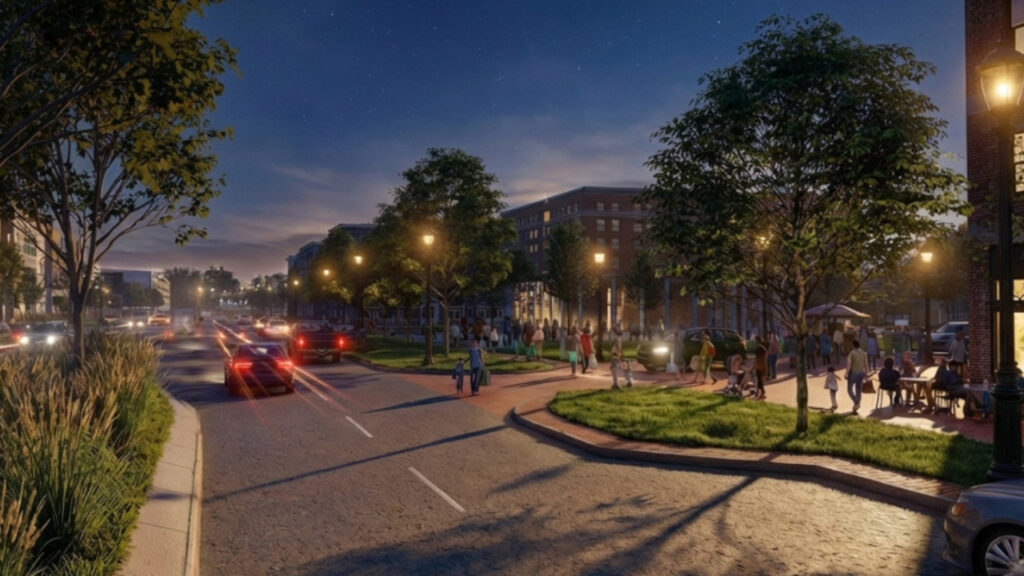
Renderings included with the plan show a redesigned First Avenue East with new trees, lighting, landscape medians, wider pedestrian areas and new pedestrian-oriented development, including “active sidewalks” and more comfortable spaces for visitors.
According to the redevelopment plan, residents consistently described First Avenue East as a corridor with strong potential and a strategic location, but struggling with blight, safety concerns, and underinvestment. Key themes included the need for safer pedestrian conditions, improved lighting and streetscape, support for locally owned businesses, and access to daily needs – most notably, a full-service grocery store to replace Hy-Vee.
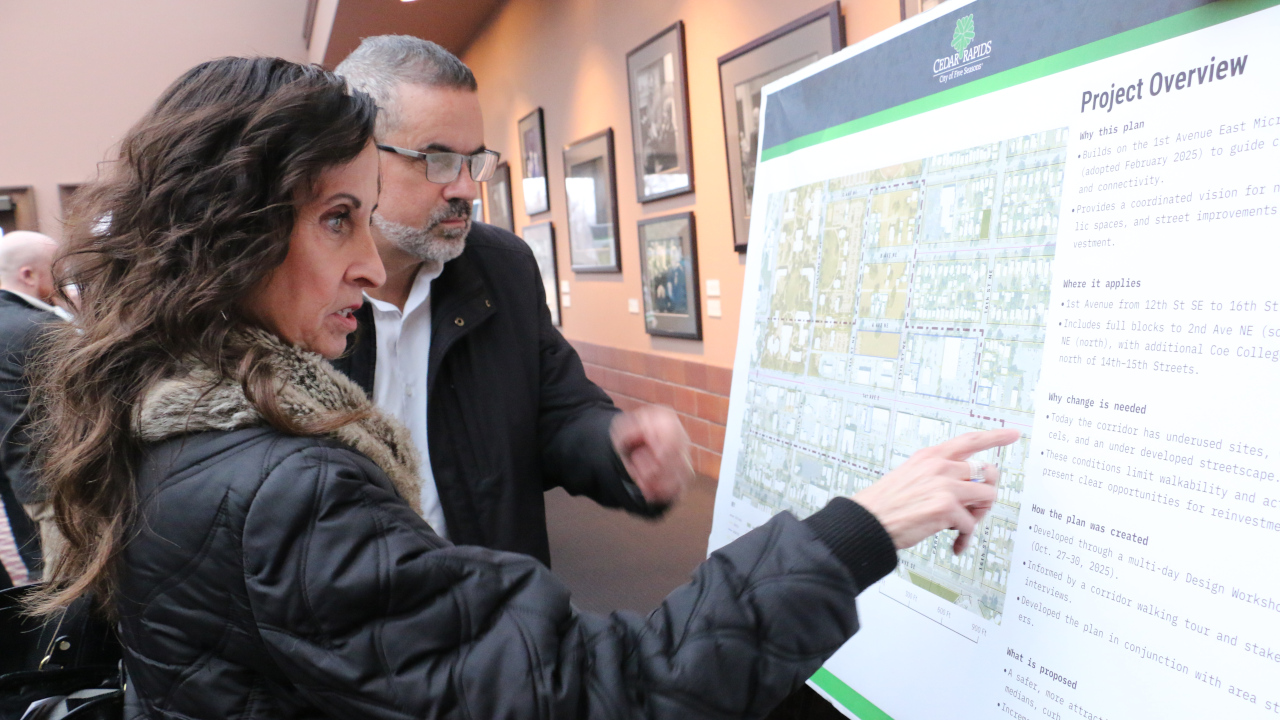
Dozens of area residents attended an open house on the plan Feb. 9 at Coe College. According to city officials, pedestrian safety and public realm improvements (sidewalks, lighting, landscaping, and gathering spaces) emerged as the strongest priorities from comments submitted by open house attendees. Safer crossings, reduced traffic speeds, street trees, and pedestrian amenities received the highest levels of support. Access to a full-service grocery store was also a clear and consistent community priority, city officials said.
Council members embraced the potential of the redevelopment plan.
“There is such a reimagining of this area, (and) this really helps to tell that story,” council member Ashley Vanorny said. “We know that First Avenue is a major thoroughfare here in Cedar Rapids. That’s not going to change at all with any of these plans, but I think bringing it up to speed, what it could be, and making it safer for pedestrians, which are so abundant there, is a huge intent on this, and I really appreciate that.”
“The reality is, we have to do something. There’s no way around it,” added council member Dale Todd. “If we don’t do something, it’s just going to continue to present itself as a blighted strip of disinvestment in the heart of our city.”
He also noted that while improvement plans have been launched for other parts of the city, including Cedar Lake and Wellington Heights, a targeted plan hasn’t previously been pursued for First Avenue East.
“One of the biggest challenges we come across, especially when recruiting businesses, they say, ‘what’s the plan?’ And to be quite honest, we haven’t had a plan,” Mr. Todd said. “We had a plan for NewBo, Czech Village, Time Check, every place else, but this is a nice plan. You’ve been able to put this together with significant community input and buy-in. Notice no one’s here at the meeting today telling us we shouldn’t do this. It’s ncredibly important to institutions like Coe (College) and others, (and) it builds on the framework of what you’ve done already. The Heights project won an award not too long ago. And there you’ve got the Medical District … You had a plan, and you made a commitment to get it done. I think it’s time for us to get this thing done.”
Extensive details on the First Avenue East Redevelopment Plan are available via an interactive online presentation developed by the city.