
The Fairfax City Council discussed a potential data center moratorium ordinance in the city limits Tuesday night, July 14 – but importantly, the moratorium was not approved by the council, and several procedural steps remain before the moratorium could be considered for approval.
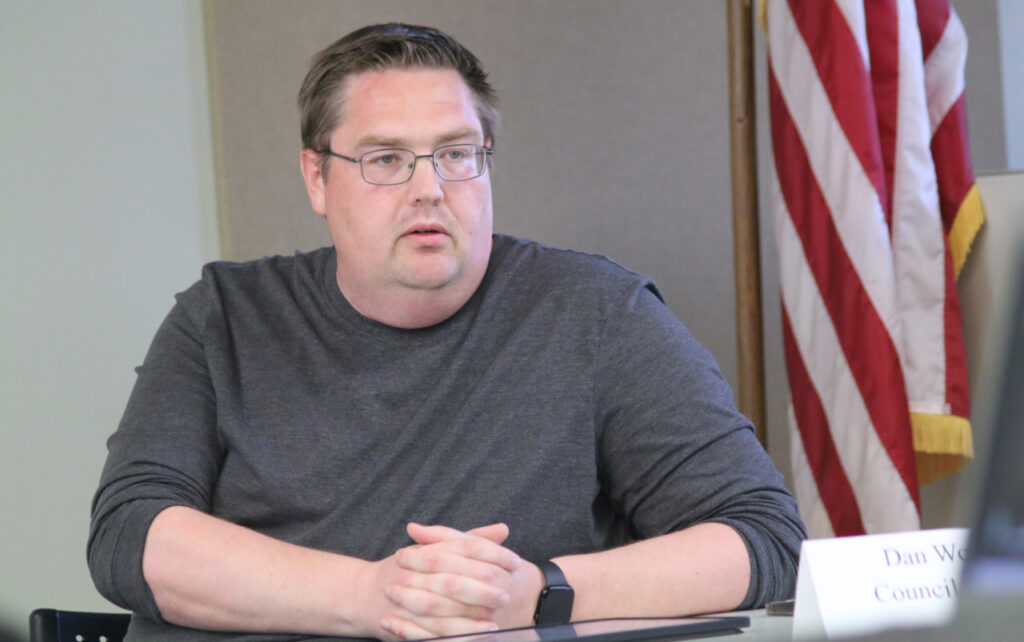
The ordinance, proposed by council member Dan Wozniak, would impose “a moratorium in high-impact data centers” within the Fairfax city limits. And unlike moratoriums passed for unincorporated Linn County and other jurisdictions around Iowa, the proposed ordinance does not include a specific end date.
“The moratorium shall remain in effect unless modified or repealed by a subsequent ordinance adopted by the City Council,” the ordinance states.
Mr. Wozniak clarified that point, indicating that the ordinance is “just saying this type of business, we’re putting a moratorium on, so we do more research. This one’s saying that when these items are proven out, whether it’s studies and impact, then it’s okay. That might be tomorrow. It might be 10 years from now. It’s not in our court. It’s in whatever prospective company wants to build.”
“This is structured a little differently than other moratoriums that you’ve seen,” he added. “That isn’t exactly a timetable per se, but more or less items or conditions that need to be solved before any potential [data center] business comes to Fairfax.”
Council member Deb Mallie asked if the moratorium ordinance should be reviewed by the city attorney, and Mr. Wozniak agreed that would be appropriate. “I would make a motion that the attorney reviews this, just like anything, because they have to defend it,” he said.
According to the ordinance, several criteria would be used define a “high-impact” data center, including:
- An anticipated electrical demand of 10 megawatts or more;
- A dedicated utility infrastructure, including electrical substations or transmission upgrades;
- A facility using industrial-scale cooling systems, including water-based cooling;
- Large-scale backup generation systems, including generators;
- Utility-scale operations characteristics “that materially exceed those normally associated with
- existing commercial or light industrial uses within the city”; and
- A determination that a facility will function as “utility-scale digital infrastructure, rather than a traditional commercial or light industrial use.”
City staff would determine if those criteria are applicable to any data center application, officials said.
“If a business approaches Fairfax, we have city staff reviews that say, does this actually fit within the definition? Do they satisfy all this?” Mr. Wozniak said. “If it’s yes, then it comes to the council. If no, then there’s items to fix and address. Either way, before anything happens, the council has to make a vote. Planning and zoning would have to get involved too, because we don’t have heavy industrial zoning anyway.”
Mayor Jo Ann Beer asked how a moratorium ordinance would impact the Planning and Zoning Department’s ongoing work on a data center zoning ordinance.

In response, Fairfax Planning and Zoning administrator Eric Von Sprecken detailed a separate, more comprehensive data center zoning ordinance for the city, which is still in progress:
He said the Fairfax ordinance uses Linn County’s data center ordinance as a base, but is being reworded to be “way more stringent” for Fairfax.
The Fairfax ordinance will addresses water runoff, power usage, stormwater collection, and ongoing performance standards, with efficiency, sound decibel levels, and water runoff control maintained over time.
Mr. Von Sprecken also said the ordinance will include third-party inspection accountability, calling that provision “a key one that a lot of people haven’t looked at.”
He said the ordinance will evaluate the power and water needs of an entire proposed complex, not just a single building, closing a potential loophole.
“If one needs… 10 megawatts, and that’s what they propose to the council, but they got five buildings – well, that’s a lot more than what we’re talking about,” Mr, Von Sprecken said.
The ordinance will apply to all data centers, not split into “large” and “small” categories, as Linn County’s ordinance does.
Mr. Von Sprecken also acknowledged data center technology is evolving quickly.
“By the time you write something in, it’s going to be changing,” he said. “We’re trying to think foresight as much as we can.”
No firm timeline was given to complete the zoning ordinance, but a first draft is expected to come to the council for consideration “pretty soon,” Mr. Von Sprecken said.
With that in mind, council member Mike Daly argued the council should wait for Planning & Zoning’s ordinance before acting on the moratorium proposal, noting the council has no pending data center applications to approve.
“I don’t see this council in any capacity approving a data center currently, so I don’t think we need to rush,” he said.
Mr. Von Sprecken said that acting without first establishing on-the-record work toward an ordinance could expose the city to legal risk if a developer submitted a project in the interim.
“If they present a project to us and we have not discussed or tried to entertain the idea on record that we’re trying to make an ordinance, that’s where you get a sticky situation, where we’re opened up for some lawsuits.”
The council voted 3-1, with Mr. Daly in opposition, to advance the moratorium ordinance for further consideration and potential amendments.
The council is next set to consider the moratorium ordinance at its regular meeting July 28, when a resolution will be on the agenda to set a date for a future public hearing and first consideration. That date would likely be sometime in August, based on the council’s current meeting calendar.
Fairfax’s data center discussions come in the wake of significant traffic strain in the city, tied to the QTS and Google data center campuses under construction in nearby Cedar Rapids.
Thousands of construction workers are working on the two sites daily, and many are using Fairfax streets to get to the sites.
KCRG-TV9 has reported that construction worker traffic “turned once-quiet streets into daily traffic nightmares for Fairfax residents,” with a special council work session hearing reports of speeding, near misses and thousands of extra vehicles on roads not built for them.
“We’re seeing a lot of the negatives, (and) we’re not seeing a lot of potential positives,” Mr. Wozniak said in the KCRG report.
READ THE PROPOSED FAIRFAX DATA CENTER MORATORIUM ORDINANCE: