
Iowa’s population grew in 2025, but the gains remain heavily concentrated in metro counties, while nonmetro and rural areas now rely almost entirely on international migration to sustain what growth they still have, according to a new report from the Common Sense Institute.
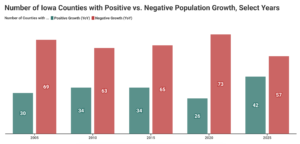
The report, “Iowa’s Demographic Lifeline: Immigration and the Rural-Urban Divide,” found the state added about 7,900 residents in 2025, a 0.25% growth rate — half the national rate. But only 42 of Iowa’s 99 counties gained population on net, while 57 lost residents.
Click here to read the full report
Three counties grew by 1% or more: Dallas County, 3.2%; Wayne County, 1.6%; and Warren County, 1.5%. Nine counties declined by at least 1%, led by Clay County at -1.9%, followed by Pocahontas, Louisa, Cherokee, Floyd, Franklin, Page, Humboldt and Kossuth.
Over the longer term, Iowa’s metro counties added 368,094 residents between 2001 and 2025, while nonmetro and rural counties combined lost approximately 109,000 — even as the state’s total population grew. Metro Iowa added residents every year of that 25-year span.
A majority of Iowa counties recorded more deaths than births in 2025. Even in metro counties, net births fell from a 2007 peak of 11,492 to about 4,400 in 2025, a 60.2% decline. Since 2022, international migration has been the only positive contributor to population change across nonmetro Iowa.
The report also found migrants moving into and out of metro Iowa differ economically: those leaving are more likely to be married, college-educated and employed, while those arriving are more likely to live in or near poverty. Nonmetro Iowa shows the opposite pattern — its in-migrants tend to be more economically established than those leaving, but too few move in to offset the outflow.
“Metropolitan Iowa continues to grow through births, domestic migration, and international migration, while much of nonmetro Iowa now depends almost entirely on international migration to sustain what little population growth it still has, if any,” said Ben Murrey, director of policy and research at Common Sense Institute, in a statement. “These trends highlight the demographic challenges facing Iowa and the importance of understanding not just whether the state is growing, but where that growth is occurring and the factors driving it.”