
If there were any previous questions about Linn County Board of Supervisors chair Kirsten Running-Marquardt’s position on Alliant Energy’s proposed Morgan Valley Energy Center northwest of Fairfax, she has now made her opinions on the project abundantly clear.
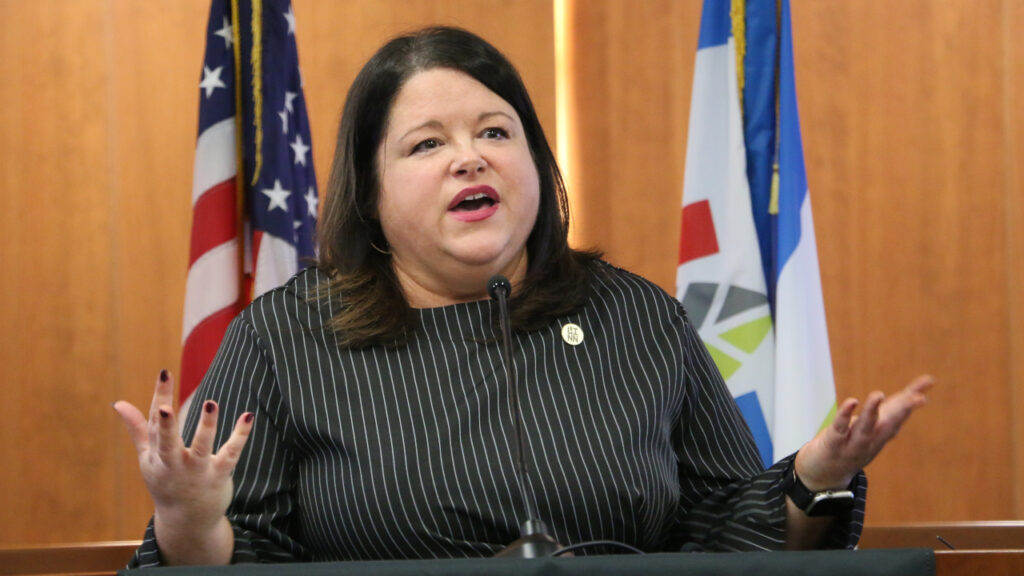
“Maybe if this power was needed for our residents, it would be easier for me to support this project,” Ms. Running-Marquardt said as she presented the annual State of Linn County address Thursday afternoon, June 11 at the Jean Oxley Public Service Center in Cedar Rapids. “But this gas plant, for me, has been a dedicated use only for providing power for the Google and QTS data centers currently under construction in southwest Cedar Rapids, benefiting and profiting only QTS, Google and Alliant.”
Alliant Energy representatives have said the proposed 720-megawatt natural gas-fired power plant off Highway 30, near the Linn-Benton county line, is needed “to support long‑term energy security and reliability for our customers,” not for any specific end user.
But Ms. Running-Marquardt, who emphasized she was only speaking for herself, not on behalf of fellow supervisors or the county as a whole, said she was personally told that the power from the plant “was to be for the data centers” and that any power for area residents would be a “Plan B.”
As a Title V facility under federal Clean Air Act regulations, the plant would qualify as a major source of criteria pollutants – including nitrogen oxides, carbon monoxide, sulfur dioxide, particulate matter, ozone and lead.
Ms. Running-Marquardt said project supporters’ comparison of emissions from the plant to car exhaust or lawn mower emissions are “menacing diversions at best, to reduce the impact of the tonnage of pollution that would be released long-term into our air.”
“Our people do not deserve to bear this great burden of pollution and costs the data centers and Alliant are putting on us, especially our most vulnerable populations,” she said.
She called on Alliant to add selective catalytic reduction technology to the facility, which she said could reduce nitrogen oxide emissions by up to 90%, and said that Alliant has declined to include it, citing cost.
She also said Alliant could have chosen a combined-cycle design rather than a single-cycle design – a design the company had proposed when it was considering siting the plant inside Fairfax city limits.
“If they are choosing their bottom line over people, Alliant still has time to choose to add a selective catalytic reduction technology for this plant,” she said. “I urge them to make this change.”
She estimated the plant would increase Linn County’s CO2 output by approximately 23%.
“I urge Alliant and Cedar Rapids, Google, and QTS data centers to do the right thing,” she said. “Now is the time where the data centers and Alliant can step up, be here, develop here, but do the right thing by our people. I have asked this privately multiple times, and now I plead publicly.”
Ms. Running-Marquardt also raised concerns about potential rate increases for residential customers to fund the proposed Morgan Valley plant, saying there is no guarantee Alliant will not pass costs to ratepayers.
Ms. Running-Marquardt outlined three parallel regulatory tracks for the Morgan Valley proposal: an air quality permitting process through the Linn County Public Health Department and the Iowa Department of Natural Resources; a rezoning application that will go before the Linn County Planning and Zoning Commission and ultimately the Board of Supervisors; and a separate Iowa Utilities Commission proceeding, which is already underway.
She said the Board of Supervisors has not yet received a formal rezoning application from Alliant, but said there would be multiple public input opportunities once that application arrives. She also announced a public meeting on the air quality permitting process scheduled for June 24 at 6 p.m. At that meeting, Linn County Public Health officials and a third-party professional will discuss the relationship between environmental conditions and public health.
Ms. Running-Marquardt raised a separate but related concern about transmission lines being built through Linn County by ITC to support the Cedar Rapids data center developments. She said the county has no authority over eminent domain or condemnation in unincorporated areas, limiting its role in such projects to road use agreements.
She said she recently learned that ITC signed a contract with the College Community School District to route 345-kilovolt transmission lines – capable of carrying up to 4,000 megawatts – directly over baseball and softball diamonds and between two schools on the district’s campus. “I just leave it with ITC and a data center representative to please find a different solution,” she said. “The lines are not up yet. Please move the lines away from going directly over the baseball fields, the softball fields, and in between schools.”
She said she is not objecting to the broader transmission network, only that specific section. “Move the lines away from our kids,” she said. “They can do this and still supply the data centers with the power they need.”
In her address, Ms. Running-Marquardt highlighted three zoning ordinances the board passed in the past year governing large-scale data centers, nuclear energy development, and gas-fired electric generating facilities in unincorporated Linn County.
She said the ordinances reflect a “community first” approach requiring public input, transparency on water use, noise, road impacts, emergency planning, and long-term community benefits.
She emphasized that no elected officials or county staff have signed NDAs in connection with any of the projects.
“We are not doing things behind closed doors,” she said.
Ms. Running-Marquardt referenced the nuclear zoning ordinance in the context of renewed interest in restarting the Duane Arnold Energy Center near Palo, saying the county’s framework recognizes federal authority over nuclear safety while preserving local land use responsibilities including infrastructure impacts, emergency response coordination, and long-term community planning.
She also cited the NextEra relationship as an example of a successful partnership.
“We took a regional approach, put people first, and have good partnerships with NextEra and others,” she said.
Ms. Running-Marquardt also addressed a number of other county issues during her speech, including the protection of water resources – which she described as “one of the most important long-term issues facing communities across Iowa – citing broad, multi-department collaboration involving Public Health, Conservation, Secondary Roads, the Iowa Geological Survey, the Iowa Flood Center, and six watershed management authorities — aimed at protecting drinking water, improving water quality, and reducing flood risk.
Other topics included public safety and mental health; homelessness; transportation; the county’s financial health; conservation efforts; and government modernization.
Ms. Running-Marquardt returned repeatedly throughout the address to a theme she said guided the county’s work across every department and every major decision of the past year: Putting community first while maintaining what she called a “balanced approach” to economic development.
“Economic development is critical for the county to move forward, (but) it must be done with a balanced approach,” she said early in the address, applying that approach explicitly to the Morgan Valley gas plant controversy, the data center transmission line dispute, and the county’s broader zoning work on energy infrastructure.
She emphasized that the two goals — growth and community protection — are not mutually exclusive.
“We will be pro-economic growth while putting our residents first. We can do both,” she said. “We can have smart economic development, smart growth, and put our people first. These major corporations can make a few changes that will have huge, long-lasting positive effects for our community.”