
Despite the objections of dozens of area property owners and the recommendation of the Planning and Zoning Commission, the Linn County Board of Supervisors voted 2-1 Monday morning, Feb. 9 to approve the first reading of a rezoning application for a new residential memory care facility near Toddville.
If approved in two subsequent readings at board meetings Feb. 11 and Feb. 18, the rezoning will mark the first time a multi-family rezoning application has been approved in Linn County, officials say.
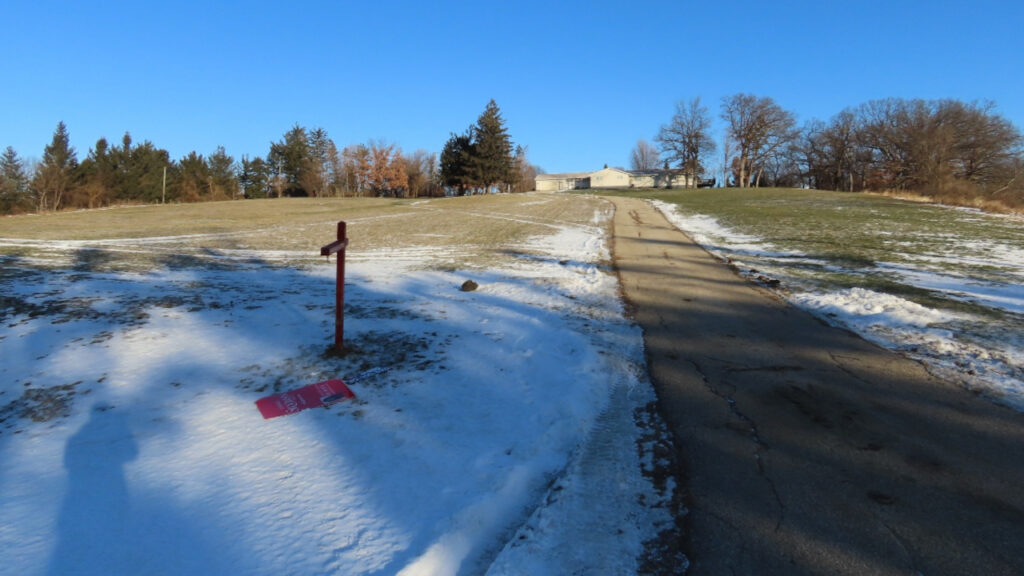
The proposal, submitted by Jerry Horak of Riverside, would bring a state-licensed residential memory care facility for dementia and Alzheimer’s disease patients to a 11.68-acre property at 3541 Todd Hills Road, an unincorporated area just north of Hiawatha.
As proposed, the project would remodel an existing home on the property, formerly occupied by Richard Rojek, who passed away in March 2025. A deck would be added, along with other modifications to protect the residents’ safety. The facility would accommodate up to 14 residents.
Natalie Ramirez, an architect representing Mr. Horak, said the facility would be operated as a franchise of an Omaha-based company, and would be the first of its kind in Iowa.
The county Planning and Zoning Commission had voted 3-2 Jan. 20 to recommend denial of the application, after hearing arguments from a number of neighboring residents that, despite county officials’ assertion to the contrary, the application comprised “spot zoning” for a business use and was incompatible with the surrounding residential neighborhoods.
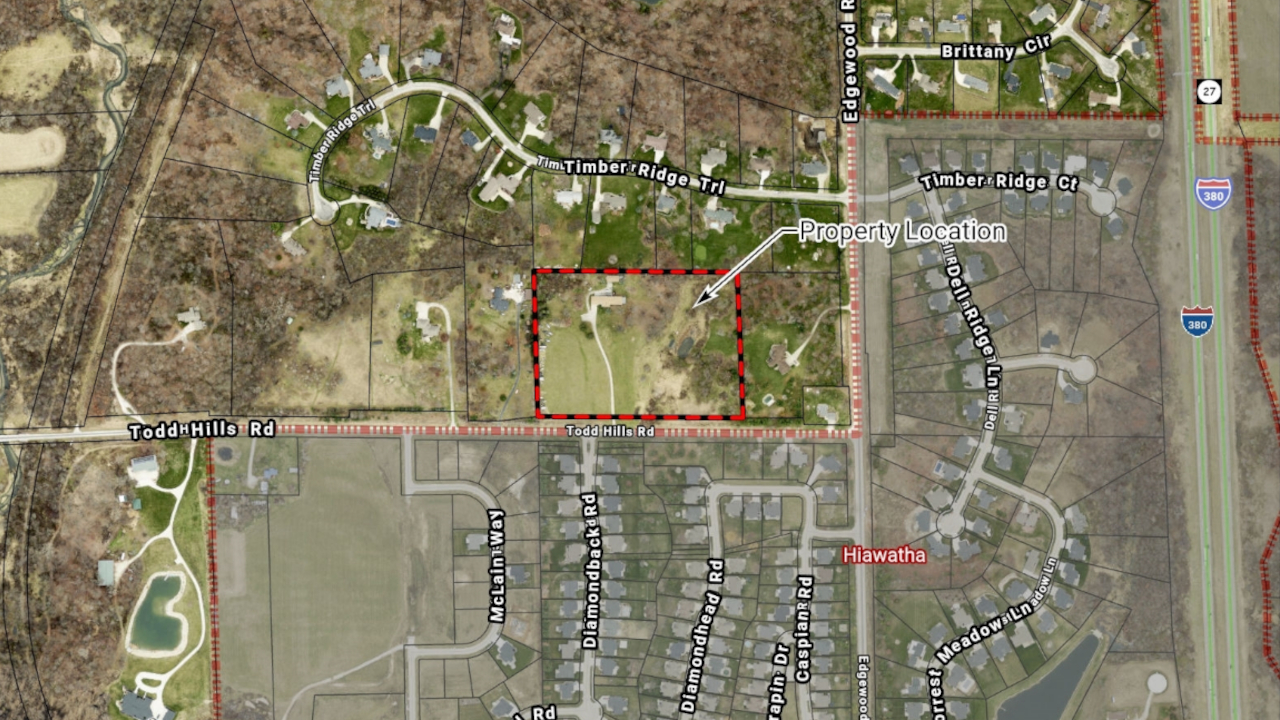
Brad Wylam, a planner with Linn County Planning & Development, said the application would rezone the property from its current Rural Residential 3-Acre (RR3) designation to an Urban Services Residential – Multi-Family (USRMF) designation, which would allow a memory care facility for eight or more residents under a conditional use permit. He noted that his department recommended approval of the rezoning request based on compatibility with county standards and a high score on the county’s Land Evaluation Site Assessment (LESA) standard.
A petition bearing 131 signatures was submitted to Linn County opposing the proposal, along with 22 emails in opposition.
Several residents spoke in person against the rezoning proposal at both the Planning and Zoning Commission and Board of Supervisors meetings. While not specifically objecting to the memory care facility, residents asserted that the zoning change amounted to “spot zoning” that could lead to other developments on the property in the future, from a larger memory care facility to multi-family housing – even the potential for other commercial developments.
“This property is not a new development,” said neighbor Brett Larson of Cedar Rapids. “It’s in an established neighborhood. Every homeowner here, including myself, purchased their property based on zoning that already existed around them. Changing zoning at this point undermines the very purpose of the planning and zoning.”
Another neighboring property owner, Lisa Halverson, said the applicants’ planned use was “immaterial” to what could happen with the property if the rezoning request was approved.
“There could be multi-family dwellings, which are apartments,” Ms. Halverson said. “There could be some single-family zero-lot-line townhouses. There can be two-family dwellings, like duplexes and condominiums, and community centers, and even, strangely enough, a bank, credit union, savings and loan, or a brokerage. None of those things are in alignment with the present single-family residential use in all the surrounding area.”
The future zoning of the property was also called into question.
Mr. Wylam said the project’s developers have reached an agreement to connect to Hiawatha’s water and sewer services, and have reached an “agreement in principle” for the property to be voluntarily annexed into the city of Hiawatha. While there’s no specific timetable for the annexation, he said he expected it could be completed “in the next couple of years,” pending approval from local and state agencies.
Supervisor Brandy Z. Meisheid opposed the rezoning proposal, citing concerns she shared with area residents about the potential future use of the property.
Supervisors Kirsten Running-Marquardt and Sami Scheetz voted in favor of the rezoning.
Ms. Running-Marquardt said that most recent Linn County rezoning applications are for “heavy industrial” projects with potential pollution and safety concerns.
Conversely, she said, the memory care facility “met the LESA scores. It is something that we don’t have to look at for diminished property values, nor the pollution and safety concerns that are absolutely serious with many other kinds of rezoning that are being brought forth to the county right now.”
Mr. Scheetz also said the project met Linn County’s rezoning standards, and noted that while this project doesn’t currently propose multi-family housing, it’s important for the county to consider the potential for those types of developments.
“If we say we’re a welcoming community that wants people to come here, we cannot be denying every single time we might have the possibility of affordable housing or multifamily housing at some point,” he said. “To be clear, the decision we’re making today is not for multifamily housing, it’s for a memory care facility that is going to help elderly residents of our county and our community in the later years of their life … (but) if we’re serious about welcoming people into our communities and about growth, we have to be serious when the pedal comes to the metal and making case-by-case decisions like this.”