
The University of Iowa has received nearly $1.5 million from the U.S. Department of Defense to expand its materials science center and explore new ways to use advanced materials in quantum technologies.
The $1,498,989 award, issued through the Department of Defense’s Air Force Office of Scientific Research, will bring together researchers in chemistry, engineering and physics to study how different materials can be combined to build light- and electronics-based quantum systems. The award was granted Sept. 9, 2025.
The project, titled Heterogeneous Nanoscale Materials Collaborative for Quantum Technologies at The University of Iowa, will be based at the university’s Materials Analysis, Testing, and Fabrication (MATFab) Facility. Created in 2019 by the Office of the Vice President for Research, MATFab centralizes the university’s micro- and nanofabrication research and is housed in 1,500 square feet of clean room space at the Iowa Advanced Technology Laboratories.
Potential applications of the research range from improved remote sensors capable of detecting toxins in drinking water to faster, higher-resolution mapping of battle spaces.
A significant portion of the funding will be used to purchase new fabrication equipment, including tools that allow researchers to pattern and etch materials and a printing system that enables materials to be layered or stacked to optimize their optical and electronic properties.
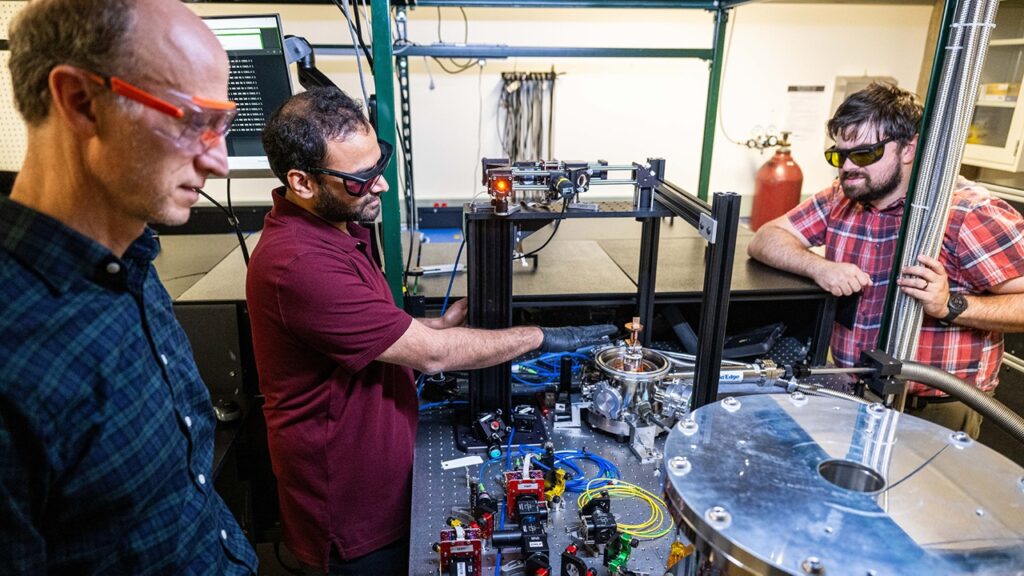
“We want to utilize the quantum mechanical properties of new materials,” said Ravitej Uppu, an assistant professor in the Department of Physics and Astronomy and a principal investigator on the award. “If we can harness these new materials, functionalize them, then we could make sensors that can achieve better image quality and better sensing performance.”
Aliasger Salem, associate vice president for research, said the award represents a major investment in the university’s research infrastructure.
“This award represents a transformative investment in Iowa’s capacity for advanced materials research and nanofabrication,” Mr. Salem said. “It enables MATFab to expand into emerging areas such as heterogeneous material integration and quantum device fabrication — fields critical to national competitiveness in defense and energy-efficient technologies.”
The new equipment will replace aging infrastructure at MATFab, according to Tori Forbes, a professor in the Department of Chemistry and the facility’s director since 2022.
“It’s been challenging to keep this aging equipment functional and enable faculty and students to conduct research in this area,” Ms. Forbes said. “This award will ensure that students can receive training on state-of-the-art equipment and faculty can continue to innovate.”
Among the planned purchases is a maskless grayscale lithography system that allows researchers to use a laser to create three-dimensional patterns at extremely small scales.
“It has a resolution down to 300 nanometers,” Mr. Uppu said. “That flexibility lets us fabricate everything from light-routing devices to tiny transistors relevant for quantum technologies in a university research setting.”
The expanded facility will be available to students and faculty across Iowa, as MATFab seeks to position itself as a regional innovation hub. Mr. Uppu said the university plans to host a summer school for students from regional colleges to train them on the new fabrication tools.
“That way, we create a new bridge between the universities to start thinking about potential collaborative projects. And naturally, MATFab becomes the central hub for that, because it hosts all the required facilities,” he said.
The other co-principal investigators on the project are John Prineas and Thomas Folland, both in the University of Iowa’s Department of Physics and Astronomy.