

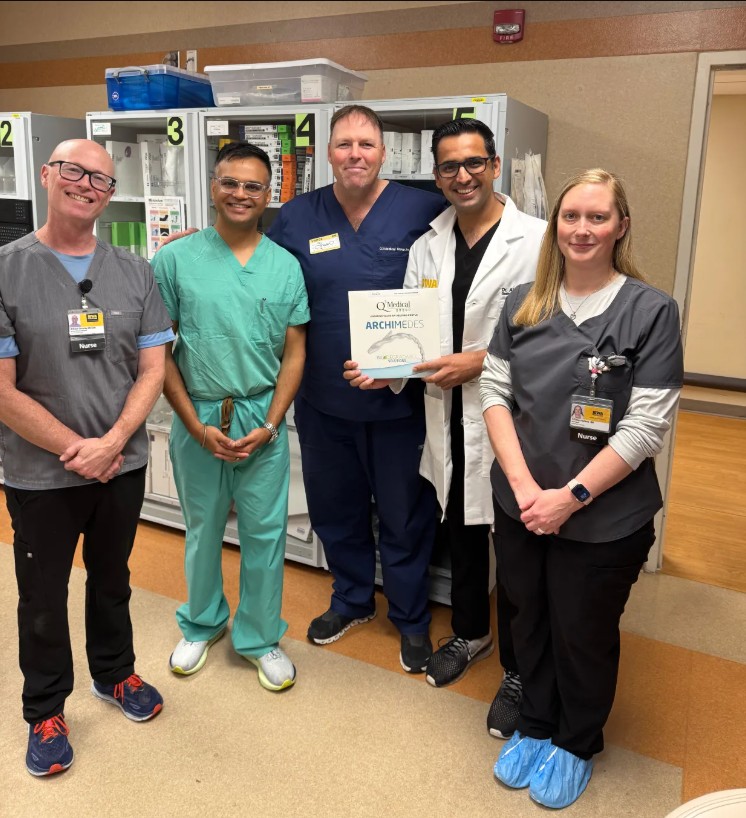
University of Iowa Health Care gastroenterologists performed the nation’s first procedure using a newly approved biodegradable pancreatic stent in December, marking a milestone in minimally invasive treatment for pancreatic disorders.
According to a blog post on UI Health Care’s website, Drs. Abdullah Abbasi, Munish Ashat and Rintaro Hashimoto completed the first U.S. procedure using ARCHIMEDES, a biodegradable pancreatic stent designed to reduce recovery time and eliminate the need for a follow-up removal procedure. The device was recently approved by the U.S. Food and Drug Administration for use in the United States.
Pancreatic stents are commonly used during endoscopic retrograde cholangiopancreatography, or ERCP, a procedure that diagnoses and treats problems in the bile and pancreatic ducts. Traditional stents, made of plastic or metal, require removal two to four weeks after insertion, creating additional cost, discomfort and risk of complications.
The ARCHIMEDES stent gradually dissolves inside the body, eliminating the need for a second procedure and reducing the risk of infection, according to the UI Health Care post.
“Most patients are able to leave the facility within 30 to 40 minutes and won’t feel the stent at all,” Dr. Ashat said. “By improving their recovery, we can reduce further discomfort and avoid complications.”
The first procedure using the ARCHIMEDES stent was performed in 2019 on a patient at the Chinese University of Hong Kong, Prince of Wales Hospital, according to NS Medical Devices.
Three different versions
ARCHIMEDES is available in three versions designed to degrade at different rates. The fast-degrading stent, which dissolves within 12 days, is currently the only version approved for use in the U.S.
Medium- and slow-degrading versions last approximately 20 days and up to 11 weeks, respectively. Future FDA approvals for those versions are anticipated.
In addition to clinical benefits, the biodegradable stent offers added convenience for patients, particularly those traveling long distances for care.
“In addition to eliminating multiple follow-up visits, biodegradable stents give patients the comfort of knowing they’re done after the first procedure,” Dr. Abbasi said. “Particularly for our rural patients, who sometimes drive hours to get to us, it can be a challenge to come back so soon after their procedure.”
Since becoming the first U.S. center to perform the procedure, UI Health Care has completed 11 successful cases using the ARCHIMEDES stent. Three additional medical centers across the country are planning to adopt the technology.
“We are constantly looking for and implementing new technologies to help us treat our patients — often the most complex patients in the state of Iowa,” Dr. Abbasi said. “We are pleased with the outcomes we’ve seen with ARCHIMEDES and look forward to expanding its use.”