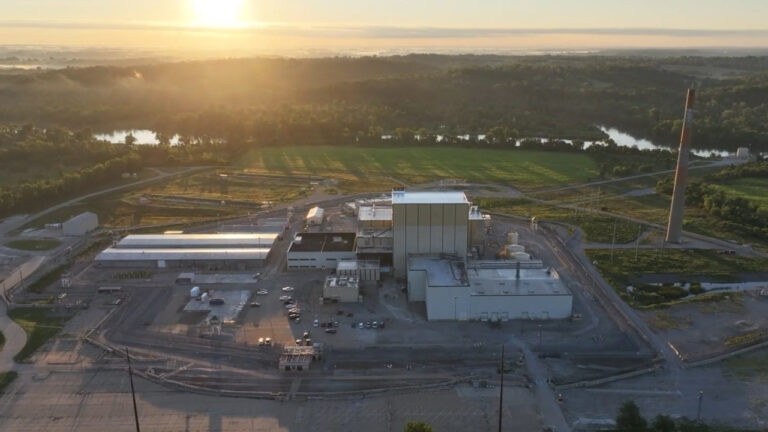

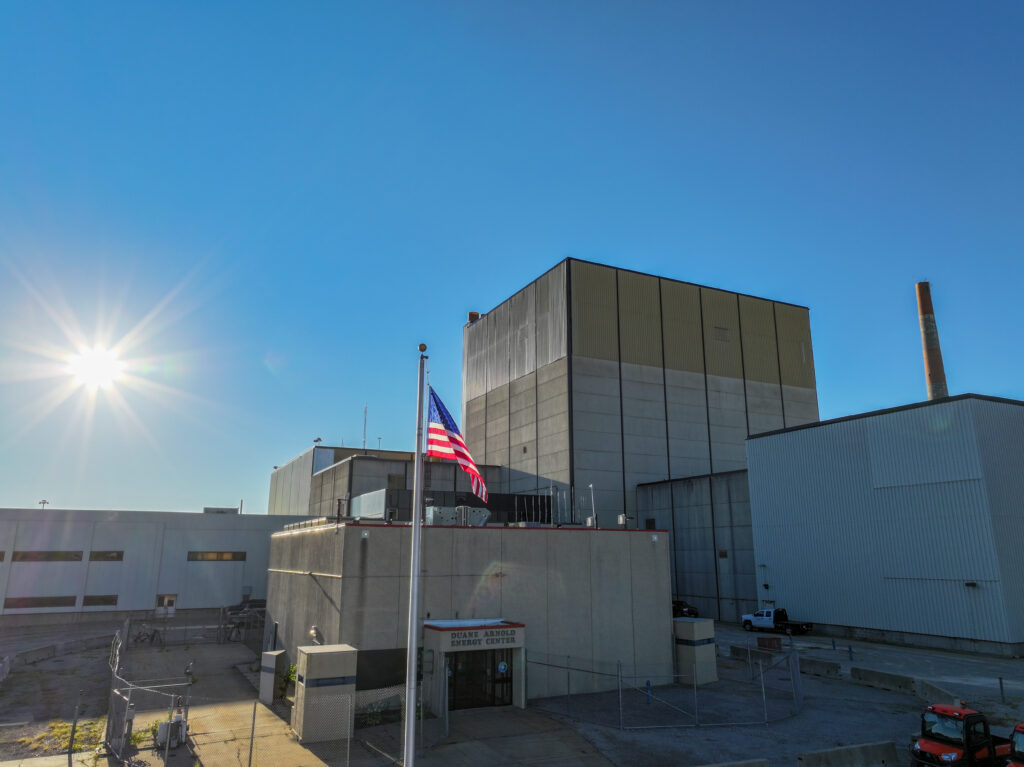
Before a packed house of local residents, business and industry leaders, the Linn County Board of Supervisors voted unanimously Monday morning, Jan. 5 to approve the first reading of a rezoning ordinance for the Duane Arnold Energy Center property.
If approved at two subsequent readings, including the second reading set for Wednesday, the rezoning would mark the latest local step in an extensive procedural process that could culminate in the restart of the Duane Arnold nuclear power plant near Palo, which was shut down in late 2020 after 45 years of continuous operation.
Several local residents and economic development officials spoke in favor of the rezoning during a public hearing Monday, saying the plant will help address a newfound surge in electrical demand driven by AI and data center developments and will generate hundreds of new jobs, both during construction of new facilities at the plant and the ongoing operation of the plant itself.
Google has signed an agreement with NextEra to purchase the majority of the power from a restarted Duane Arnold, spurring hopes that the plant’s restart will be approved.
The supervisors also heard details of a proposed memorandum of understanding with NextEra Energy, requiring the company to cover all costs incurred before the plant reopens, and a Host Community Agreement, which provides an annual payment of $1.9 million to Linn County, increased annually by 5%, and a section that requires NextEra to fully cover all costs in the event of an emergency response incident involving the plant.
“The host community agreement is essential to give local government communities a seat at the table when addressing nuclear power uses,” Linn County Planning and Development director Charlie Nichols said. “And I think that for nuclear power to have a resurgence in the U.S., local communities will need a seat at the table, and this is a good model for local communities.”
As he has in the past, Mr. Nichols pointed out that the rezoning, which is being proposed to comply with the county’s new exclusive-use zoning code for nuclear power facilities, is one of many steps that will be required on the local, state and federal level before the plant can be authorized to restart.
“This is the first step in a much longer process,” Mr. Nichols said. “Ultimately, the Nuclear Regulatory Commission makes a decision on whether or not this site can restart. And they are still in the early stages of reviewing the site and determining what needs to change for it to reopen and start generating power. That NRC review includes a safety analysis and reactor design approval, environmental review and licensing, radiological emergency planning, ongoing inspections and compliance. Indeed, (Duane Arnold) cannot restart operations until all these benchmarks have been met, and I would say that the lift for getting NRC approval is much higher than it is for the rezoning.”
Supervisor Sami Scheetz said the host community agreement, which will be formally considered by the board at its regular meeting Wednesday, is critically important for the local community as Duane Arnold moves closer to a restart.
“I think a lot of people have trepidation when we see this explosion of AI and everything that’s related to data centers, about the communities paying a price for that growth,” Mr. Scheetz said. “And I think what this agreement says to the residents of Linn County is we are not going to be paying the price for a company that’s worth hundreds of billions of dollars to come in and profit off of our community. The agreement that we’re going to be signing … is a demonstration to the people of Linn County that we are being responsible for taking our time, we’re thinking through the growth that AI is meaning is (bringing to) our community, and we’re going to make sure that our residents and taxpayers are not footing the bill for massive, massive profits for private companies.”
Supervisor Brandy Z. Meisheid agreed, saying the agreement brings the most possible fiscal protection for Linn County residents regarding a potential plant restart.
“There are still things that are regulated by the NRC that are beyond our control, but what we do have the ability to protect and the ability to set boundaries on and regulations on, we did everything that we could within our Linn County jurisdiction,” Ms. Meisheid said.
Supervisor Kirsten Running-Marquardt said the planned agreements prioritize the interests of the county’s residents.
“The primary goal of these things are to put Linn County residents first, their quality of life and what kind of county we want to have moving forward in the future,” Ms. Running-Marquardt said. “And so I’m going to be supportive of this today because of that reason, because we’re putting Linn County residents first, but also because this is really important to our local workforce and our local economy.”
Those economic impacts were outlined Monday in a presentation by Garrett Goldfinger, lead developer on the Duane Arnold Energy Center recommissioning project. According to Mr. Goldfinger, the recommissioning would create more than 1,600 jobs in Iowa during construction of new facilities, and more than 400 permanent jobs. Over a 25-year operation period, the plant would generate nearly $16 billion in economic impact, including $9 billion across Iowa and $8 billion in Linn County alone, and local generation taxes (in lieu of property taxes) of $1.6 million per year for the Cedar Rapids school district and $1 million per year for Linn County.
If a restart is approved, NextEra officials estimate the plant could restart in late 2028 or early 2029.