


Conducting an initial job interview remotely, Ben Elliott soon noticed a pattern.
“It became pretty apparent the candidate had the audio hooked up in a text-to-speech agent,” said Mr. Elliott, chief operating officer of Genova Technologies, a Cedar Rapids-based software developer. “Within the first couple of questions I started getting very suspicious that all of the answers were having a pause at the beginning. The candidate was reading it off the screen.”
Mr. Elliott, who’s been interviewing candidates for a decade and working with artificial intelligence software even longer, drew on his experience to deliver a few changeups.
“I started weaving in some questions that were based on their particular experience,” Mr. Elliott said. “The AI agent was going to have a problem with that, because it wasn’t based on its experience.”
From code to customer solutions
Seemingly in just a few years, artificial intelligence software has rapidly become an everyday presence across the regional economy. Tools such as ChatGPT, Grammarly and Claude have become ubiquitous in offices and workplaces, and companies have developed their own proprietary applications, both for their own use and for their customers.

By Mr. Elliott’s estimate, software engineers at Genova have generated code with AI to design apps and systems for customers in avionics, defense, health and commercial markets since around 2012. The company’s Business Objective System Supplement (BOSS) is a front-end process merging a customer’s business goals and the tech requirements needed to reach them. BOSS was made available to Genova customers, often incorporated into their own Genova-created apps, after proving its usefulness internally.
“Oftentimes it’s very hard for normal people to talk to software engineers,” said Genova CEO Dawn Ainger. “The BOSS process makes sure we can have that. It’s continually been refined, but it’s part of what grew us from a small business to a large business. [Customers] want to know the money’s going to be spent well. BOSS helps make sure we’re all on the same page.”
“One of the big challenges in software development over the past 50 years has been trying to get that alignment between what the customer really wants and the technical solution,” said Mr. Elliott. “It’s a series of conversations we have to really have a great understanding of what the desired system is going to look like.”
Voice commands and virtual engineers
This integration of AI extends beyond software development into manufacturing.
ALM Positioners has developed AI assists for the positioning equipment it builds for other manufacturers. The Rock Island, Illinois-based company — near the Iowa-Illinois border — designs and builds large complex devices that hold components in place for welding, scanning and assembly into a user’s end product.

“It’s a natural evolution,” said Patrick Pollock, ALM’s CEO. “I have AI do a whole lot of really neat stuff.”
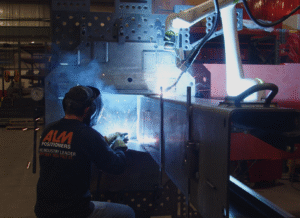
On the shop floor — both its own and customers’ — that can mean VIKI and DAVE, both developed by ALM. The Voice Initiated Kinetic Intelligence (VIKI) headset, incorporated via Bluetooth into a welder’s helmet, allows the operator to reposition a component through voice commands, rather than stopping a process to make inputs via a control panel.
“The application with VIKI is directly connected to our positioner,” Mr. Pollock said. “[The operator] can tell it ‘Elevate 10 inches, rotate 30 degrees counterclockwise,’ and it will do it.”
DAVE, for Digital Application Virtual Engineering, can save weeks designing and engineering a machine to a customer’s specific needs.
“If you request a quote from ALM, you have the opportunity to interact with the virtual engineer that will ask you questions about what you’re trying to accomplish, and it will refine the solution for the customer based on what we’re teaching it,” Mr. Pollock said.
ALM’s sales staff builds on DAVE’s work and other AI tools, like Microsoft’s Copilot, to analyze potential new markets and customers.
“We have 200 to 300 customers, and our salespeople are using the AI intelligence to do research on suppliers of our customers or on competitors,” Mr. Pollock said. “It can create the information, it can put it in a table and say ‘Okay, here’s a potential target for you.’ Copilot looks at customer websites and determines other potential customers out there.”
Reducing the clerical burden in health care
Organizing and drawing upon appropriate data from diverse sources reduces the filing workload in health care.

“The clerical burden has always been huge, just based on the amount of information we have,” said Dr. Shiny Mathewkutty, cardiologist and chief informatics medical officer at Mercy Medical Center in Cedar Rapids. “Now, while we’re talking to the patients it’s able to transcribe our notes.”
That has virtually eliminated physicians’ “pajama time,” the hours after each workday spent transcribing notes.
“We’ve collected so much data in all these care settings,” said Jeff Cash, Mercy’s chief information officer. “AI will sift through that and find the context for your current visit.”
Generating relevant data from what’s often decades of doctor’s visits, often across different health care organizations, can produce a seamless experience for a patient’s latest visit, saving time for both provider and patient.
Last fall, Mercy staff also began using Volpara, a program to simplify risk assessment and better manage patients’ breast cancer treatment.
“That helps us with our cancer treatments, to analyze the image and the tumor depth,” Dr. Mathewkutty said. “The sooner we can find cancer the better it is, and that’s always our focus.”
Thoughtful application of AI tools such as voice-to-text applications can make for a happier patient experience at Mercy.
“There are times I have people in the room who are just upset about what’s going on in their lives and need to let that out,” said Dr. Mathewkutty. “The good thing about AI is, it filters out that. It’s good about filtering out that noise and making sure it’s patient-focused.”
Still, human supervision and intervention is needed to make the best use of AI tools.
“We would not let AI happen without a clinician approving it,” Mr. Cash said. “We don’t let the AI run the patient care.”
Streamlining the sales process in real estate and insurance
Organizing and refining information through office AI is making Mel Foster Company’s real estate and insurance agents more efficient.

“It’s really quickly become a natural extension of their toolbox,” said Kris Ratigan, director of marketing for the Davenport firm. “Instead of spending hours on routine tasks, agents can produce content in minutes. It allows them to focus on high-value situations like meeting with clients, and negotiations. It’s really helped them organize their day more effectively.”
Mel Foster’s real estate agents use AI to draft listings, complete with “virtually staged photos.” Virtually staged illustrations are accompanied by a caption noting they’re AI generated, and agents review draft plans and documents before passing them along.
“A lot of them have been able to come out with some pretty robust marketing plans for their clients, and they’re liking that,” said Ms. Ratigan. “Insurance is a little slower to adopt, but producers can draft client communications to explain some policy language in simpler terms to their clients.”
The experience factor: Why human expertise still matters
While it excels at tedious, time-consuming back-office tasks, users have found AI is no substitute for employees’ experience. In fact, an experienced worker or a well-trained new hire can make better use of AI.
“If you give a tool like that to a professional with years of experience, that can really boost their productivity,” said Thiago Serra, assistant professor of business analytics at the University of Iowa’s Tippie College of Business. “When you give that to someone who’s just starting, you may not have the same critical engagement about what’s produced. A senior software engineer can learn a lot from this because they’ve learned from their mistakes in the past. When you think about an intern, it’s a little different because you don’t have that mileage.”
“There are some things it’s really good for, and some things it’s really going to struggle with at a high level,” Mr. Elliott said.
That’s applicable to other industries.
“Some of our customers are talking about having us help them understand the mountains of customer-service data they have,” said Ms. Ainger. “They’ve been in business for decades and they can’t see the forest for the trees. That’s a very smart way to use AI data and analytics.”
Realistic expectations for the future
The pervasiveness of AI technology changes what’s expected of new hires and their would-be employers. Just how those expectations are managed is a work in progress.
“I‘m wondering how this is changing how people get hired,” Mr. Serra said. “What’s expected of them? What they look for is someone who asks all the right questions.”
“It really hasn’t changed what I’ve looked for,” Mr. Elliott said. “Attitude, aptitude, integrity. When somebody really doesn’t understand something, they’ll use 500 words to explain something that should be 10.”
Mr. Serra expects industries to adopt a more realistic view of AI’s capabilities.
“There were moments when AI became trendy and there were high expectations, but at some point, the bubble burst,” said Mr. Serra. “What we’re seeing is an advance. We’re not going back, but at this point maybe we’re expecting too much.”
While AI has moved from experiment to everyday tool, companies across the region are finding that success comes not from automation alone, but from pairing artificial intelligence with human expertise — a combination that lets both do what they do best.